






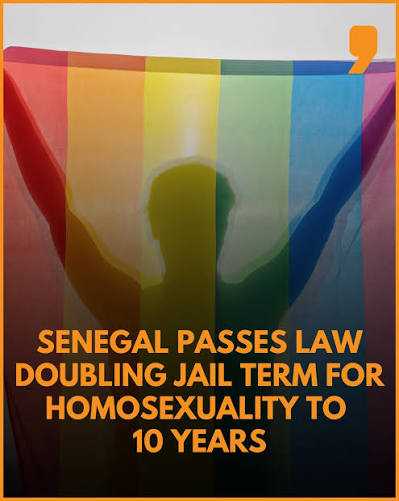
Lawmakers in Senegal have approved legislation that significantly increases penalties for same-sex relations, doubling the maximum prison sentence to 10 years.
Members of parliament voted in favour of the measure on Thursday, also backing provisions that impose prison terms of between three and seven years for individuals accused of promoting or financing same-sex relationships.
During parliamentary debate, some lawmakers voiced strong support for stricter laws. MP Diaraye Ba told colleagues that the legislation was intended to strengthen existing restrictions.
“Homosexuals will no longer breathe in this country,” Ba said during the debate, drawing applause from some MPs. She added that “homosexuals will no longer have freedom of expression in this country.”
Under the new legislation, harsher penalties may apply if same-sex acts involve a minor. The law also raises fines from between 100,000 and 1.5 million CFA francs to between 2 million and 10 million CFA francs.
The reforms also introduce penalties aimed at preventing misuse of the law. Anyone who falsely accuses another person of being homosexual without evidence could face a prison sentence of two to three years and a fine ranging from 200,000 to 500,000 CFA francs.
Related Stories
The legislation follows campaign promises by Ousmane Sonko, who pledged during the 2024 elections to reinforce existing laws on same-sex relations.
Authorities say the new provisions also redefine what the penal code describes as “unnatural acts” and aim to prevent what officials describe as the promotion of homosexuality.
Amadou Ba said organisations or groups promoting what he described as “LGBT philosophy” through films, television, writing or other platforms could face legal consequences under the new law.
He said the government considers such ideas to be inconsistent with Senegalese cultural traditions, noting that LGBTQ advocacy is frequently portrayed by some political leaders as an attempt by Western countries to impose foreign values.
The law has drawn criticism from rights groups. Human Rights Watch warned that provisions targeting the promotion or financing of homosexuality could be broadly interpreted and may restrict fundamental freedoms.
Alex Müller, the organisation’s director of LGBTQ issues, said the wording of the legislation could limit freedom of expression and association, and may also affect access to healthcare.
She cautioned that organisations working to combat HIV and AIDS could be impacted, particularly those that provide services to men who have sex with men, who face higher risks of infection.
Across Africa, laws criminalising same-sex relations remain common. According to human rights groups, at least 32 of the continent’s 54 countries maintain legislation that prohibits such relationships, with penalties ranging from prison terms to, in some cases, the death penalty.





Leave Comments