
A Baby, a School Bag, a Second Chance
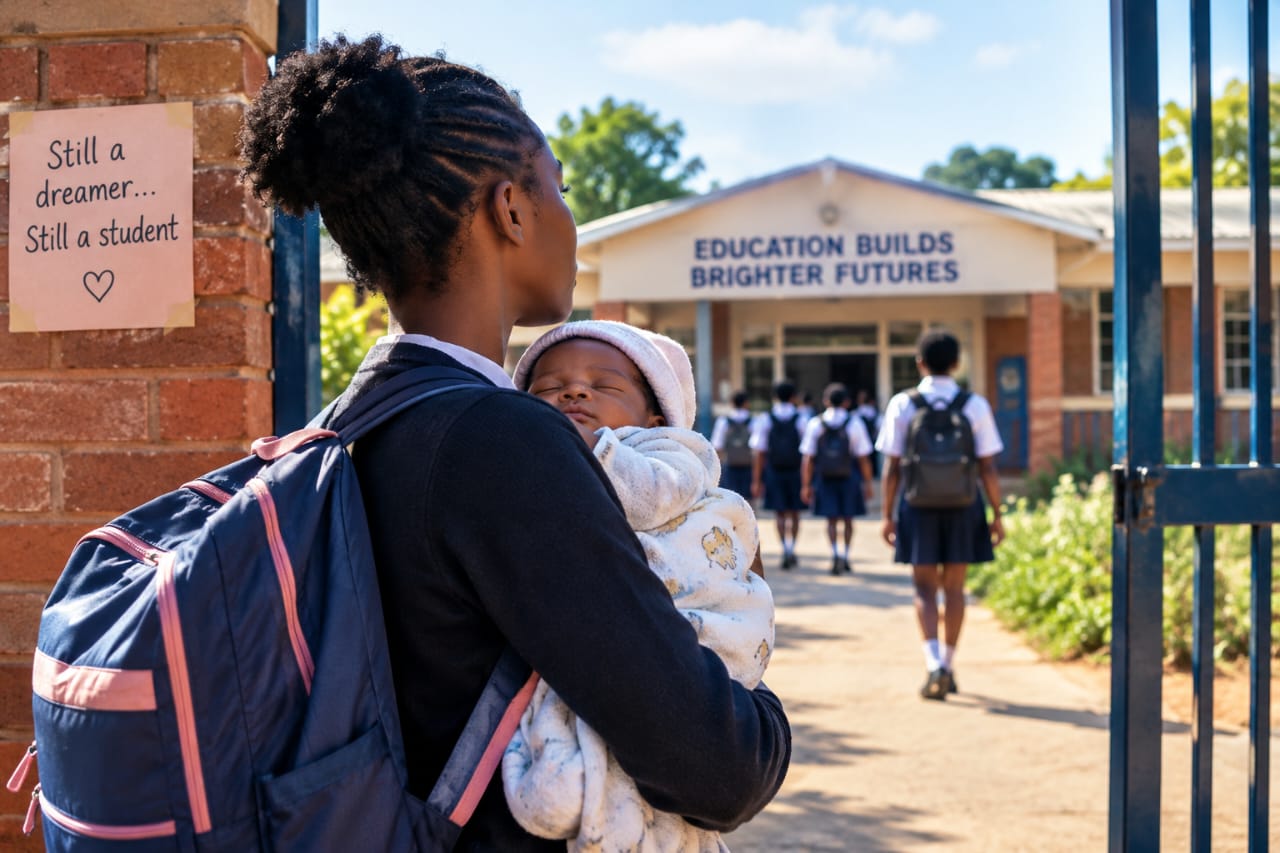
The school day begins long before the bell rings for the teenage mother whose dream of completing her education now competes with the demands of raising a baby.
Before thinking about assignments, mathematics lessons or examinations, she must feed her child, prepare for school and find someone to look after the baby while she is away.
The schoolbag she once carried without a second thought is now weighed down by worries.
For teenage mothers who decide to return to school after falling pregnant, the journey is often difficult. Childcare, stigma and financial constraints are among the challenges they face.
Zimbabwe’s Education Amendment Act of 2020 provides for pregnant learners to re-enter the education system. However, formal access to education does not necessarily remove the financial, social and practical barriers young mothers encounter.
Faith was only 16 when she fell pregnant. She was supposed to sit for her Ordinary Level examinations that year, but her boyfriend at the time refused to take responsibility.
Her father died when she was 10, leaving her aunt to care for her. The family struggled to pay her school fees and meet their daily needs. Discovering that she was pregnant shattered her world.
“I knew I had made the biggest mistake of my life. If I had the chance to terminate, I would have terminated.
“There is no day that passes without me thinking about the biggest mistake I made. I went back to school after I got pregnant, but the challenge was who would look after my baby,” Faith said, tears rolling down her cheeks.
On July 29, 2026, Zimbabwe’s Constitutional Court set aside the 2024 High Court ruling in Women and Law in Southern Africa and Talent Forget v Minister of Health and Others (CCZ 16/26) and sent the matter back to the High Court for a fresh hearing.
The High Court had declared parts of sections 2(1) and 4 of the Termination of Pregnancy Act unconstitutional because they excluded pregnancies resulting from sexual intercourse with minors and marital rape from the definition of “unlawful intercourse” for the purposes of legal abortion.
The case raises questions about whether girls under 18 should have access to safe and legal abortion in circumstances beyond those currently permitted by law, and how the consequences of unintended pregnancy affect their futures. Faith’s experience illustrates some of the challenges young mothers face.
Her aunt worked in other people’s fields to earn food and clothes. It was difficult for her to carry a baby on her back while Faith attended school.
“I dropped out of school because I had no money for childcare, and the stigma I faced became unbearable. I could not stand it anymore. Sometimes I would go with my aunt to work in people’s fields to get food and clothes for my baby,” she said.
Faith later joined an afternoon class with learners taking supplementary lessons. She was allowed to bring her baby, but this created further difficulties.
“I could bring my baby along to this class, but sometimes a whole hour would pass while I was outside with the baby crying,” she said.
Her classmates began complaining that the crying disrupted their concentration. Eventually, she stopped attending.
Speaking at the International Day of the Girl Child commemorations, Cephas Shanyurai, the Ministry of Primary and Secondary Education’s principal psychologist, said the Education Amendment Act allowed teenage mothers to return to school.
“We first of all ask the teen mum which school they would like to be enrolled in. We prepare the teachers, the parents and the other children for their return,” he said.
Shanyurai said the ministry had support structures across the country, including guidance and counselling services, school health coordinators and a chatbot through which learners could seek assistance.
However, Faith’s experience raises questions about how effectively these measures work in practice.
She faced stigma at school, where other learners avoided playing with her and some parents discouraged their children from associating with her. She also struggled to access counselling, worsening her situation.
Memory Kadau, a sexual and reproductive health and rights advocate and feminist, said there was a significant difference between having a legal right to education and being able to exercise that right in a safe, supportive and discrimination-free environment.
“A girl may be legally entitled to return to school but face ridicule from classmates, judgemental attitudes from teachers, rejection by her family or pressure from her community. Parents will not even want their children to play or be in the company of this girl,” she said.
“She may struggle with childcare responsibilities, transport costs, breastfeeding, inadequate sanitation facilities or the financial demands of raising a child while studying.”
Kadau said the litigation involving Women and Law in Southern Africa and Talent Forget had contributed to Zimbabwe’s ongoing debate about reproductive justice, children’s rights and constitutional equality.
She noted that although the Constitutional Court did not uphold the High Court’s declaration of invalidity in July 2026, the case raised fundamental questions about protecting adolescent girls who experience unintended pregnancy, particularly where sexual exploitation or unequal power relations are involved.
“One of the most important questions emerging from the litigation is whether a legal framework can adequately protect children from sexual exploitation while failing to provide accessible reproductive healthcare when pregnancy occurs,” she said.
Kadau argued that protecting children from sexual abuse should not mean denying them a voice in decisions about its consequences.
“The fact that a girl is below the age of 18 should trigger additional safeguards, protection and support. It should not automatically mean that her voice, health needs and circumstances are disregarded,” she said.
She added that laws, policies and institutions should uphold children’s dignity, equality, health, education and best interests.
Given the opportunity and support to access childcare, clothes and food for her baby, Faith hopes to return to school and fulfil her dream of becoming a nurse.
The case involving Women and Law in Southern Africa and Talent Forget raises broader questions about whether Zimbabwe’s legal framework gives girls under 18 meaningful choices when faced with unintended pregnancy. As the matter returns to the High Court for a fresh hearing, young girls continue to navigate decisions that can shape their health, education and future opportunities.
A second chance should not depend on whether a girl becomes a mother, nor should motherhood automatically close the door to her ambitions. Every girl should have access to accurate information, the opportunity to make informed decisions about her body and the support she needs to pursue her future.
A schoolbag and a baby should not force a girl to choose between her education and her future.

About Patricia Mashiri
Reporter