
AFTER THE COURTROOM: IS THERE ANY OTHER ROUTE TO CHALLENGE CAA3?
The Constitutional Court’s decision to reserve judgment in two challenges to Constitutional Amendment No. 3 has shifted Zimbabwe’s constitutional dispute into a waiting.
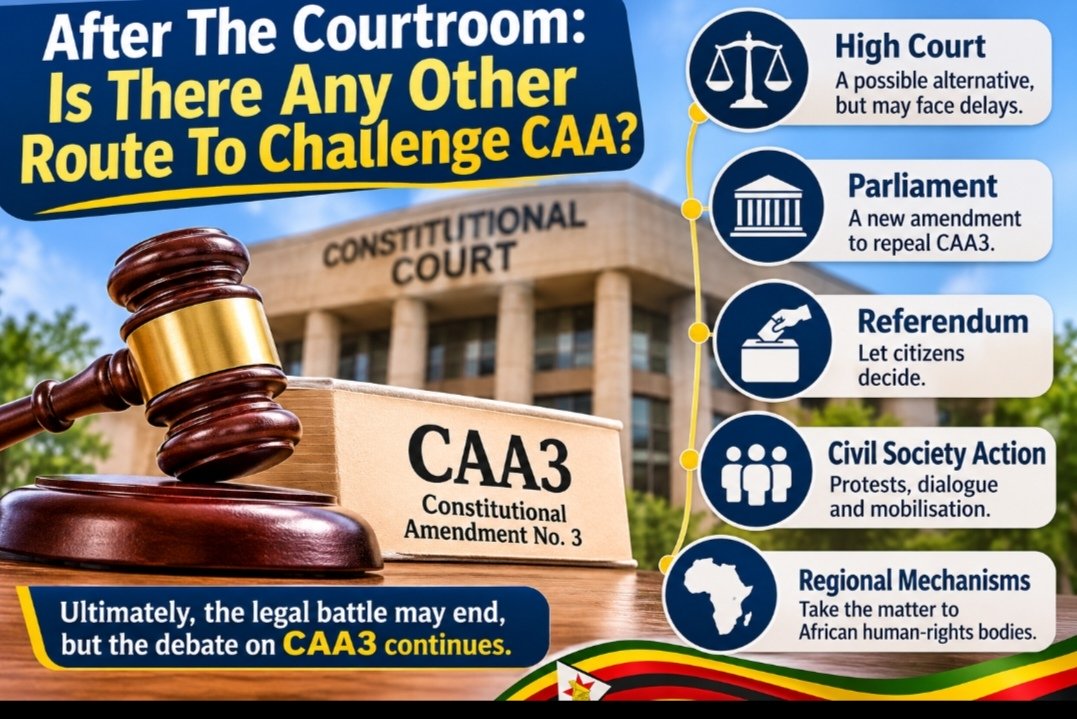
The Constitutional Court’s decision to reserve judgment in two challenges to Constitutional Amendment No. 3 has shifted Zimbabwe’s constitutional dispute into a waiting period, but the bigger question is what happens if the country’s highest court ultimately rejects the applicants’ arguments.
The hearings on Wednesday, November 18, brought before seven judges two separate challenges: Vhurande Mahlupeko’s application questioning the process through which the amendment was enacted, and former legislator Prince Dubeko Sibanda’s challenge to the extension of presidential and parliamentary terms from five to seven years, particularly its application to incumbents.
While Mahlupeko argues that ten provisions were introduced into the final legislation without being included in the original gazetted Bill for public consultation, Sibanda relies on Section 328(7) of the Constitution, which restricts amendments extending the period a person may occupy public office from benefiting those already holding that office.
Government’s response in court has itself become part of the controversy. In his analysis of the proceedings, Phillan Zamchiya said lawyers representing the State in Sibanda’s case concentrated on preliminary objections, arguing that the applicant had approached the wrong court and should have started in the High Court, rather than directly defending the application of the extended terms to sitting officeholders.
Zamchiya argued that the Government’s position raised a difficult question: if Section 117(2)(a) requires Parliament to exercise its constitutional amendment powers in accordance with Section 328, how could an alleged failure to comply with that obligation fall outside the Constitutional Court’s jurisdiction under Section 167(2)(d)?
The argument is contested, however. Government’s lawyers maintained that the dispute did not qualify for direct access under the constitutional provision relied upon by Sibanda. The court must determine whether the case meets the requirements for it to hear the matter directly.
The position taken by Speaker of Parliament Jacob Mudenda also brought the President into the dispute over constitutional responsibility.
In an opposing affidavit, Mudenda argued that any obligation arising under Section 117 was shared between Parliament and the President, rather than resting on Parliament alone.
Political commentator Mbizvo Jealousy Mawarire interpreted this as an acknowledgement that Parliament had a constitutional obligation in the amendment process, with Mudenda arguing that the President should also have been sued over the alleged failure.
Mawarire further questioned the consistency between the arguments advanced in Justice Minister Ziyambi Ziyambi’s opposing affidavit and those contained in the Government’s subsequent heads of argument.
These exchanges do not settle the constitutionality of CAA3. They illustrate how the parties are contesting not only the amendment itself but also the legal route through which the court should examine it.
For constitutional law, the distinction is critical. A refusal to grant direct access would not automatically amount to a ruling that CAA3 is constitutional. It could mean that the applicants must pursue their claims through the High Court.
Section 167(1) of the Constitution makes the Constitutional Court the highest court in constitutional matters, while Section 167(3) gives it the final decision on whether an Act of Parliament is constitutional.
The Constitution also requires the Constitutional Court to confirm an order of constitutional invalidity made by another court before that order takes effect.
This means that if direct access is refused, applicants may still have the option of approaching the High Court, depending on the court’s ruling and the nature of their claims.
Constitutional lawyer Lovemore Madhuku has previously argued that this route could cause delays because even if the High Court finds in favour of the applicants, its order declaring the legislation unconstitutional would still require confirmation by the Constitutional Court.
But if the Constitutional Court eventually hears the substantive arguments and rejects them, the judicial options become much narrower. There is no ordinary appeal against a final Constitutional Court judgment.
That does not necessarily mean every legal avenue would disappear. The five challenges previously identified by Madhuku raise overlapping but distinct constitutional questions, including the removal of the direct presidential vote, the extension of terms to incumbents and the parliamentary process through which the amendments were introduced.
In September, Madhuku said the cases were effectively “hunting together” because they raised related issues, although they advanced different legal arguments.
They included challenges by war veterans, an omnibus application involving veterans represented by former Finance Minister Tendai Biti, the MDC’s challenge to the removal of the direct presidential vote and Mahlupeko’s challenge to the parliamentary process.
The outcome of one case would not automatically dispose of every separate application. However, if the Constitutional Court settles a common constitutional question against the applicants, the other litigants could face a significantly more difficult legal path.
The Law Society of Zimbabwe’s submissions on the original Bill provide another important dimension.
The professional body argued that Sections 95 and 143, which provide for the terms of the President and Parliament, are term-limit provisions under Section 328.
It said the extensions could be enacted without a referendum in themselves, but Section 328(7) would prevent them from benefiting incumbents.
The Law Society also argued that changing Section 328 itself would trigger the more stringent amendment procedure, including a referendum. Its analysis did not find every proposed change to be inherently unconstitutional, making it an important counterpoint to the broader claims advanced by opponents of CAA3.
Parliament: Can the law be reversed from within?
One of the most direct alternatives would be to take the fight back to Parliament.
The Constitution does not make constitutional amendments irreversible. Parliament can initiate another amendment to repeal or alter provisions of CAA3, provided the new process complies with the applicable constitutional requirements.
That would require political support within the legislature, including the prescribed two-thirds majorities in both the National Assembly and Senate. Depending on the provisions targeted, the process could also trigger public consultation and referendum requirements.
This, however, shifts the challenge from the courtroom to the political arithmetic of Parliament. Opponents would have to persuade legislators to reverse a constitutional amendment that the legislature itself approved.
The possibility also raises questions about whether opposition parties, independent MPs and other legislators could build a parliamentary coalition around a repeal or amendment proposal.
The referendum question: Can the people still have the final say?
A referendum remains another major point of contention, but it is important to distinguish between a referendum that is constitutionally mandatory and one that is being demanded as a political solution.
The Zimbabwe Council of Churches has maintained that the changes should be taken back to the people through a free, fair and credible national referendum.
In a pastoral letter issued in July, the church body argued that the enactment of CAA3 had not brought the dispute to finality.
“We observe that the signing of CAA3 into law on 7 July 2026 has not brought the contestation of the same into finality. Instead, CAA3 has deepened national polarisation and generated serious constitutional, political, and moral contestation,” the ZCC said.
It added: “A referendum would not be an act of weakness; it would be an expression of confidence in the people, a safeguard of legitimacy and a means of reducing the division now threatening our common life.”
The church’s position is that a referendum would give citizens a direct opportunity to express their will on the changes. However, citizens cannot automatically compel a referendum simply because they disagree with a Constitutional Court judgment.
The legal question remains whether the provisions amended by CAA3 fall within the categories protected by Section 328(6), (7), and (9), which prescribe more stringent procedures for certain constitutional changes.
If the court rejects the argument that a referendum was legally required, the ZCC's proposal would effectively become a political demand for a fresh public mandate rather than an automatic legal consequence of the ruling.
Civil society, demonstrations, and public pressure
The next route could be outside Parliament and the courts altogether.
Sections 58 to 61 of the Constitution protect freedoms of assembly, association, demonstration, and expression. These provisions provide a constitutional basis for peaceful civic mobilisation, public campaigns, petitions, and organised opposition to government policy.
The Zimbabwe Council of Churches has urged citizens to exercise these rights peacefully while calling on the government and security services to facilitate rather than suppress lawful civic action.
The church has also called for an inclusive national dialogue involving political parties, churches, civil society organisations, traditional leaders, businesses, women, young people, and citizens across the political divide.
This would create another platform for opponents of CAA3 to press for a political settlement even if the courts uphold the amendment.
The Defend the Constitution campaign, convened by Tendai Biti, had previously indicated that its response would not be limited to litigation.
“CDF is considering all available constitutional, legal and democratic options, including further litigation,” Biti said.
“The people of Zimbabwe remain the ultimate custodians of the Constitution, and we will continue to defend the 2013 Constitution through all lawful means available.”
The challenge for such campaigns would be translating public opposition into sustained organisation, broad participation, and specific demands capable of being acted upon by Parliament or Government.
Political analyst Brighton Mutebuka believes the political consequences of the court proceedings may already extend beyond the legal outcome.
“Regardless of the formal outcomes of the Constitutional Court cases, the regime has already suffered a devastating psychological & PR loss,” Mutebuka said.
He argues that the Government’s reliance on preliminary objections rather than defending the amendment on its substantive merits could damage public confidence in the process.
Mutebuka also believes that even if the court strikes down the ten provisions allegedly introduced without public consultation, Government could follow the required procedure and attempt to reintroduce them.
In his view, those provisions are strategically important because they give the Judiciary and MPs a stake in the new constitutional arrangements.
He further argues that a judgment upholding CAA3 could be used by President Emmerson Mnangagwa to claim that the highest court has settled the dispute, potentially strengthening his position in the internal ZANU-PF contest.
These are Mutebuka’s political assessments, not established evidence of the President’s intentions or the court’s likely decision. Nevertheless, they raise an important question about whether a court judgment can settle the legal dispute without resolving the wider political contestation.
The electoral route: Can voters still influence the outcome?
CAA3 also changes the relationship between citizens and the presidency by transferring the election of the President from a direct popular vote to a joint sitting of the National Assembly and Senate.
That means the electoral route cannot be considered separately from the new constitutional framework.
If CAA3 remains in force, voters will still elect Members of Parliament, and those elected representatives will participate in choosing the President under the amended system.
Opponents of the amendment could therefore seek to mobilise voters around parliamentary representation, accountability and the need for legislators to reflect citizens’ views on the constitutional changes.
However, this is not equivalent to restoring the direct presidential vote. It would operate within the system created by CAA3 and would not, by itself, reverse the seven-year terms or reinstate the previous presidential election arrangements.
The electoral route is therefore a longer-term political avenue, rather than an immediate legal remedy.
Could the dispute move beyond Zimbabwe?
There is also the question of regional and international human-rights mechanisms.
Zimbabwe is a party to the African Charter on Human and Peoples’ Rights, which protects political participation and the right of citizens to participate freely in the government of their country. The African Commission on Human and Peoples’ Rights provides a mechanism through which eligible complaints alleging violations of Charter rights can be considered.
The African Commission is not an appellate court for Zimbabwe’s Constitutional Court and cannot simply repeal CAA3. Any communication would have to meet admissibility requirements, including the general requirement that local remedies be exhausted unless recognised exceptions apply.
The United Nations human-rights treaty system may also provide avenues for eligible complaints, depending on the particular right invoked, the treaty obligations binding on Zimbabwe and the applicable complaint procedures.
Such processes could bring international scrutiny to questions surrounding political participation and constitutional safeguards, but they would not automatically suspend the amendment or replace domestic constitutional remedies.
The regional route is therefore more likely to provide an avenue for human-rights scrutiny and international advocacy than an immediate mechanism for overturning CAA3.
The political question beyond the judgment
For Mutebuka, the court's decision could also have implications for the internal balance of power in ZANU-PF, particularly the relationship between Mnangagwa and Vice-President Constantino Chiwenga.
He argues that a ruling in favour of the Government could be presented as confirmation that the amendment had survived scrutiny by the country's highest court, while a partial ruling against the ten provisions could still leave the central changes intact.
The Patriotic Alliance, a coalition of political parties operating in Matabeleland, has also called for peaceful and lawful efforts to challenge CAA3, saying the Constitution should not be manipulated to serve the interests of individuals or officeholders.
“Our opposition to the disputed constitutional changes is not opposition to Zimbabwe or its people. It is a defence of constitutionalism, democratic accountability, the right to vote and the principle that public office must remain subject to constitutional limitations,” the coalition said.
Its position reflects a wider argument among opponents that the dispute concerns not only the tenure of the current officeholders but also the future relationship between citizens and the institutions exercising power.
If the Constitutional Court rejects the substantive challenges, opponents of CAA3 would therefore face a choice between pursuing any remaining distinct legal claims, pressing Parliament for a reversal, demanding a referendum as a political solution, organising peaceful civic action or seeking scrutiny through regional and international human-rights mechanisms.

About Oscar Jeke - Reporter
Staff Writer