
Analysts Question Zimbabwean Businesses’ Models Beyond Borders
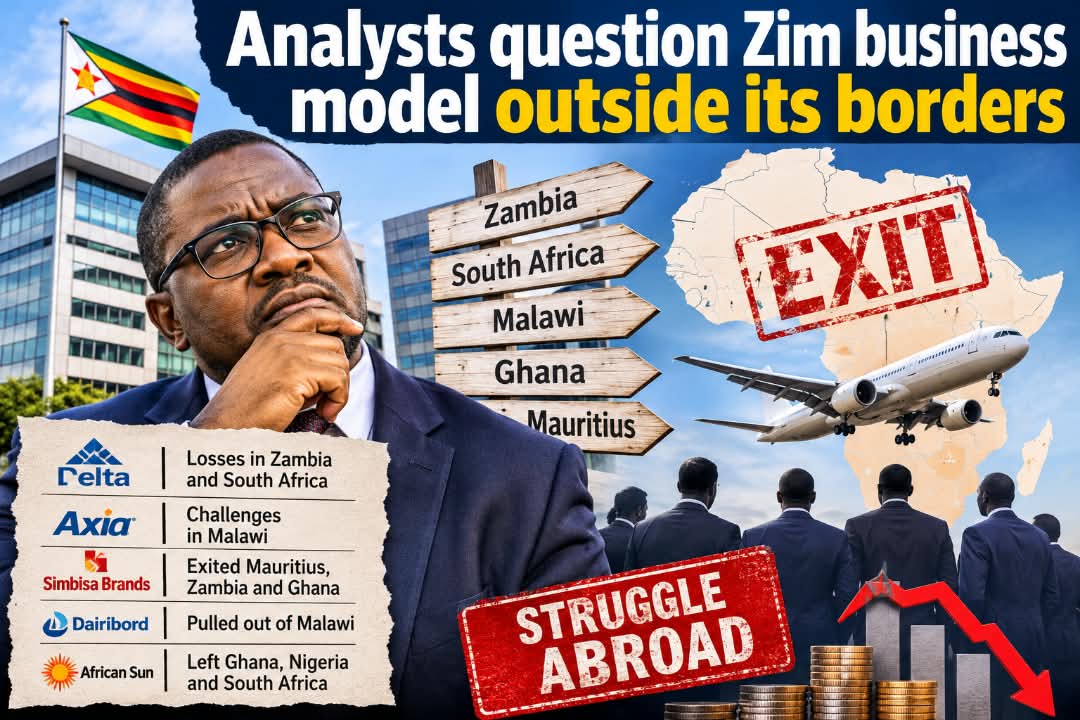
Zimbabwean companies are facing questions over the sustainability of their business models beyond the domestic market, as a series of setbacks and withdrawals from other African countries raises concerns about their ability to compete in different economic and cultural environments.
Investment analyst Rufaro Hozheri sparked the debate after questioning why companies that dominate Zimbabwe's domestic market often struggle when expanding into neighbouring and other African markets.
Hozheri cited Delta Corporation's reported difficulties in Zambia and South Africa, Axia's challenges in Malawi, Simbisa Brands' exits from Mauritius, Zambia and Ghana, Dairibord's withdrawal from Malawi, and African Sun's departure from Ghana, Nigeria and South Africa.
Brighton Musonza said the challenges went beyond access to capital, arguing that Zimbabwean companies also needed stronger international management expertise and the ability to adapt their operations to different cultures.
"Scaling is an issue because our capital markets are small, but as well I think a lot goes with the type of manager," Musonza said.
He questioned the dominance of chartered accountants in executive management, arguing that technical financial expertise did not necessarily translate into the skills required to manage international businesses.
"Your brands, management style and people management have got to be adaptive to different cultures," he said, citing examples of multinational companies that have had to adjust their operations to local consumer preferences.
Musonza also called for stronger international business management departments and policies within companies, while arguing that Zimbabwe's business education system, including the University of Zimbabwe's MBA programme, needed major reforms.
He added that companies were not investing sufficiently in brand development, arguing that brand equity was central to corporate success.
Monomotapa Capital similarly argued that some Zimbabwean businesses failed to conduct adequate research into foreign markets before expanding, instead attempting to replicate their domestic operations.
"They typically also second executives from Harare instead of hiring locally. Also they choose external markets poorly," the investment firm said.
However, entrepreneur Victor Mapunga challenged the argument that hiring local executives was necessarily the solution, drawing on his experience of expanding businesses across several African markets.
Mapunga said Zimbabwe had greater consumer spending power than its economic reputation suggested, while warning that operating conditions differed significantly across countries.
"Scaling in Africa is very, very hard. Even SA firms are pulling out of some markets. Everything changes per country, regulations, taxes, labour laws, FX controls, corruption, you name it," he said.
He argued that building institutions capable of adapting to different markets was particularly difficult, adding that he respected companies such as Liquid Intelligent Technologies and Simbisa Brands for their efforts to establish themselves across borders.
Other contributors pointed to the limitations of Zimbabwean companies themselves.
Marshall George argued that many local businesses were simply too small to compete effectively in foreign markets, while Ethan Malibongwe Moyo identified Seed Co as one of the few possible exceptions and noted that several banks had also struggled with regional expansion.
Accountant Tafadzwa Mukudu said the problem was partly a failure to understand local consumer behaviour and give consumers in foreign markets a sense of ownership of the brands.
"Failure to adapt to different markets. We transplant concepts that work in Zimbabwe to other cultures. We don't allow locals to feel like they own the brand," he said.
Mukudu also questioned the dominance of accountants in business leadership, arguing that companies needed more entrepreneurial thinking.
The debate also raised questions about whether some domestic companies had benefited from market conditions that were difficult to replicate elsewhere.
Nigel Kadziyanike attributed the problem partly to protectionism, arguing that local firms could become less competitive when operating in a market where they enjoyed significant domestic advantages.
Tanaka Mubaiwa went further, questioning whether the dominance of some Zimbabwean companies was built on political connections, government ownership and influence rather than their ability to compete independently.
Everisto Gwaidza also pointed to patronage as a factor, although he identified Econet, ZimRe Holdings, First Mutual Holdings and Nyaradzo Group as examples of companies that appeared to be performing relatively well.
However, the challenges are not exclusive to Zimbabwean businesses.
Satoshi Nakamoto cited the struggles of international retailers and telecommunications companies in other African markets, arguing that even established multinational brands have failed to translate success in one country into profitability elsewhere.
Tapiwa Ngezi said companies also had to contend with established competitors and consumer preferences that take time to change, making mergers and acquisitions an important route into unfamiliar markets.
Malvern Mudzingwa similarly argued that South African companies had also withdrawn from some African markets, suggesting that the difficulties could partly reflect the broader challenges of intra-African investment rather than weaknesses unique to Zimbabwean businesses.
Kudakwashe Dhliwayo said companies would eventually have to adapt because international competitors were increasingly entering the Zimbabwean market, making continued reliance on domestic dominance difficult to sustain.

About Oscar Jeke - Reporter
Staff Writer