
Chinese ambassador calls for policy certainty and responsible investment as trade is predicted to hit US$ billion in 202
China calls for policy certainty and responsible investment in Zimbabwe as bilateral trade is projected to reach US$6 billion in 2026.
Chinese Ambassador Zhou Ding has called for a predictable business environment in Zimbabwe while urging Chinese enterprises to strengthen compliance with local laws, labour standards and community obligations, as economic ties between the two countries reach unprecedented levels.
The calls come amid growing engagement between organised labour, government and investors on how Zimbabwe can attract and retain foreign capital while ensuring that investment delivers tangible benefits to its citizens.
Speaking at the 20th anniversary of the Chamber of Chinese Enterprises in Zimbabwe on Wednesday, Ambassador Zhou said bilateral trade was projected to reach US$6 billion in 2026, up from less than US$300 million in 2006.
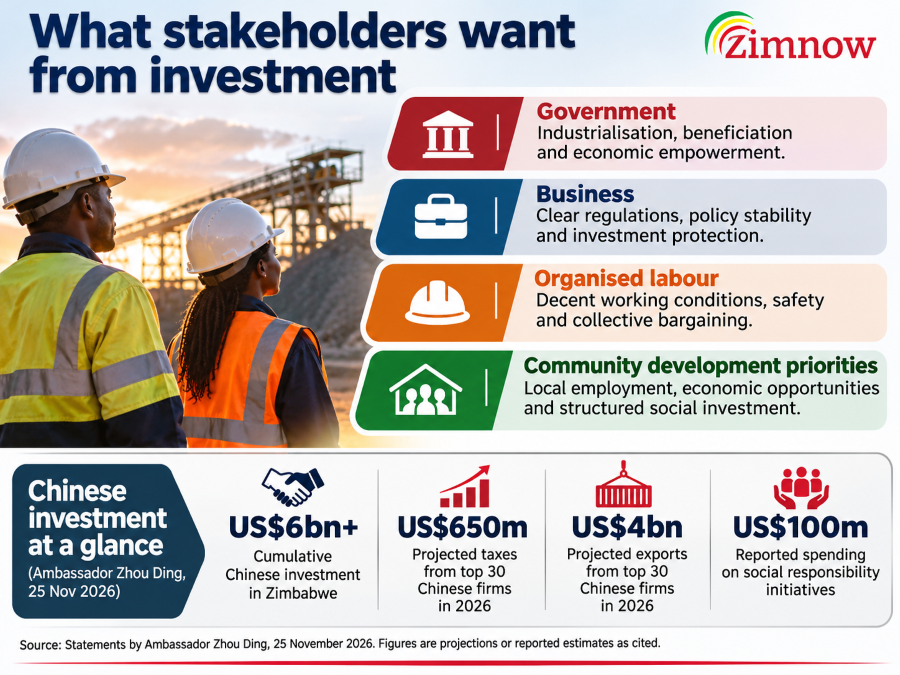
The top 30 Chinese enterprises operating in Zimbabwe are projected to contribute US$650 million in taxes and generate US$4 billion in export earnings this year, according to preliminary statistics cited by the ambassador.
“Trade and investment relations cannot be sustained—still less thrive—without a fair, transparent and predictable business climate,” he said.
The need for policy certainty has also been acknowledged by the Zimbabwean government. Addressing the International Business Conference at the Zimbabwe International Trade Fair in April, Vice President Constantino Chiwenga reaffirmed government's commitment to consistent policies, transparent regulation and investment protection.
“Our focus remains on predictability, confidence building and sustainable growth,” Chiwenga said.
Similarly, the Zimbabwe National Chamber of Commerce, during consultations on the reserved sectors policy in February, called for clear regulations, administrative predictability and realistic transition timelines.
“Empowerment, competitiveness and productivity are not mutually exclusive,” the chamber said.
However, Ambassador Zhou also placed responsibilities on Chinese investors, urging them to deepen industrial cooperation with local partners and align their operations with Zimbabwe’s National Development Strategy 2 and Vision 2030.
“I encourage the Chamber to take the lead in guiding all Chinese enterprises to operate in full compliance with local laws and regulations, uphold rigorous safety and labour standards, integrate into local communities and honour their social responsibilities,” he said.
His remarks come against the backdrop of an engagement between the Chinese Embassy and the Zimbabwe Congress of Trade Unions (ZCTU), whose leadership has raised concerns about working conditions, occupational safety and industrial relations in some Chinese-owned enterprises.
In a report published on November 25, labour publication The Worker said the federation, led by its president Valentine Chikosi, had proposed joint training programmes on Zimbabwean labour laws and a formal platform for regular engagement among unions, the embassy and Chinese businesses.
Community development is another area where Zimbabwe is seeking more structured outcomes from foreign investment.
In July, Mines and Mining Development Minister Polite Kambamura indicated that government was developing a framework to shift mining companies from conventional corporate social responsibility towards corporate social investment, prioritising community development, local employment and economic empowerment.
The Chamber marked its anniversary with the release of a Report on Economic Contribution and Social Responsibility of Chinese Enterprises in Zimbabwe, with Ambassador Zhou putting Chinese companies' contributions to social responsibility initiatives at US$100 million.
With cumulative Chinese investment exceeding US$6 billion, the challenge for both countries is increasingly one of translating the scale of economic cooperation into sustainable enterprises, decent employment and stronger domestic value chains.

About Zim Now News Desk
Staff Writer