
Chinese-backed projects to add over 1,000MW to Zimbabwe’s power capacity, says ambassador
Chinese-backed energy projects could add over 1,000MW in Zimbabwe, while lithium firms paid US$400m in nine-month taxes, says Zhou Ding.
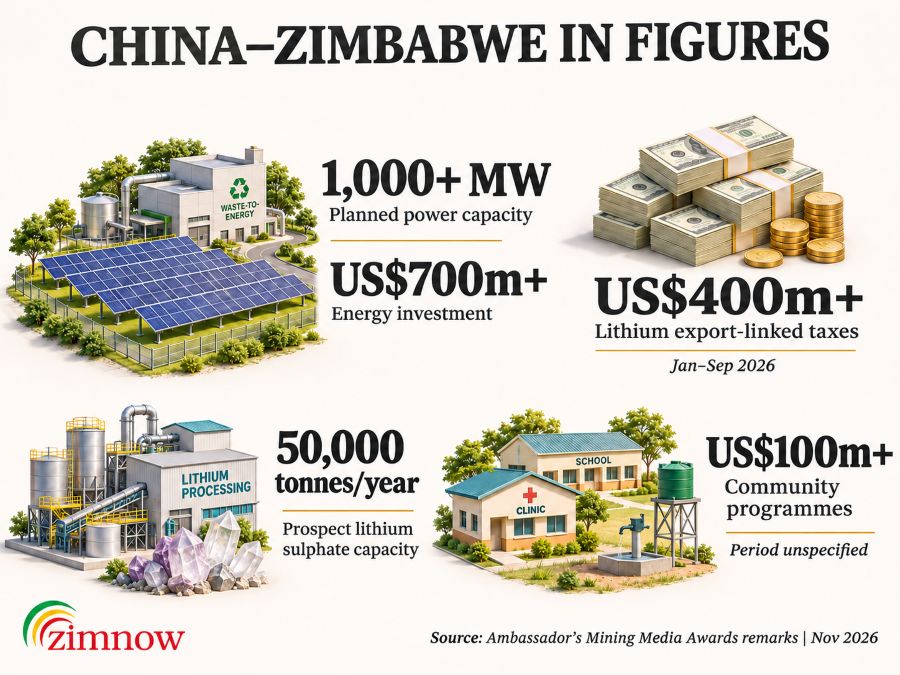
Chinese-backed solar and waste-to-energy projects are expected to add more than 1,000 megawatts of installed electricity capacity in Zimbabwe, involving investment exceeding US$700 million, Chinese Ambassador Zhou Ding has said.
Speaking at the Annual Mining Media Awards in Harare, Amb Zhou presented the projects as part of efforts to strengthen electricity supplies for mining, other industries and households.
“Sustainable mining cannot happen without a reliable power supply,” he said.
The proposed additions would expand Zimbabwe’s generation capacity, although the speech did not identify individual projects, commissioning dates or how much electricity would be supplied to the national grid rather than used directly by companies.
Installed capacity measures a plant’s maximum rated output. Actual electricity supplied depends on operating conditions, with solar generation varying by daylight and weather.
Amb Zhou said existing China-Zimbabwe energy cooperation projects, including Hwange and Kariba South power stations, were already supporting industries and households. The new projects would also create employment and training opportunities, he said.
Alongside the energy investment pipeline, Amb Zhou reported that Chinese lithium companies contributed more than US$400 million in export-linked taxes between January and September 2026. That represents an average exceeding US$44 million a month.
“In the first three quarters of 2026 alone, Chinese lithium firms contributed over 400 million U.S. dollars in export-linked tax revenue to national coffers,” he said.
He identified lithium fiscal charges as including a 10% export tax, a 3% community development levy, a 7% mining royalty and a 1% Minerals Marketing Corporation of Zimbabwe marketing fee.
Amb Zhou linked the contributions to Zimbabwe’s ambition to capture greater value from its minerals through local processing, skills development and community investment.
“China fully supports Zimbabwe’s strategic goal of raising local beneficiation and downstream value addition for mineral resources,” he said.
Huayou’s Prospect Lithium project has produced lithium sulphate and has annual production capacity of 50,000 tonnes, he said. Sinomine’s Bikita Minerals and Yahua’s Kamativi Mining Company are also constructing lithium sulphate plants scheduled for commissioning in 2027.
The plants would expand the processing undertaken within Zimbabwe, although their capacity figures do not indicate actual annual production.
On community investment, Amb Zhou said Chinese companies had channelled more than US$100 million into programmes supporting schools, clinics, roads, boreholes and livelihoods across Zimbabwe. The speech did not specify the reporting period or the number of people served.
He said the Chamber of Chinese Enterprises in Zimbabwe would soon publish a report documenting companies’ economic contributions and corporate social responsibility programmes.
Amb Zhou also called for stable, transparent and predictable policies to sustain investment, deepen local processing and expand benefits for communities.

About Zim Now News Desk
Staff Writer