
Lawyers request Air Force coordinates as family contests removal from land held under Gvt-issued documents
Lawyers representing the Mandebvu family are seeking clarity over the boundaries of Eastdale Air Base following the family’s removal from disputed farmland in Gutu
Lawyers representing the Mandebvu family are seeking clarity over the boundaries of Eastdale Air Base following the family’s removal from disputed farmland in Gutu, with the Air Force of Zimbabwe (AFZ) indicating that it wants the matter resolved and brought to finality.
In a letter dated 10 April 2026, addressed to the family’s legal practitioners, Mutendi, Mudisi and Shumba, and referenced HQ/930/4/Regt, the AFZ said it wished to pursue the matter with a view to bringing it to finality.
The letter, signed by AFZ Air Vice-Marshal Biltim Chingono, states: “The AFZ does not own the whole of Eastdale farm, but only a portion of it was gazetted as a cantonment area.”
The family’s lawyers have since asked the Air Force to provide the coordinates defining the air base’s boundaries.
The request seeks to establish the extent of the military reservation and identify land outside it—a question central to assessing the competing claims over Eastdale Ranch in Gutu district, Masvingo Province.
The development follows an August 31, 2026 letter in which Zimbabwe Defence Forces Commander, General Emmanuel Matatu, acknowledged that the disputed land had been gazetted as a cantonment area under Notice Number 93 of 2006.
General Matatu has encouraged the two warring parties to “find common ground and resolve the matter amicably.”
For the Mandebvu family, however, the correspondence leaves a significant question unanswered: how the military’s claim relates to the land the family reportedly occupied under an offer letter and subsequent lease issued by the Ministry of Lands.
Previous reports described the family as having developed the approximately 175-hectare property over more than two decades.
The legal team’s request places the precise location of the military boundary at the centre of the dispute. Establishing that boundary would allow the parties to compare the Air Force’s claimed reservation with the land occupied by the family, rather than treating the entire disputed property as necessarily falling within the air base.
While General Matatu’s letter cites the 2006 designation, it however does not attach the gazette notice, coordinates or a survey plan showing how the military reservation overlaps with the Mandebvu family’s holding.
Nor does it explain how the family’s reported Government-issued land documents were dealt with before the eviction. These omissions leave the relationship between the military designation and the family’s reported tenure documents unresolved in the available record.
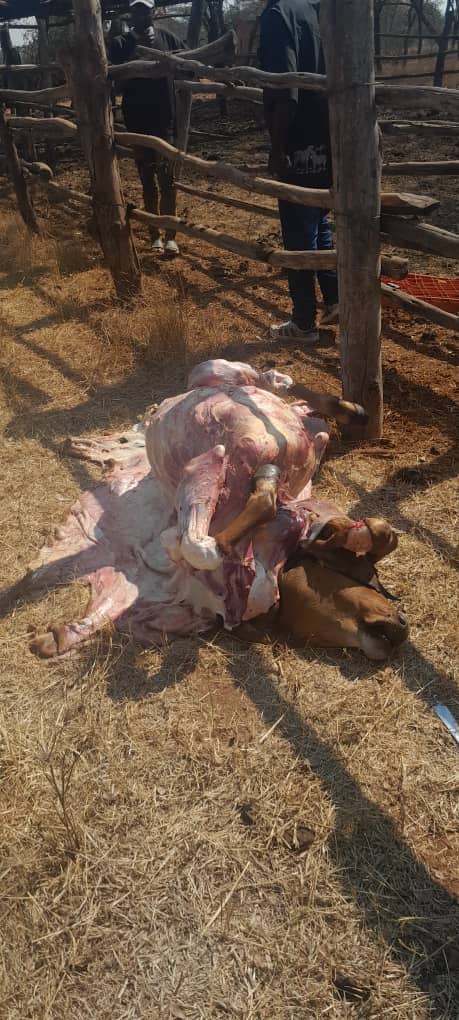
The major concern for the Mandebvu family is that their livestock continue to die in the tens owing to lack of grazing pastures following their removal from the property.
An August 11 report attributed to a local weekly publication described substantial agricultural investment by the family, including cattle, small livestock, poultry and fish farming. It reported that the family held an offer letter and was subsequently granted a lease.
According to that account, soldiers from nearby Eastdale Air Base arrived at the property at night, ordered the family to leave and subsequently occupied the farmhouse, with household belongings reportedly placed outside. These allegations were attributed to sources familiar with the dispute.
The reported consequences extended beyond the loss of accommodation. More than 70 cattle and over 100 goats and sheep were reportedly being moved across the Gutu–Chivhu Road twice daily to access borrowed grazing near the Drifontein turn-off, with herdsmen using red flags to stop traffic.
The same report described poultry losses and abandoned fish ponds, illustrating the disruption to the family’s farming operations. The available information does not establish whether those conditions have since improved.
While General Matatu’s letter acknowledges the dispute and urges dialogue, it also maintains that the land was gazetted as a cantonment area under Notice Number 93 of 2006.
“The land in question was gazetted as a cantonment area under Notice Number 93 of 2006 and became prohibited to private occupation,” the letter states.
That position does not, in the correspondence supplied, address whether any portion of the family’s holding lies outside the gazetted area—the issue the lawyers’ request for coordinates now seeks to clarify.
The available documents also leave questions about the procedure followed in removing the family. General Matatu’s letter does not identify a court order authorising the eviction, while the earlier report said it had not established whether eviction proceedings had been instituted. This does not establish that no order exists, but its existence and terms remain unverified.
The correspondence does not address compensation, alternative land or arrangements for the family’s agricultural investments. It instead directs the parties towards discussions with the Air Force, in line with General Matatu’s advice that they should “find each other” and agree on an amicable solution.
For the displaced family, the request for coordinates represents an effort to have the dispute examined against identifiable boundaries.
And until those boundaries are compared with the family’s allocation documents, the available record does not resolve whether all, part, or none of the disputed holding falls within the military reservation.

About Gilbert Munetsi
Correspondent