
Mutare clrearing agent in court over lithium smuggling plot: how smuggling tests the country's export controls
A Mutare clearing agent has appeared in court for allegedly facilitating the smuggling of 1,440 tonnes of lithium ore to China
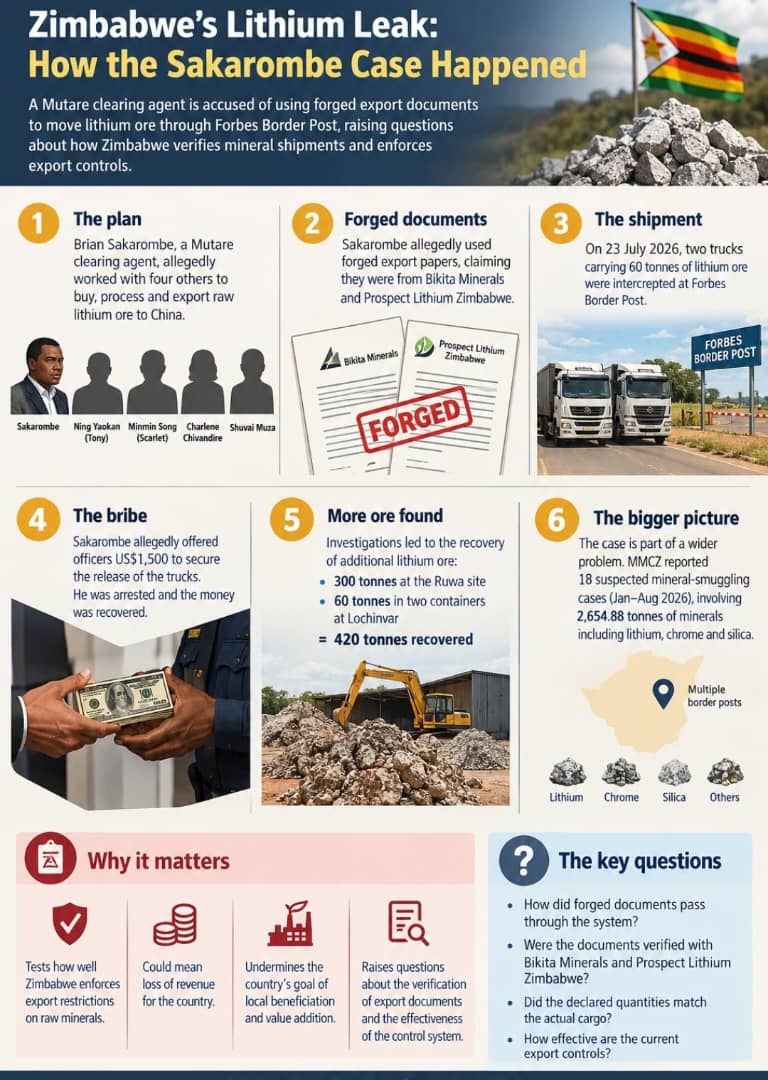
A mutare clearing agent, Brian Sakarombe, is accused of forging export documents for lithium ore that he claimed were from Bikita Minerals and Prospect Lithium Zimbabwe. Sakarombe is reported to have helped move 1,440 tonnes of lithium ore through the Forbes border post. The allegations have not yet been proven in court. This case raises questions about how Zimbabwe checks mineral export documents and enforces restrictions on raw mineral consignments. Sakarombe allegedly worked with
Ning Yaokan, also known as Tony; Minmin Song, also known as Scarlett; Charlene Tanyaradzwa Chivandire; and Shuvai Muza. Prosecutors say the operation was meant to buy, process, and export raw lithium ore to China. Sakarombe was sent to the Forbes border post to help move the shipment using forged documents that he claimed were from Bikita Minerals.
On July 23, 2026, two trucks carrying 60 tonnes were seized at Forbes. Sakarombe allegedly offered officers US$1,500 for the release of the intercepted trucks. Additionally, 420 tonnes of lithium ore were found at various locations. Sixty tonnes from two containers were seized at Lochinvar, while 300 tonnes were seized at the Ruwa site.
The case reflects a challenge that authorities may face in enforcing restrictions. How can a shipment of this size pass through the export system if the documents are forged? This question matters because in February 2026 the government announced a suspension of exports of all raw minerals and lithium concentrates, even those already in transit.
The Ministry of Mines and Mining Development directed the Zimbabwe Revenue Authority and the Minerals Marketing Corporation of Zimbabwe to enforce the suspension. The Sakarombe case highlights restrictions designed to control the origin of mineral shipments, their intended destination, and, importantly, whether the documents support the shipment.
A Mineral-Smuggling Problem
The Forbes case is not isolated; it occurs amid concerns about the misuse of export papers and attempts to move material that does not meet export requirements. Between January and August 2026, the MMCZ reported 18 cases of suspected mineral smuggling and irregular movement involving 2,654.88 tonnes of mineral material. These cases included lithium, chrome and silica. The 18 cases involved offences such as moving lithium ore, misuse of export papers, and movement without valid documents.
In February 2026, four trucks were reportedly seized at Beitbridge carrying lithium concentrate without documentation. The available figures do not show how many mineral shipments were inspected, how many irregularities were found, or how many cases ended in convictions.
In another case, a consignment of lithium ore was seized with three trucks, a diverted container, and fraudulent export papers. The shipment was intercepted at Beira. It was destined for China.
How the Export-Control System Is Supposed to Work
The MMCZ handles mineral marketing and export authorisation while ZIMRA administers customs controls at the border. The Ministry of Mines, on the other hand, oversees mining sector requirements, including compliance with rules governing beneficiation, export, and mineral production.
To clear a shipment, it must be supported by customs documentation. The mineral must match what is being cleared. The government’s suspension included minerals in transit. A question that arises is, if the documents used in the Forbes case were forged, at what point should this have been noticed? The question requires examining whether the descriptions on the documents matched the shipment.
In July 2025, an investigation by Global Press Journal documented allegations of corruption. One example involved a shipment declared as chrome in 2023. Inspectors found that it contained raw lithium. A former border agent alleged that bribes were used to bypass shipment records.
In this case, the information available does not show which checks were made before reaching Forbes.
The case also raises questions about whether documents were checked with Bikita Minerals and Prospect Lithium Zimbabwe, whether permit numbers were verified against official records, and whether the declared quantities matched the truck weighbridges.
Economic Cost
Loss to the state should be separated from the shipment. The value of ore differs from the value of processed ore or the final product. Zimbabwe’s push for beneficiation is aimed at keeping more value from supporting processing in the country.
Zimbabwe’s minerals are a source of export earnings, royalties, and taxes. When they are exported illegally, the country risks losing revenue and control over trade.
ZIMRA’s 2025 report recorded collections of ZWG 202.96 million and US$1.19 million, while the duty value of detained goods was ZWG 97.11 million and US$2.25 million.
If minerals are illegally exported, then the country loses revenue and control over trade.
Moving minerals illegally puts Zimbabwe at risk of missing out on revenue. An article by Mining Zimbabwe reports that Zimbabwe loses US$400 million every year because some tantalum, cesium, and lithium exports are not reported.
For Zimbabwe, the challenge is not to arrest smugglers but also to show that Zimbabwe controls mineral exports in a tight and consistent way.
The Sakarombe case is decided in the courts, but the question remains: how much can Zimbabwe rely on its mineral export controls if forged documents can be used for large lithium shipments out of Zimbabwe?

About Munyaradzi Mashiri
Court Correspondent