
POSB’s Record Profits Put Under Spotlight
The People’s Own Savings Bank has emerged as one of Zimbabwe’s more unusual banking performers, recording a record US$10.28 million profit in 2025 and delivering returns that economic analyst Munyaradzi Hoto says compare favourably with those of the country’s largest listed bank.
But beneath the strong earnings is a business model facing pressure from regulatory changes to bank charges, questions over how effectively deposits are being deployed into lending, and the distinctive regulatory position of a state-owned savings institution.
Hoto argues that POSB has received limited attention from investment analysts despite its financial performance, which he says is stronger than its low public and market profile would suggest.
“POSB may be the most overlooked bank in Zimbabwe. No listing. No analyst coverage. Few headlines. Yet it made a record US$10.28m profit in 2025 and, by my calculations from audited results, earned about twice the return on assets of the country's largest listed bank,” Hoto said.
His calculations put POSB's return on average assets at approximately 8.4 percent in 2025, compared with 3.8 percent for CBZ, although these are analyst-derived ratios rather than figures directly reported as a comparative measure by the two banks.
POSB's published audited results show net profit rising 19 percent to ZWG275.02 million in 2025, from ZWG231.65 million in 2024. Net interest income increased to ZWG399.10 million, while fees and commission income rose 96 percent to ZWG1.05 billion.
The bank's earnings structure is particularly important. Hoto calculates that fees and commissions accounted for approximately 72 percent of the combined total of net interest income and fee income, making non-funded income a major contributor to profitability.
That dependence has become a vulnerability following the Reserve Bank of Zimbabwe's 2026 measures capping cash withdrawal charges at two percent and reducing or removing other transaction charges. The changes took effect from March 31 and were intended to lower the cost of banking for customers.
POSB's first-half 2026 results show the impact. Net profit fell 42 percent to ZWG108.48 million from ZWG187.42 million in the comparable period, while net operating income declined nine percent to ZWG659.47 million. Operating expenses increased by three percent to ZWG550.99 million.
The pressure on earnings has, however, not been accompanied by a loss of deposits. Customer deposits increased by approximately 37 percent in the six months to June 2026, reaching US$99.4 million, while loans stood at US$54.3 million, according to figures cited by Hoto.
This translates into a loan-to-deposit ratio of about 55 percent, suggesting that a substantial proportion of the bank's deposit base is held outside customer lending.
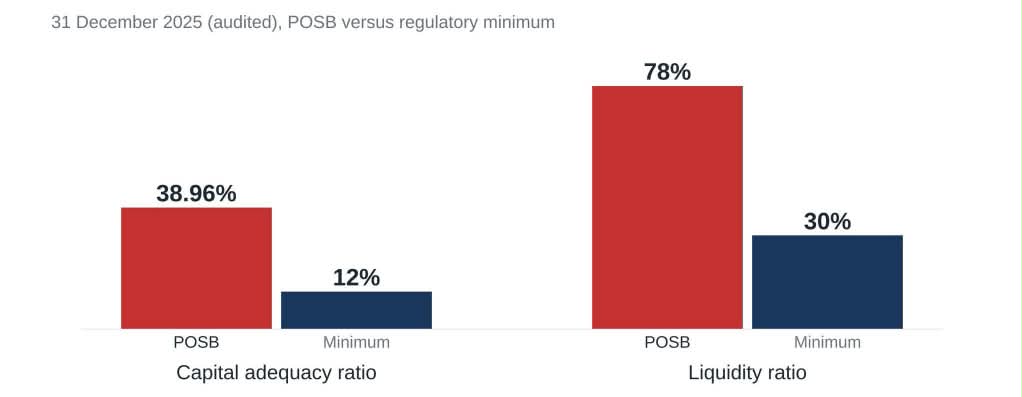
Hoto argues that the bank's capacity to expand lending is supported by its capital and liquidity position. Its capital adequacy ratio stood at 38.96 percent at December 2025, while liquidity was 78 percent, against the respective benchmarks cited in its financial reporting. Non-performing loans stood at 2.09 percent at June 2026, below the five percent benchmark.
“The customers stayed. The pricing changed,” Hoto said, arguing that POSB's growing deposits demonstrate the resilience of its customer base even as regulatory changes affect its traditional fee-driven earnings.
He also points to the bank's rising dividend payments as evidence of its growing financial contribution to its shareholder. Dividends increased from US$220,000 in 2022 to US$590,000 in 2024, US$1.52 million in 2025 and US$5.14 million in July 2026.
However, the bank's regulatory position complicates comparisons with conventional commercial banks.
POSB is established under the People's Own Savings Bank Act rather than operating as an ordinary bank incorporated under the Banking Act. The Reserve Bank's 2025 Monetary Policy Statement explicitly stated that POSB, established under the POSB Act, does not have minimum capital requirements, although it benchmarks itself against Tier II banking institutions.
This distinction is important when interpreting its reported capital position and comparing it with listed commercial banks. POSB publishes capital adequacy and liquidity ratios, but its statutory framework means that its regulatory obligations are not identical to those applying to ordinary banking institutions.
Analyst Rufaro Hozheri argues that the bank's state ownership and regulatory structure help explain why it attracts limited investment research attention.
“There is a good reason why analysts don't cover POSB, journalists do cover it by the way,” Hozheri said.
He added that POSB's government ownership limits the investment opportunities available to market analysts and their clients.
“You can't spend time analysing something that you can't get a piece of or advise your clients to,” he said, referring to the absence of publicly traded shares through which investors could acquire an interest in the bank.
Hozheri also questioned comparisons with commercial banks because of POSB's different regulatory framework, arguing that it does not face the same capital adequacy requirements.
The Reserve Bank's published position supports the distinction on minimum capital requirements, although POSB's own financial disclosures continue to report capital adequacy ratios and compare them with a 12 percent benchmark.
The bank's state ownership has also raised questions about its future structure. Hozheri recalled earlier speculation that POSB could be bundled with telecommunications company TelOne as part of a possible privatisation arrangement, although the claim remains a reference to past speculation rather than an announced transaction.

About Oscar Jeke - Reporter
Staff Writer