
Potato Seed Shipment Triggers Fraud Investigation
Two men have appeared in court over allegations that they used another company’s documents to bring potato seed into Zim from South Africa
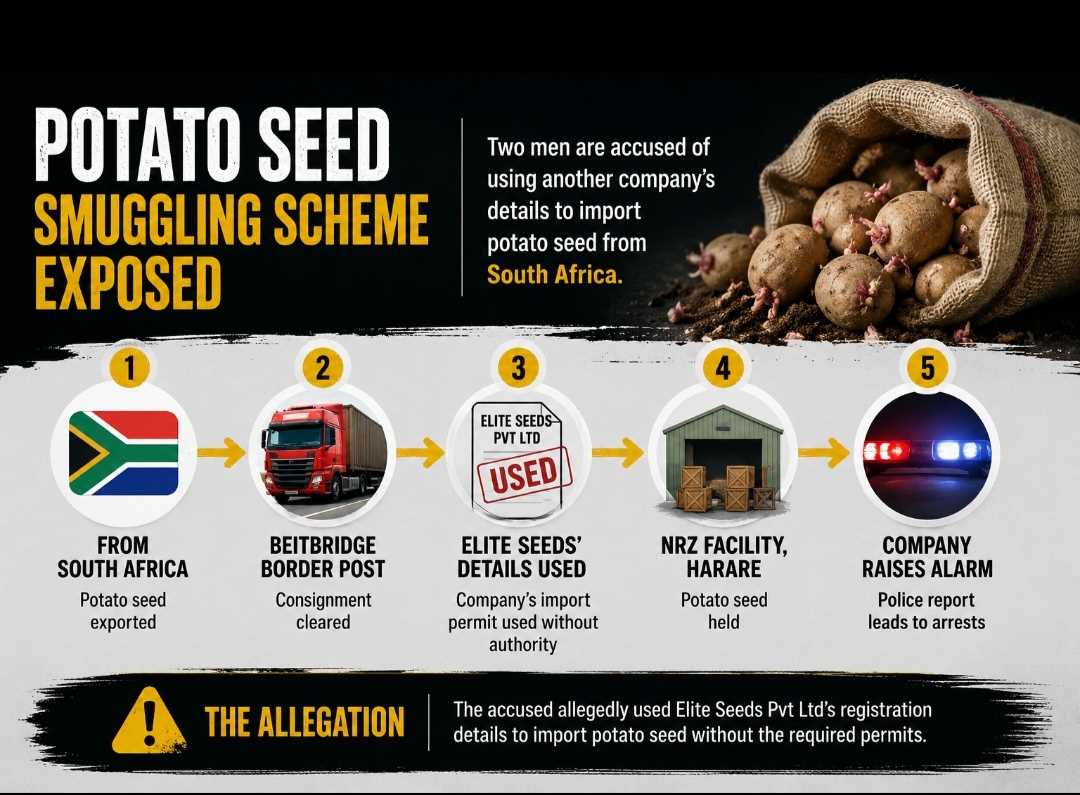
Two men have appeared in court over allegations that they used another company’s documents to bring potato seed into Zimbabwe from South Africa.
Antonio Manatsa, 61, and Vengai Chipondeni, 38, appeared before Harare magistrate Tapiwa Kuhudzai facing allegations of fraud and smuggling.
The State alleges the pair worked with a third man, identified only as Phillip, an agent at Beitbridge Border Post employed by registered clearing agent Armsurge Enterprises. Phillip remains at large.
Prosecutor Dzidzai Josiah told the court that the accused allegedly misrepresented themselves to the Zimbabwe Revenue Authority as directors of Elite Seeds Pvt Ltd.
They allegedly used Elite Seeds’ import permit number 0081227 and bill of entry number C67123 to process documents for a consignment of potato seed imported from South Africa on July 24, 2026. But the State says they never received the required documents.
However, the State says the required permits and certificates for the shipment were not in place.
These included an import licence and Plant Pest and Diseases Permit from the Ministry of Agriculture, a Bio Safety Import Permit from the National Biotechnology Authority, an Agricultural Marketing Authority registration certificate, a SADC Certificate and a Tax Clearance Certificate.
ZIMRA Loss Control Officer Samuel Munapo is listed as the first complainant, while Elite Seeds Pvt Ltd is represented by Arnold Makomborero Mapeta.
The court heard that Mapeta only learnt that his company’s details had allegedly been used on July 24, when he was informed about the consignment.
He went to the National Railways of Zimbabwe, where the potato seed was being held, and was shown import documents bearing Elite Seeds’ name.
Mapeta reportedly told authorities that his company had not imported the consignment, prompting him to make a police report at Harare Central.
The report led to the arrest of Manatsa and Chipondeni.
The two were remanded in custody and are expected back in court on September 24, 2026. When importing seeds into the country, one has to submit applicable regulations, agricultural import permits, and biosecurity authorisation. The Ministry of Lands, Agriculture, Fisheries, Water and Rural Development sets import requirements, while the Plant Quarantine Services oversees plant-health controls. The Agricultural Marketing Authority administers licensing requirements applicable to agricultural commodities. Clearance agents facilitate processing shipments on behalf of the importers. In the case in question, prosecutors allege that the shipment did not have an import licence or a plant pest and diseases permit. These are allegations presented in the case, and the requirements applicable to each document should be confirmed against the regulations governing the particular consignment.
The central question is how the shipment was processed using Elite Seeds' details when the company reportedly denied importing it, and what verification took place before the documents were accepted.
Elite Seeds representative Arnold Makomborero reportedly learnt about the consignment on July 24 and visited the Railways of Zimbabwe, where the shipment was being held.
He is said to have found documents bearing the company's name but told authorities that Elite Seeds had not imported the consignment.
A police report was subsequently made at Harare Central Police Station, leading to the arrest of Manatsa and Chipondeni.
ZIMRA loss control officer Samuel Munapo is listed as the first complainant, while Elite Seeds is represented by Mapeta. Other cases highlight import-control challenges.
Authorities continue to intercept agricultural and food products entering Zimbabwe outside established import procedures. In August, 2026, the AMA and the ZRP recovered more than 15,600kg of sesame seeds worth US$11 400. The seizure followed a joint operation targeting an alleged syndicate smuggling the crop to Mozambique through informal channels. Authorities were investigating individuals and entities suspected of buying the crop without valid licences. Zimbabwe's laws dictate that goods involved in customs offences be seized. In November 2025, Zimra was directed to effectively impose the forfeiture of smuggled goods. The different cases show the level of enforcement challenges facing authorities. The misuse of Elite Seeds' import documents occurred in a trade worth millions of dollars to Zimbabwe. UN Comtrade data presented through the World Bank's World Integrated Trade Solution reported that Zimbabwe imported 13.79 million kg of seed potatoes worth US$10.52 million kg in 2024. South Africa was the dominant recorded source of imported seed potatoes, with the trade data cited in the draft putting its value at US$9.77 million.
The quantity attributed to South Africa in the same data, however, requires verification because the reported 13.93 million kg exceeds Zimbabwe's stated total imports of 13.79 million kg. The figures should be checked against the reporting country, product classification, and units before publication. Although the above figures do not reflect the value of the shipment involved, they show the scale of the seed-potato trade and the importance of tight control. Control of seed potatoes is important not only for compliance but, more importantly, for agricultural production. Zimra's 2025 report reported 299 seizures under the anti-smuggling campaign, while 368 drone-assisted interceptions were also reported in the same year. This case is a reflection on the verification of import documents, the role of clearing agents, and the checks that are done before shipments are released.

About Munyaradzi Mashiri
Court Correspondent