







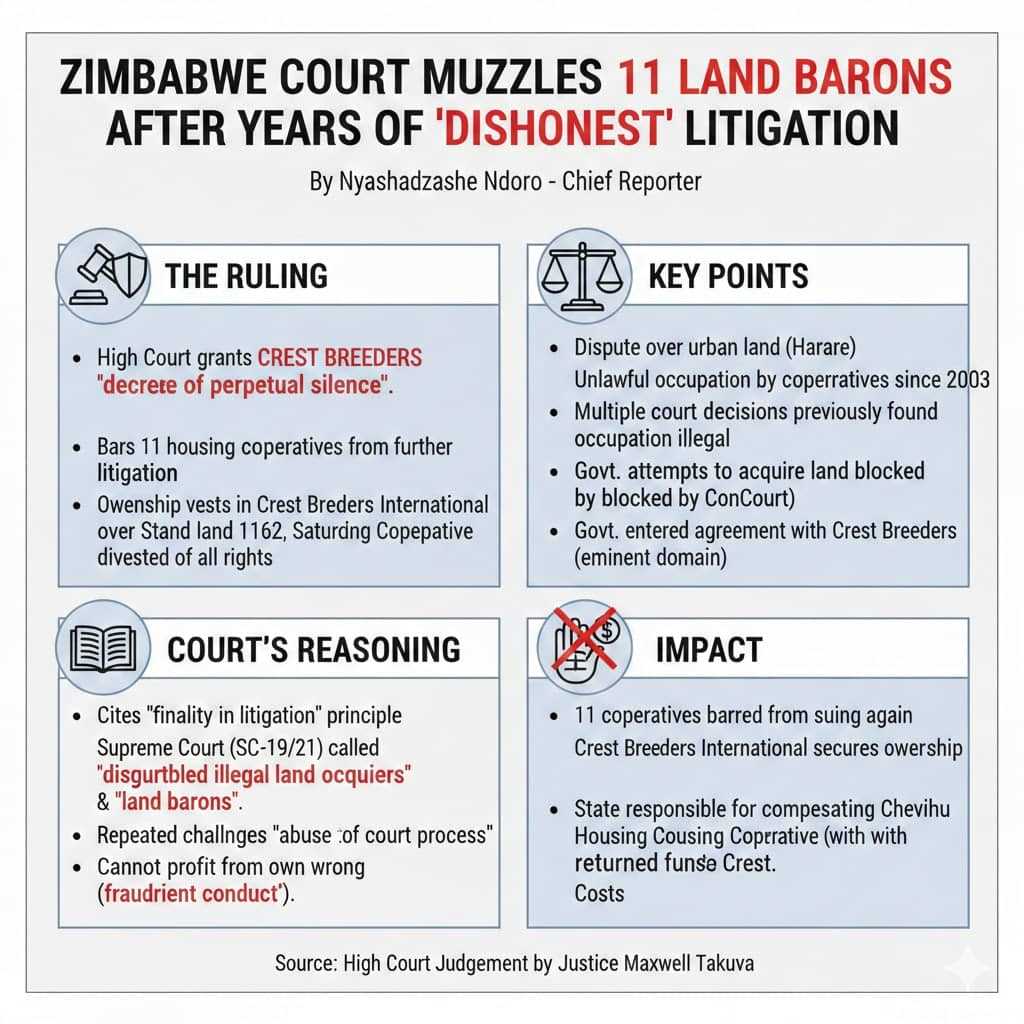
The High Court has shut the courtroom doors on eleven housing cooperatives it accused of years of dishonest and vexatious litigation, issuing the rare remedy of a decree of perpetual silence in a protracted Harare land dispute that judges say had been conclusively settled by the Supreme Court.
In a judgment delivered by Justice Maxwell Takuva, the court barred the cooperatives from instituting any further legal proceedings over Stand Number 1162, Saturday Retreat Township, declaring that ownership vests in Crest Breeders International (Private) Limited and that the continued court challenges amounted to an abuse of process.
The ruling effectively ends more than two decades of litigation over the land and sends a strong warning to housing cooperatives and land barons who repeatedly seek to relitigate settled matters through the courts.
Justice Takuva ruled that the first respondent, Chevhu Housing Cooperative Society Limited, had been divested of any right, title or interest in the disputed stand and ordered it to pay costs of suit.
The matter was brought by Crest Breeders International, represented by Nyawo Ruzive Attorneys, against eleven housing cooperatives and two government ministers — the Minister of Lands, Agriculture, Climate Change, Fisheries and Rural Resettlement, and the Minister of Local Government, Public Works and National Housing. The first to eleventh respondents were represented by Koto and Company.
Crest Breeders International is the registered owner of the Remaining Extent of Saturday Retreat under Deed of Transfer 4035/86. Although the land was originally rural, it was incorporated into the City of Harare in 1996 through Statutory Instrument 41 of 1996, rendering it urban land.
The court heard that from 2003 onwards, the housing cooperatives unlawfully occupied the land. Multiple court decisions subsequently declared their occupation illegal. Despite these rulings, the cooperatives continued to institute fresh legal proceedings relating to the same property.
Related Stories
Government efforts to resolve the dispute included attempts to acquire the land under the Land Reform Programme. However, the Constitutional Court later ruled that urban land could not be acquired under that programme. The State then entered into an agreement with Crest Breeders International under its powers of eminent domain, providing for compensation and the allocation of alternative land.
Justice Takuva noted that the Supreme Court, in Chevhu Housing Society Co-operative Limited v Crest Breeders International (Pvt) Ltd SC-19/21, upheld the legality of the agreement between the applicant and the State. In that ruling, the apex court described members of the cooperative as “disgruntled illegal land occupiers” and criticised the leadership for acting as “land barons,” finding no legal basis to reverse the acquisition or compensation agreement.
The High Court considered whether the respondents had repeatedly litigated issues already conclusively determined, whether exceptional circumstances justified a decree of perpetual silence, and whether their conduct warranted judicial intervention.
Justice Takuva emphasised the constitutional principle of finality in litigation, citing section 169 of the Constitution and section 26 of the Supreme Court Act, which render Supreme Court decisions final and binding. He ruled that the respondents’ continued challenges were vexatious and undermined the authority of the courts.
“The law recognises the utility of a decree of perpetual silence to prevent repeated and vexatious litigation,” Justice Takuva said, citing South African authorities including Brown v Simon (1905) TS 311 and Corderoy v Union Government (1918) AD 512. He also relied on Matsika v Standard Chartered Bank 1997 (2) ZLR 389, which holds that a litigant cannot profit from fraudulent conduct.
“On the facts, the respondents are neither owners nor lawful occupiers of the land. They have consistently sought to re-litigate matters already conclusively determined by the Supreme Court, including the validity of the 18 December 2014 agreement, the payment of compensation and the lawful acquisition of urban land,” the judge said.
The court further criticised allegations made by the respondents against the Supreme Court in their affidavits, describing them as scandalous and improper, particularly given that they were legally represented.
Chevhu Housing Cooperative Society Limited was formally declared divested of all rights and interests in Stand Number 1162, with ownership vesting in Crest Breeders International. A memorandum of agreement entered into by certain respondents was declared not binding.
The court ordered that the duty to compensate the first respondent lies with the State and that monies paid by Crest Breeders International be refunded. Chevhu Housing Cooperative was ordered to pay costs of suit.








Leave Comments