






Government proposals to widen ministerial powers to exempt certain procurement contracts from public scrutiny have triggered sharp divisions in Parliament, with legislators warning that the changes could either strengthen oversight or create new loopholes for secrecy in high-value public deals.
Debate on the Public Procurement and Disposal of Public Assets Amendment Bill (H.B. 2, 2025) intensified this week as lawmakers clashed over provisions that critics say could undermine transparency in billion-dollar state contracts.
Presenting a joint report by the Portfolio Committee on Budget, Finance and Investment Promotion and the Public Accounts Committee, Chipinge East legislator Lincoln Dliwayo said the committees conducted nationwide public hearings from 20 to 25 July 2025, in compliance with Section 141 of the Constitution, which requires Parliament to facilitate public participation in law-making.
The hearings were held in five major centres and reached 306 participants, 67 percent male and 33 percent female. While participants welcomed Parliament’s outreach, concerns were raised over low turnout, limited publicity and doubts about whether public submissions would meaningfully shape the final law.
Ministerial exemption powers under fire
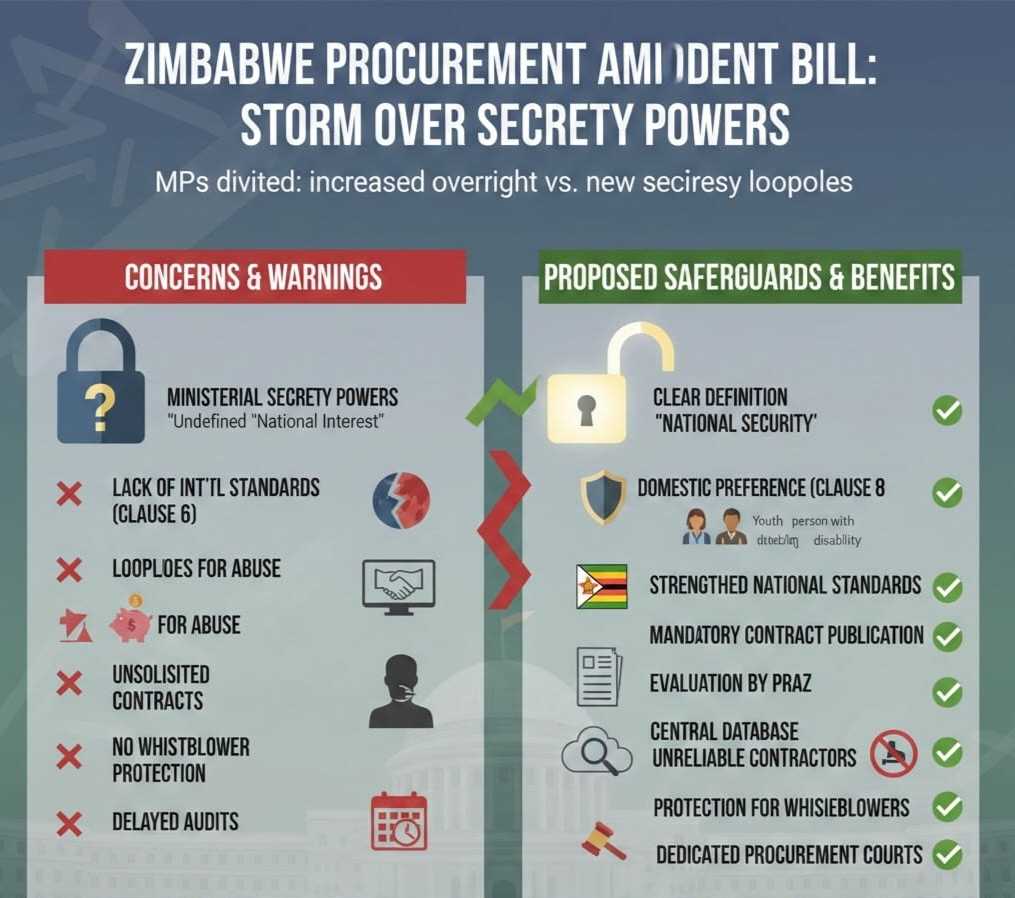
One of the most contentious provisions is Clause 3, which empowers the Minister to exempt certain procurements from publication where disclosure is deemed contrary to national interest.
Public submissions urged lawmakers to clearly define “national security” and restrict exemptions strictly to defence and security-related contracts. The parliamentary committees echoed these concerns, warning that vague language could invite abuse.
Opposition legislator Edwin Mushoriwa cautioned that without a clear definition of “national interest”, the clause could be used to shield non-security procurements from scrutiny. He argued that broad exemption powers were “not in the country’s best interest” and risked weakening transparency in public procurement.
Masvingo South MP Tanatswa Mukomberi defended the clause, saying it was necessary to balance transparency with national security considerations, provided strong oversight mechanisms are in place to prevent misuse.
Domestic preference and marginalised groups
Clause 8, which mandates preferential treatment for domestic suppliers, including war veterans, youths, women and persons with disabilities, also generated mixed reactions.
Most public submissions supported domestic preference as a tool to drive inclusive growth and local industrialisation. However, participants warned of possible abuse through fronting, where individuals use marginalised groups as conduits to secure contracts.
The committees recommended that the Bill clearly define what constitutes “youth-owned”, “women-owned”, “war veteran-owned” and “disability-owned” enterprises. They also proposed clear thresholds for tenders reserved for these groups, along with publication of a register of qualifying businesses and their areas of trade.
Mushoriwa warned that failure to define “war veteran” could allow cartels to exploit the provision. He added that while inclusivity is critical, the law must avoid creating new forms of discrimination or elite capture.
Related Stories
Scrapping international standards divides opinion
Clause 6, which removes the requirement for bidding documents to incorporate international standards, also split opinion.
Some participants argued that abandoning international benchmarks could compromise quality in public projects, while others said strict standards often disadvantage local firms.
Mushoriwa said if international standards are removed, Zimbabwe must urgently strengthen its national standards framework to protect quality, particularly in infrastructure development.
Mukomberi supported the amendment, arguing it would level the playing field for domestic companies and simplify procurement processes.
Oversight, timelines and transparency gaps
Public hearings highlighted persistent concerns over delayed audits by the Auditor-General and late submission of financial statements by Ministries, Departments and Agencies, weakening parliamentary oversight through the Public Accounts Committee.
Clause 11, which shortens certain procurement timelines from 14 days to 10 days, also drew criticism, with participants questioning whether complex, high-value contracts could be adequately assessed within shorter periods. The public proposed flexible timelines based on contract value.
The Bill introduces an evaluation role for the Procurement Regulatory Authority of Zimbabwe, expanding its mandate from monitoring to active assessment, a move broadly welcomed during consultations.
Other proposed reforms include mandatory publication of contract awards, tighter rules governing disposal of public assets, and a ban on selling surplus state assets to employees to prevent conflicts of interest.
Gaps remain
Mushoriwa argued that the Bill fails to adequately regulate unsolicited bids, which he said account for many controversial deals that bypass competitive tendering. He called for clear rules to prevent abuse.
He also proposed a central database of unreliable contractors and stricter controls on prepayments, including mandatory bank guarantees to protect public funds.
Additional public submissions recommended the creation of specialised procurement courts, stronger whistleblower protections and a Local Content Rating and Certification System to support industrialisation.







Leave Comments