









Sub-Saharan Africa remains at the heart of the global child mortality crisis, with the latest report by the United Nations Inter-agency Group for Child Mortality Estimation warning that millions of children continue to die from largely preventable causes.
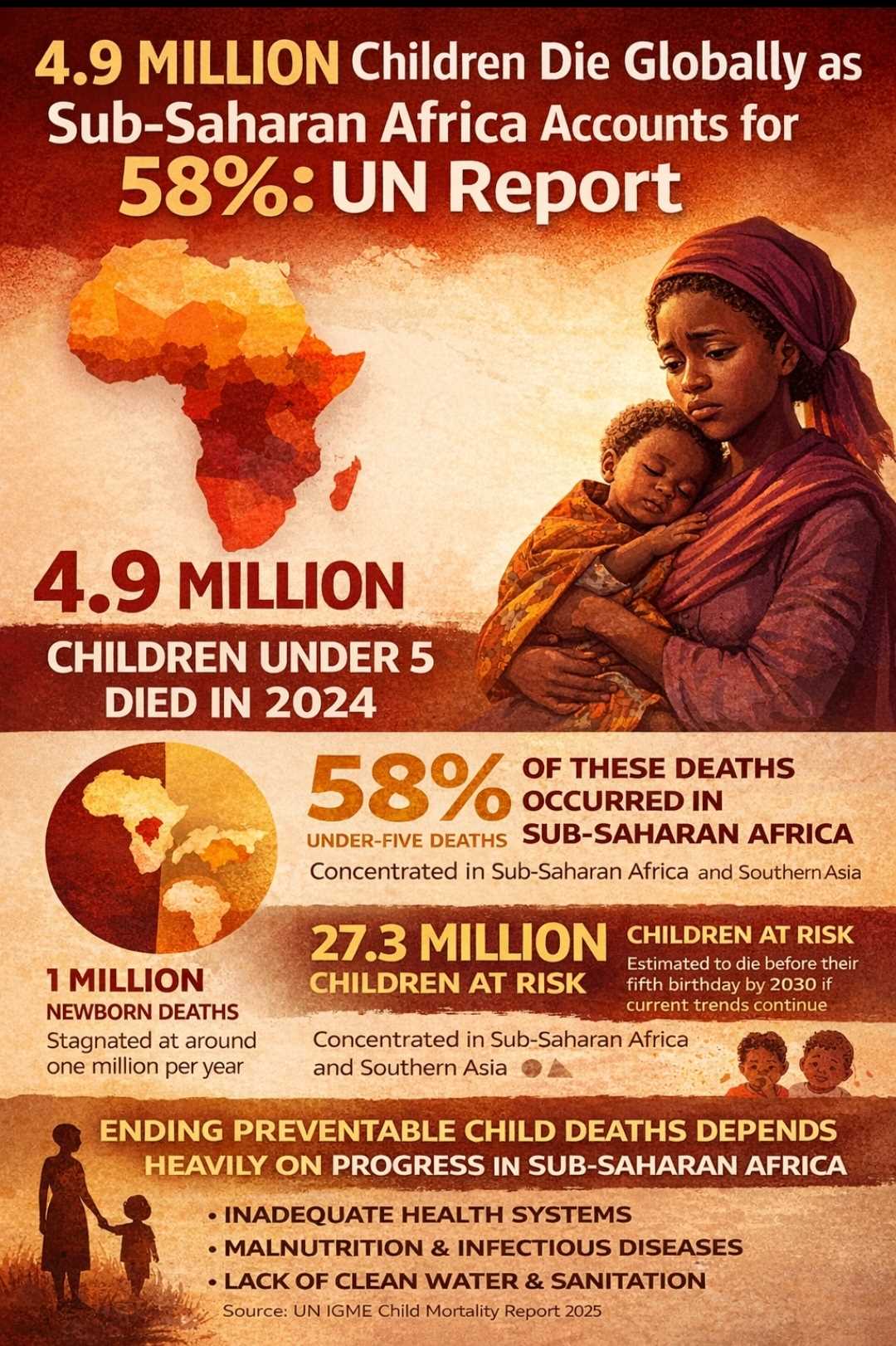
The report highlights that in 2024 alone, an estimated 4.9 million children died before reaching their fifth birthday, most from preventable or treatable conditions.
“These losses are made even more tragic by the fact that most of them were caused by conditions that are preventable or treatable with well-established, cost-effective interventions,” the report states.
Sub-Saharan Africa carries the heaviest burden of these deaths, with the region accounting for a disproportionate share of global under-five mortality.
“Sub-Saharan Africa and Southern Asia continued to bear a disproportionate burden of global under-five deaths, accounting for more than 80 per cent of all under-five deaths worldwide,” the report notes.
More specifically, the report shows that sub-Saharan Africa alone accounted for 58 percent of global under-five deaths in 2024, underscoring the scale of the crisis in the region.
Experts say population growth, combined with slower progress in reducing mortality rates, is intensifying pressure on already strained health systems.
“The global burden of child, adolescent and youth deaths is shifting heavily to sub-Saharan Africa,” the report states, attributing this to “population growth… slower mortality reductions and the continued prevalence of preventable causes of death.”
The situation is particularly alarming for newborns, with neonatal deaths in sub-Saharan Africa stagnating at around one million per year.
“In sub-Saharan Africa, neonatal deaths have stagnated at roughly one million per year,” the report notes.
Health experts say many of these deaths are linked to conditions that can be addressed through improved access to basic healthcare services, including skilled birth attendance, vaccination and timely treatment of infections.
Related Stories
However, inequality remains a major barrier.
“Persistent and profound disparities in child survival continue to impede global progress,” the report states, noting that access to life-saving interventions remains uneven across and within countries. �
The report further highlights that a child’s chances of survival are heavily influenced by where they are born, with stark contrasts between high-income and low-income regions.
“In 2024, a child born in the country with the highest [under-five mortality rate] was more than 57 times more likely to die before reaching age 5 than a child born in the country with the lowest,” it states.
In sub-Saharan Africa, infectious diseases such as malaria, pneumonia and diarrhoea remain leading causes of death among children, compounded by malnutrition and limited access to clean water and sanitation.
The report warns that progress in reducing child mortality has slowed in recent years, raising concerns about the ability of many countries to meet global targets.
“Global progress in reducing under-five mortality has slowed in the SDG era,” it notes, adding that continued progress “cannot be assumed without renewed commitment, sustained investment and targeted interventions.”
The outlook remains concerning if urgent action is not taken.
“If current trends continue, an estimated 27.3 million children will die by 2030 before reaching their fifth birthday,” the report warns, with sub-Saharan Africa expected to account for the majority of these deaths.
Despite the grim statistics, the report emphasises that solutions are known and achievable.
“The progress documented in this report demonstrates that child… mortality is not an intractable problem,” it states, calling for stronger investment, better data systems and targeted interventions focused on the most vulnerable populations.
As global attention turns toward meeting the 2030 targets, the report makes it clear that ending preventable child deaths will depend heavily on progress in sub-Saharan Africa, where the stakes remain highest.








Leave Comments