






An investigation by The Sentry has supported allegations made by Vice President Constantino Chiwenga linking businessman Kudakwashe Tagwirei and politically connected interests to cartel-like control in Zimbabwe’s fuel sector.
The report’s allegations align with concerns Chiwenga raised when he warned against “cartels” distorting the economy.
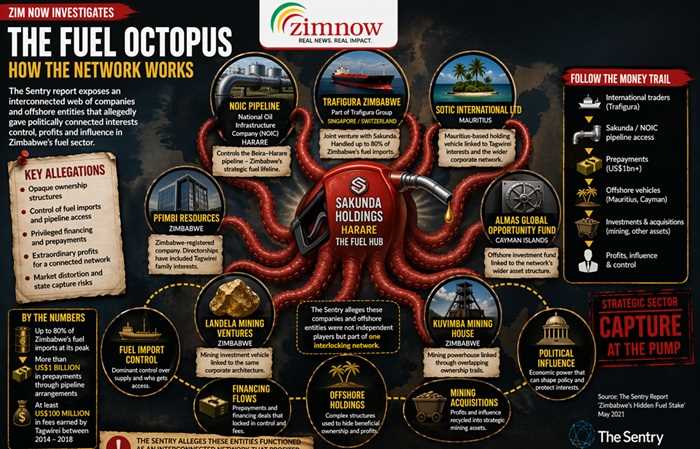
The Sentry traces what it describes as an interlocking corporate web around businessman Kudakwashe Tagwirei, rather than a single fuel company acting alone.
At the centre is Sakunda Holdings, Harare, identified as the local operating hub. Through a joint venture with Trafigura Zimbabwe, linked to parent structures in Singapore and Switzerland, Sakunda reportedly gained privileged access to Zimbabwe’s strategic fuel pipeline run by the National Oil Infrastructure Company, NOIC, headquartered in Harare.
The report says the joint venture at one stage handled up to 80 percent of Zimbabwe’s fuel imports, with more than US$1 billion in prepayments reportedly moving through arrangements tied to pipeline access. It says Tagwirei earned at least US$100 million in fees from the relationship between 2014 and 2018.
The trail then moves offshore. The report points to Sotic International Ltd, Mauritius, as a major holding vehicle linked to Tagwirei interests, with related references to Almas Global Opportunity Fund, Cayman Islands, and Pfimbi Resources, Harare, whose directorships reportedly overlap with Tagwirei family interests.
Related Stories
The argument is that these entities were not isolated investments but part of one ecosystem linking fuel, offshore finance and asset accumulation. It also draws links from this architecture into mining through Landela Mining Ventures and later Kuvimba Mining House, suggesting fuel profits may have underpinned wider strategic acquisitions.
For readers trying to make sense of the report, its essential claim is blunt: what looked like separate companies, contracts and funds may have functioned as a coordinated network. That is why the findings are being read by some as lending weight to allegations by Vice President Constantino Chiwenga about cartel behaviour linked to Tagwirei-associated interests.
The Sentry report traces the alleged fuel network through named corporate entities linked to Kudakwashe Tagwirei, centring on Sakunda Holdings (Harare) as the local anchor of the operation. It highlights Sakunda’s former joint venture with commodity giant Trafigura Zimbabwe, linked to offices in Harare and parent structures in Singapore and Switzerland, which the report says gave the network extraordinary leverage over fuel imports and access to the Beira-Harare pipeline. The report also points to Fossil Agro, associated in records with Harare addresses tied to the Tagwirei network, as part of a web of companies allegedly used in structuring ownership and moving interests behind the scenes.
This expose comes at a time when ordinary Zimbabweans are grappling with fuel hikes impacting the prices of transport, commodities and services despite a recent marginal downwards review.
The Middle East supply shock exposed how much of Zimbabwe’s pump price is domestic policy rather than imported crisis. At the height of the Iran-Hormuz tensions, Zimbabwe’s petrol hit US$2.17 a litre, among the highest in the region, while Zambia was around US$1.60, despite facing the same global oil shock. A leaked ZERA table of price build-ups showed about US$0.857 per litre in taxes and levies on petrol, nearly 40 percent of the pump price, up sharply from US$0.5209 just two weeks earlier.
The Sentry report alleges opaque structures, and hidden interests may have shaped parts of Zimbabwe’s fuel supply chain, potentially allowing a narrow network to exercise outsized influence. That appears to lend weight to Chiwenga’s earlier suggestion that cartel behaviour, rather than ordinary market forces alone, are affecting the sector.





Leave Comments