









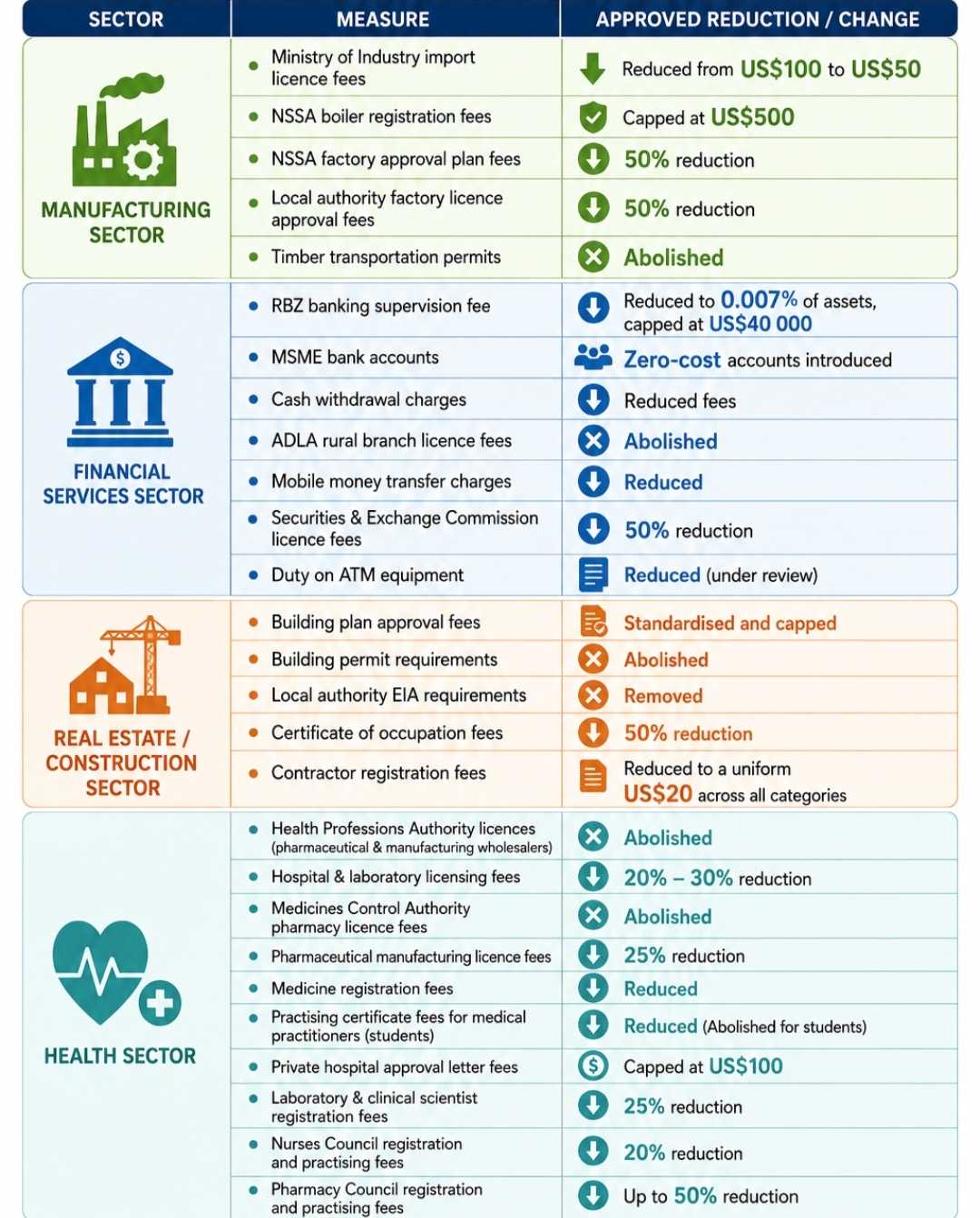
Ministry of Finance, Economic Development and Investment Promotion has announced a broad package of regulatory reforms targeting key sectors of the economy, aimed at improving ease of doing business, lowering compliance costs and stimulating economic growth.
In a press statement, Finance Minister Mthuli Ncube said Cabinet had endorsed comprehensive measures covering manufacturing, financial services, real estate and healthcare industries.
“Government, through Cabinet, has approved a comprehensive package of regulatory reforms aimed at improving the ease of doing business, reducing compliance costs and stimulating broad-based economic growth across key sectors of the economy,” the statement reads.
Authorities said the reforms form part of ongoing efforts to modernise Zimbabwe’s regulatory framework and attract investment.
“These reforms… form part of ongoing efforts to modernise the regulatory environment, enhance operational efficiency, attract both domestic and foreign investment, and support the growth of Micro, Small and Medium Enterprises (MSMEs), which remain central to Zimbabwe’s economic transformation agenda under Vision 2030,” the ministry said.
Manufacturing Sector Reforms
Government approved several measures designed to strengthen industrial productivity, competitiveness and value addition.
Among the key interventions are reductions in licensing and approval fees as well as the removal of selected permits.
These include:
Reduction of Ministry of Industry import licence fees from US$100 to US$50 for most items.
Capping NSSA boiler registration fees at US$500.
A 50% reduction in NSSA factory approval plan fees.
A 50% reduction in local authority factory licence approval fees.
Abolition of Rural District Council timber transportation permits.
“These interventions are expected to significantly lower production and compliance costs, thereby improving the competitiveness of locally produced goods in both domestic and export markets,” the statement said.
Government added that the reforms would promote re-industrialisation, enhance capacity utilisation and support MSME growth within manufacturing value chains.
Financial Sector Measures
To deepen financial inclusion and improve access to affordable banking services, authorities introduced reforms targeting transaction and supervision costs.
Key measures include:
Reduction of the Reserve Bank of Zimbabwe banking supervision fee to 0.007% of assets, capped at US$40,000.
Introduction of zero-cost bank accounts for MSMEs.
Reduction in cash withdrawal fees for USD and ZiG transactions.
Abolition of RBZ licence fees for ADLA rural branches.
Reduction in mobile money transfer charges.
A 50% reduction in Securities and Exchange Commission registration and licence fees.
Related Stories
Review and reduction of duty on ATM equipment.
“These measures will lower the cost of financial services and transactions, increasing access to banking—particularly for MSMEs and underserved communities,” the ministry said.
Officials added the reforms are expected to promote digital financial inclusion, improve liquidity circulation and strengthen participation in the formal financial system.
Real Estate Sector Changes
Government also introduced reforms to streamline property development and construction processes by reducing administrative bottlenecks.
Approved measures include:
Standardisation and capping of local authority building plan approval fees.
Abolition of certain building permit requirements.
Removal of Environmental Impact Assessment requirements administered by local authorities.
A 50% reduction in certificate of occupation fees.
Reduction of contractor registration fees to a uniform US$20 across all categories.
“These measures are expected to shorten project approval timelines and eliminate bureaucratic delays that have historically constrained sector growth,” the statement said.
Authorities believe the changes will improve project viability, encourage investment in housing and infrastructure, and enhance transparency in local authority processes.
Health Sector Reforms
In the health sector, Government introduced reforms aimed at lowering operational costs for healthcare providers and improving access to services.
Measures include:
Abolition of Health Professions Authority licences for pharmaceutical and manufacturing wholesalers.
Reduction of licensing fees for hospitals and laboratories by 20%–30%.
Abolition of Medicines Control Authority pharmacy licence fees.
A 25% reduction in pharmaceutical manufacturing licence fees.
Reduction in medicine registration fees.
Reduction of practising certificate fees for medical practitioners, with abolition for students.
Capping private hospital approval letter fees at US$100.
A 25% reduction in laboratory and clinical scientist registration fees.
A 20% reduction in Nurses Council registration and practising fees.
The ministry said the reforms are intended “to improve access to quality healthcare services and reduce operational costs for providers.”










Leave Comments