







Interview with Dr Zhou Jinyan
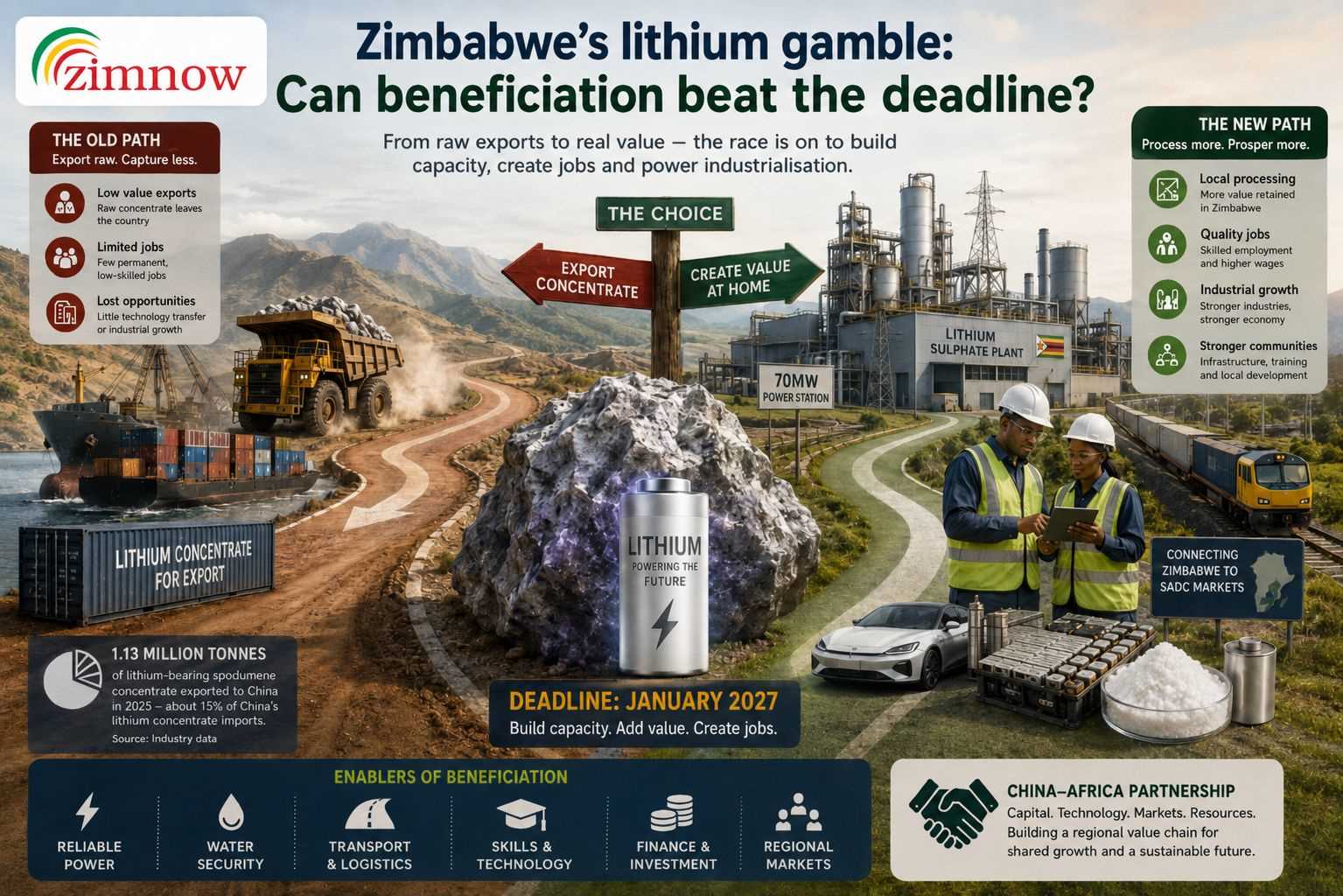
Zimbabwe wants lithium miners to stop exporting concentrate and process more locally by January 2027, as part of a broader push to capture more value from its strategic minerals.
But with most processing plants still under construction, questions remain over whether the deadline is realistic, how government can protect national interests without frightening investors, and what a successful China-Zimbabwe lithium partnership should look like beyond extraction.
Zim Now’s Monica Cheru spoke to Dr Zhou Jinyan, Associate Professor at the Shanghai Academy of Global Governance and Area Studies, Shanghai International Studies University, on Zimbabwe’s lithium beneficiation push, China-Africa industrial cooperation and Africa’s place in global battery mineral value chains.
Q: Zimbabwe wants lithium miners to stop exporting concentrate and process more locally by January 2027. From a China-Africa cooperation perspective, is this the right policy direction, and what risks come with the tight timeline?
Dr Zhou Jinyan: From a China-Africa cooperation perspective, the direction is fundamentally correct. Africa has long been confined to the role of raw material supplier. Zimbabwe’s push to create more value from lithium is a legitimate exercise of resource sovereignty. China’s commitment to “modernization partnerships” and “industrial capacity cooperation” with African countries supports this logic.
However, the risks accompanying the tight timeline (January 2027) should not be overlooked. First, a tight timeline may prove counterproductive. Among the seven major producers, only one has completed a lithium sulphate plant; the rest are either still under construction or at the feasibility study stage. If concentrate exports are abruptly banned before processing capacity is in place, mines would be forced to shut down and investment would flow out, which ultimately undermining the very beneficiation strategy. Second, frequent policy changes may weaken investor confidence. From the 2022 ban on raw ore exports, to the sudden acceleration of concentrate export restrictions in February 2026, to the 16% export tax and quota system, these policy impulses have come in rapid succession, leaving companies with little room to adapt.
Q: Chinese firms have invested about US$2 billion in Zimbabwe’s lithium sector since 2021. How should Zimbabwe balance the national interest in beneficiation with the need to maintain investor confidence?
Dr Zhou Jinyan: How to balance beneficiation objectives with maintaining investor confidence is truly the core challenge facing the Zimbabwean government.
In my view, the key lies in predictability and pragmatism. Zimbabwe’s Finance Minister Ncube has clearly stated that the 2027 deadline will be upheld, but has also opened a pathway for companies unable to build their own beneficiation plants, namely the “tolling agreement” route, whereby companies with completed production capacity process materials on behalf of others. This approach can achieve the goal of local beneficiation while avoiding the shutdown of small and medium-sized enterprises. This is a pragmatic measure that deserves recognition.
However, if handled improperly, the risks are clear. Unpredictable policies may drive investment toward other lithium-producing countries. A Chinese lawyer has pointed out that Zimbabwe's policy barriers have, to some extent, weakened its attractiveness to foreign investment, and may lead some international capital to shift toward more policy-stable lithium-producing nations such as Chile.
Q: Is an extension from January to June 2027 a reasonable compromise, or could it weaken the government’s beneficiation policy?
Dr Zhou Jinyan: Yes. Six months is a modest adjustment, not a fundamental concession. Given that most plants are still under construction, a half-year extension is more a cushion.
Q: Zimbabwe has introduced export quotas and a tax on lithium concentrate exports after earlier halting shipments over alleged mineral leakages. In your view, how can governments enforce mineral sovereignty without creating policy shock?

Dr Zhou Jinyan: Effective mineral governance requires predictability rather than abrupt intervention.
First, policies should be introduced with sufficient advance warning. The announcement of the 2027 deadline itself reflects this principle, but the policy reversals in between, such as the sudden acceleration in February 2026 have undermined the effectiveness of expectation management.
Second, the government needs to proactively provide compliance measures for transition, such as tolling agreement frameworks and transitional permits, so that enterprises have a viable path forward.
Third, the industry should be involved in monitoring and compliance design, not only noted.
Sudden export bans or abrupt policy shifts often lead to supply chain disruption, investor distrust and unintended reduction in downstream capacity investment.
Q: China often speaks about modernization partnerships and industrial capacity cooperation with Africa. What would a successful lithium partnership look like beyond extraction and export to China?
Dr Zhou Jinyan: Ideally, Chinese enterprises bring capital, technology, and market access, while African countries provide resources, land, and policy space. Together, both sides build a regional industrial chain spanning from mining and beneficiation to battery materials production. Huayou’s project has already begun to embody this model. it has not only completed a beneficiation plant but is also constructing a 70-megawatt power station and participating in community road development, with the proportion of local employees steadily increasing. This kind of deep embedding is far more sustainable than mere resource procurement.
Q: Many African countries want to move up global value chains, but processing requires power, water, transport, skills, finance and markets. For Zimbabwe’s lithium sector, what are the most urgent constraints, and what would be the next realistic step after lithium sulphate?
Related Stories
Dr Zhou Jinyan: Power is the most immediate and binding constraint. Lithium beneficiation is energy-intensive, and Zimbabwe’s grid is chronically unstable. Huayou built its power plant precisely for this reason. Without reliable electricity, no processing plant can operate at scale.
Skills are also critical. Operating a sulphate plant requires chemical engineers, metallurgists, and maintenance technicians.
To reach that stage, Zimbabwe needs to make several preparations.
First, develop local technical talent through partnerships with Chinese and other international firms.
Second, secure competitive and reliable power, which is non-negotiable for high-purity processing.
Third, integrate into regional value chain. Sharing infrastructure and markets with neighbours like South Africa, which has auto and battery assembly industries, could create demand for higher-value products.
Q: If Zimbabwe produces the projected 344,000 metric tonnes of lithium sulphate annually by 2030, what could that mean for the country’s industrialisation agenda?
Dr Zhou Jinyan: If achieved, this would represent a shift from raw material exporter to midstream industrial producer and potential anchoring of Zimbabwe in the global battery supply chain. It would also improve employment quality, because sulphate plants employ more skilled workers than mines, raising average wages and skill levels.
Q: Do you think Africa should approach battery minerals country by country, or through regional value chains involving mining, processing, power, transport and manufacturing across borders?
Dr Zhou Jinyan: A regional approach is more sustainable. Lithium value chains require cross-border power pooling, shared transport corridors as well as regional demand aggregation.
Therefore, Africa should consider regional industrial development, in which SADC and AU frameworks are particularly relevant.
Q: From the Global Governance Initiative perspective, does Zimbabwe’s lithium policy reflect a wider Global South demand for fairer participation in strategic mineral value chains?
Dr Zhou Jinyan: Absolutely. Zimbabwe's beneficiation push is part of a broader movement where resource-rich countries demand a fairer share of value addition. This is a historic correction to the colonial economic structure, which for too long confined resource-rich countries to the role of mere raw material suppliers, while the profits from processing and manufacturing flowed to the developed world.
By using policy levers to promote local beneficiation and processing, the Global South are essentially asserting their right to fair participation in strategic mineral value chains.
Q: What would be a fair outcome for Zimbabwe, Chinese investors and global battery markets? More tax revenue, jobs, technology transfer, local procurement, downstream industry, or all of these?
Dr Zhou Jinyan: For Zimbabwe, fair outcome means more tax revenue from higher-value exports, more skilled employment and technology transfer.
For Chinese investors, stable returns, long-term access and risk predictability are expected.
For global market, sustainable supply and price stability is important.
For communities, environment protection, employment and local development are the key issues.
The most important outcome is credible institutional capacity, a Zimbabwean regulatory system that can enforce standards, collect taxes, and negotiate with investors and industries.
Q: If you were advising both Zimbabwean policymakers and Chinese lithium investors, what practical three-point roadmap would you propose between now and June 2027 to make beneficiation real rather than just a deadline on paper?
Dr Zhou Jinyan: I would highlight three priorities.
First, Zimbabwe can adopt a phased beneficiation roadmap for the coming five years, so that industrial upgrading follows realistic construction and commissioning timelines rather than abrupt deadlines. This would give investors the predictability needed to commit capital to downstream expansions.
Second, there should be a joint implementation platform involving government, international investors, local industry and communities, to ensure that government policy goals, investment plans and community expectations are aligned and coordinated.
Third, a joint infrastructure compact should be strengthened, especially in energy, transport, and water. Beneficiation is not only a mining issue, but depends on whether the broader industrial foundation is in place.







Leave Comments