








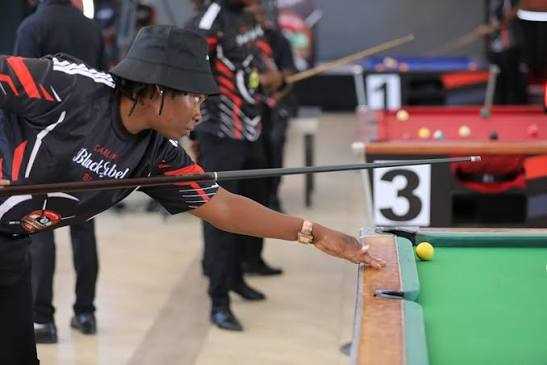
Walk into any Zimbabwean shopping centre, sports bar, or township recreation hub, and you'll find it: the quiet ritual of pool.
The chalking of cues, the measured steps around the table, the pause before the stroke—and the satisfying crack of balls scattering across green or maroon baize.
For decades, the person wielding that cue was regarded as something less than an athlete. Pool meant drinking holes, gambling, and youthful delinquency—not sporting discipline.
But that perception is collapsing. A quiet revolution has transformed Zimbabwe's pool tables from barroom corners into legitimate sporting arenas, and it's no longer possible to dismiss the sport as mere recreation while waiting for your next drink.
Academic research published in Sport in History in 2025 documents pool's metamorphosis from a recreational minority pastime into a competitive discipline with serious financial and livelihood implications.
The transformation accelerated from the 1990s onward, with dramatic growth in the 21st century. By 2011, Harare alone boasted 36 pool teams, while nine of Zimbabwe's ten provinces operated leagues. Zimbabwe made its All-Africa Pool Association Games debut in 2009, finishing seventh among 14 African teams.
Today, the sport commands a national structure: provincial competitions, elite tournaments, women's divisions, junior pathways, and international representation. It even has a national team nickname worthy of any major sporting code—the Fish Eagles.
More than 5,000 players participate in Zimbabwe's various pool leagues, though that figure barely captures the sport's true reach. Its greatest strength is accessibility. Football needs a field. Rugby demands specialised infrastructure. Cricket requires a pitch and considerable equipment. Pool needs a table, cues, balls, and modest space. That simplicity has enabled penetration across every layer of Zimbabwean society.
Historically, pool belonged largely to elite white social circles during colonial times and early independence. The late 1990s marked a turning point with leagues that increasingly opened the game to black Zimbabweans. The Harare Provincial Pool League—later the National Pool League of Zimbabwe—promoted eight-ball through organised competition and greater sporting recognition.
Cues travelled from exclusive clubs into townships, growth points, high-density suburbs, and roadside entertainment establishments. Once accessible, Zimbabweans did what they've always done with sport: they turned it into competition.
Then came the tournaments. Perhaps no competition has done more to bring pool into mainstream sporting conversation than the Carling Black Label National Pool Tournament, staged in partnership with the Zimbabwe Pool Association (ZIPA). Running for over a decade, its scale is significant. In 2024, regional competitions spanned 26 centres across all ten provinces before national finals in Harare. Sixty-four men and 64 women competed in the championship finals.
The financial rewards challenge the old perception that there's no money in pool. The 2024 champion received US$2,500 and a pool table, with US$1,500 for the runner-up, US$1,000 for third, and US$500 for fourth. These aren't token prizes—they're serious sporting incentives in an economy where young people search for alternative income sources.
Timothy Onida, the 2024 overall winner, captured the stakes: "I wanted this, and you know, coming from a marginalised area like Epworth, this means a lot. I told myself that I was going to win this for my community. The competition was fierce but fair. Winning means everything. It is not just about the money, it is equally about respect."
In 2026, the Carling Black Label championship expanded to 31 regions, with finals in Masvingo.
Bulawayo's Stephen Paswani won the men's title, defeating Mutare's Godknows "Sir Gode" Masona 5-0, while Chitungwiza's Alice Chihota successfully defended her women's crown by beating Diana Kabasa 5-2. Both champions received US$2,500 and a pool table.
Even more revealing was the gender story: at the 2026 finals, 45 women competed against 37 men—proof that pool's appeal is breaking through traditional gender barriers.
If Carling Black Label created a national platform, the National Elite Pool Players Association of Zimbabwe (NEPAZ) forged an elite competitive culture. NEPAZ tournaments have become calendar fixtures, attracting Zimbabwe's strongest players.
In August 2026, national champion Adriel "Dilele" Shamhu won a NEPAZ tournament after defeating Allan Cee 4-3 in the final. More than 200 elite players participated, with Shamhu collecting over US$1,200 in prize money. That's a long way from pool as a pastime for people with nothing better to do.
NEPAZ's reach extends beyond Harare. Its ninth edition was staged in Mutare in 2023, demonstrating growing appetite for high-level competition outside the capital. The next generation builds around formal administrative structure.
Related Stories
The Zimbabwe Pool Association, according to its constitution, serves as the national governing body, affiliated to the World Pool-Billiards Association (WPA) and All Africa Pool Association (AAPA). Its mandate: manage, develop, promote, and control pool throughout Zimbabwe while hosting regional and international competitions.
The structure goes far beyond traditional men's leagues. The constitution provides for a National Premier League, National Women's Pool League, National Junior Pool League, tertiary and schools leagues, provincial and district leagues, club competitions, and a National Heyball Association.
It places different cue-sport disciplines—blackball, eight-ball, nine-ball, ten-ball, heyball, and snooker—under one umbrella. That's a sporting ecosystem, not merely people playing in bars.
International recognition followed. In 2017, Zimbabwe hosted the All Africa Blackball Championships in Harare. Sanctioned by AAPA, the tournament brought continental competition to the City Sports Centre—a major milestone for a sport whose administration had previously endured considerable instability. The Sports and Recreation Commission hailed ZIPA's revival and its ability to stage an event of continental magnitude.
Zimbabwe's international ambitions now extend into newer cue-sport forms. In 2025, ZIPA approved heyball (Chinese eight-ball) rollout through a proposed National Heyball Association of Zimbabwe. Unlike conventional blackball on seven-foot tables, heyball uses nine-foot tables with distinct equipment and rules.
The diversification means Zimbabwean players are no longer confined to one interpretation. Blackball, eight-ball, nine-ball, ten-ball, heyball—the talent pool deepens accordingly.
The most persuasive argument for taking pool seriously isn't found in constitutions or trophies—it's in people's lives.
Research into Zimbabwean pool has documented players using tournament winnings to establish businesses around the sport. Tendai "Inspector" Mubaiwa, profiled in the study, won multiple NEPAZ titles, three Carling Black Label national championships, and a ZIPA national title.
His winnings helped him establish a pool arcade in Harare's central business district, generating income from tables, accessories, cues, clothing, and lessons.
This is the real revolution. The pool player is no longer merely a bar customer. He can be athlete, coach, referee, promoter, table owner, tournament organiser, equipment dealer, or entrepreneur. The table itself has become an economic asset.
The sport is confronting stereotypes head-on. Mubaiwa, now NEPAZ chairman, has spoken openly about dismantling pool's image as a pastime associated with drunkenness and vice. His 2026 agenda includes greater corporate sponsorship, improved player earnings, and a campaign against drugs and substance abuse.
"We need to attract major corporate sponsors if we are to take pool to the next level. There is a lot of talent in Zimbabwe, but talent alone is not enough. Players need proper support, better tournaments and opportunities to compete internationally," he said.
The very environment that once caused society to look down upon pool may explain its resilience. A pool table generates income for its owner. It provides community gathering points, creates competition, gives young people somewhere to spend their time, and offers talented players routes to prize money, travel, and international competition.
The sport, nevertheless, faces obstacles. Administration has historically been fragmented. Resources remain limited. Many venues lack professional standards. Players often finance their own travel and equipment. Sponsorship concentrates around a handful of competitions rather than distributing consistently throughout the ecosystem.
Perhaps the biggest challenge is psychological: changing how society thinks about pool. A talented pool player shouldn't have to explain why they're an athlete. The concentration required to execute a difficult shot, the preparation before tournaments, the pressure in deciding frames, the discipline demanded over long competitions—these exist across almost every recognised sport.
The difference is that pool has spent much of its history fighting for permission to be regarded as one.
Zimbabwe's pool revolution suggests permission is no longer required. The sport has built its own leagues, produced national champions, attracted corporate sponsorship, hosted continental championships, developed women's and junior structures, and created entrepreneurs.
Most importantly, it has built a following stretching from the smallest township recreation centre to national championship venues.
The green or maroon baize is no longer merely a surface for amusement. It's becoming a sporting arena. Perhaps the time has come for Zimbabwe to stop asking whether pool is a sport. The more pertinent question is why, despite everything it has already achieved, the country has taken so long to treat it like one.






Leave Comments