








By Jabulani Simplisio Chibaya
Twould charts from @dailyviz263, both sourced to the Reserve Bank of Zimbabwe’s National Payment Systems quarterly reports, look like they belong to different stories. The first shows loans to micro, small and medium enterprises (MSMEs) falling from 24,987 in 2022 to 7,826 in 2025, a 69% drop.
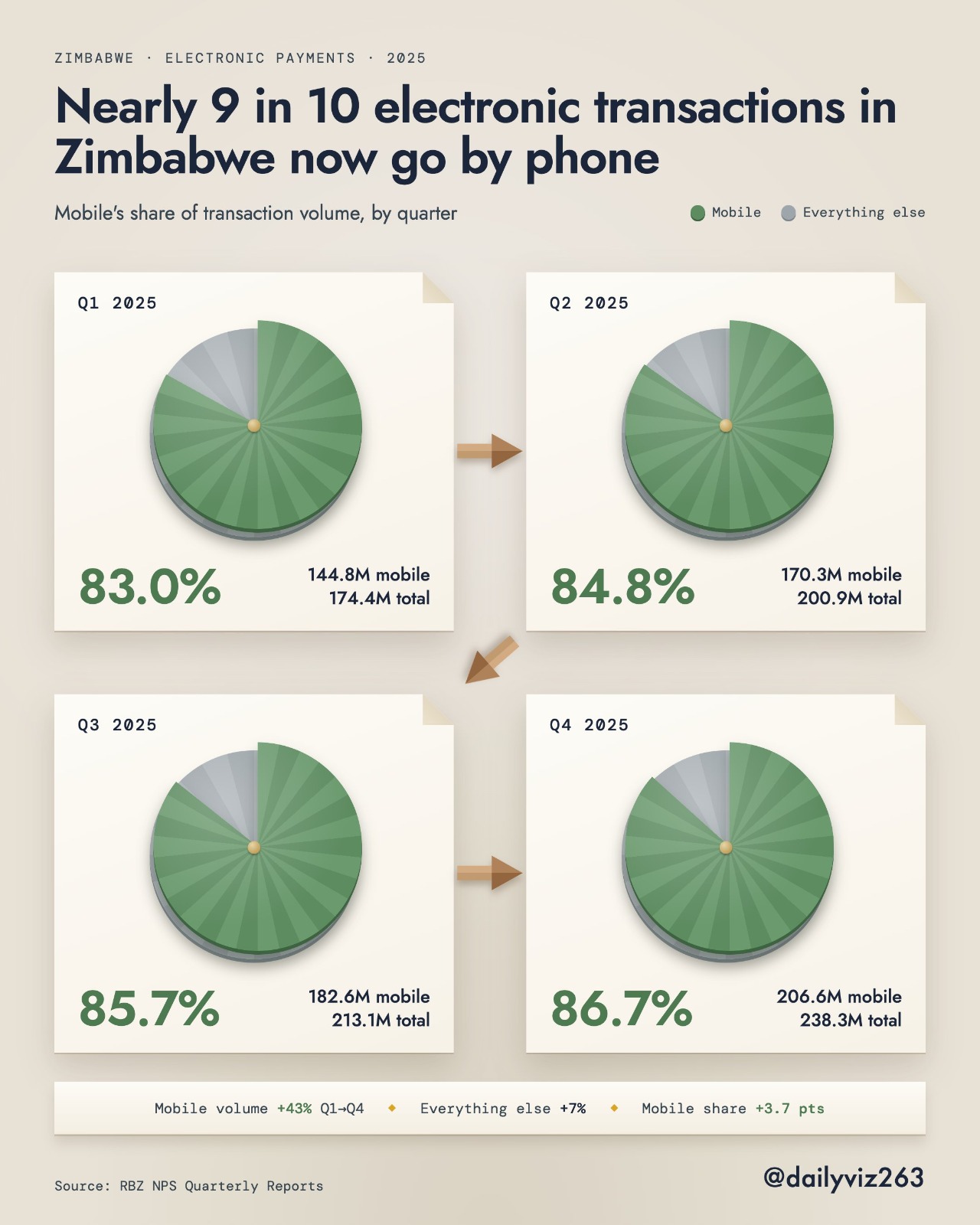
The second shows mobile’s share of electronic transaction volume rising every quarter of 2025, from 83.0% to 86.7%. Mobile volume grew 43% from Q1 to Q4, while everything else grew 7%.
One is a retreat and the other is a sprint. Read together, against the calmest prices Zimbabwe has had in decades, they tell a single story. The country has built excellent rails for moving small amounts of money but not yet the machinery for lending it. The opportunity and the danger both live in that gap.
What the numbers do and don’t say
I checked the arithmetic and the charts hold up. The loan series falls 67% in 2023, rebounds 44% in 2024 and falls 34% in 2025. The mobile shares match their underlying volumes. The Q1 total also reconciles with separate reporting: RTGS handled 2.57 million transactions and retail channels about 171.84 million that quarter, which sums to the chart’s 174.4 million.
The limits matter more. Both charts count things, not money. The loan chart counts loans, not borrowers or dollars lent. A count can fall while average loan size rises, and after several currency resets, a 2022 loan and a 2025 loan are not like-for-like. I couldn’t verify what the underlying series includes. So “-69%” is a warning light, not a verdict, and the chart’s headline wisely ends in a question mark.
Stability that is real, and narrow
The macro backdrop is genuinely good. ZiG annual inflation eased to 2.9% in August 2026, from 93.8% a year earlier, and US dollar inflation is 3.1%. The exchange rate has stayed in a narrow band around ZiG25–27 to the dollar this year, and reserves reached US$1.7 billion. The mid-term budget review puts 2025 growth at 8.3% and 2026 at 5%. In June, the RBZ cut its policy rate from 30% to 27.5%.
But look at what that stability is made of and who it serves. A 30% policy rate against inflation under 3% is a real rate in the high twenties. The RBZ itself says some banks haven’t cut lending rates enough, leaving productive sectors priced out of formal credit. Stability has reached savers and importers faster than borrowers.
That is how a calm year can coexist with a collapsing loan count: inflation was never the only obstacle to small-business credit. Price and risk assessment are the others.
Nor is stability yet confidence in the local currency. About 80% of the economy operates in US dollars, and the RBZ lists 24 consecutive months of single-digit inflation among the conditions for moving to ZiG-only. The first single-digit reading came in January 2026, so that clock can’t run out before the end of 2027.
History also counsels humility, since past gains have reversed through fiscal slippage, liquidity growth and exchange-rate instability.

What sits beneath the headlines
- Volume is not value. In Q1 2025, local-currency RTGS processed ZiG310.19 billion of ZiG532.61 billion in total value, with retail channels at ZiG222.42 billion. By count, RTGS was about 1.5% of transactions, but by value it was about 58%. So “nearly 9 in 10 transactions go by phone” does not mean nine in ten dollars do. Mobile is the rail of the small-ticket economy: airtime, groceries, transport, a remittance split three ways. Celebrate the reach, but don’t mistake it for depth.
- Mobile’s dominance is partly a symptom. Many Zimbabweans use wallets because cash was scarce, branches are few and trust in bank-held local currency was repeatedly broken. Adoption by necessity is sticky, which is good news. It also describes an economy of thin margins and small, frequent payments. That is my reading, not something the charts prove.
- Growth and credit have decoupled. If the economy grew 8.3% in 2025 while the MSME loan count fell 34%, growth came from somewhere other than small borrowers. Candidates are capital-intensive mining and agriculture, self-financed firms, and informal credit such as supplier terms, savings groups and family. This is one reading worth testing, because growth without small-business credit struggles to spread.
- The data paradox. In Q4 2025 alone, 206.6 million mobile transactions were recorded. That is a continuous, time-stamped record of who sells to whom, how often and in what amounts. Meanwhile lenders say small businesses are hard to assess. The market is short of credit and long on the data credit decisions need. That mismatch is the most interesting thing across the two charts.
- Stability has a price tag. Tight money is how the currency was steadied, and right now the bill falls disproportionately on people who need to borrow.
AI: strategy ahead of adoption
Zimbabwe has a plan. The National AI Strategy 2026–2030 was launched on 13 March 2026. It rests on six pillars, spanning talent, computing infrastructure, adoption, governance and international collaboration. It promises an implementation office, a regulatory sandbox and a National AI and Data Platform, and the President said government will incentivise businesses that use AI.
Related Stories
Now the reality. More than half of Zimbabweans (58.4%) weren’t using the internet in 2024, according to ITU data. Commentators flag expensive data and fiscal constraints, and CIPESA argues that the strategy falls short of UNESCO guidance on ethics and privacy. I couldn’t find reliable firm-level AI adoption figures for Zimbabwe, and I’d distrust any confident number.
What is observable is that digital life already runs through the phone. AI that works here will likely arrive through the same channels as that 86.7%: wallets, USSD and chat interfaces, not desktop dashboards. The meaningful trend isn’t “AI adoption” in the abstract. It is AI quietly lowering the cost of decisions inside businesses that already generate phone-native data.
Where innovators should look, and what to pick
The pick: build in the gap between the two charts. If I had to choose one thing, it would be cash-flow-based credit intelligence for MSMEs, sold to lenders rather than to the small businesses themselves. The customers are banks, microfinance institutions, development funders and mobile operators. You use consented transaction data to underwrite, price, monitor and collect on small loans. AI does what it is genuinely good at: reading messy records, scoring risk, flagging fraud and drafting follow-ups.
What policymakers can do
Make rate cuts bite. The RBZ is already pressing banks. Publishing bank-level lending-rate comparisons and backing partial credit guarantees for small loans would turn pressure into pass-through.
Open the data, with consent. Build safe, standardised data-sharing between mobile money operators, banks and credit bureaus. Publish MSME credit by value, borrower count, sector and default rate. The next chart should be able to answer the question the first one raises.
Make the sandbox a real sandbox. Time-bound, fast, with clear licensing paths for fintech and AI, so it isn’t just an announcement.
Attack the cost of being online. Data prices and rural coverage decide who benefits from the AI strategy. Without progress there, it serves the already-connected.
Protect the stability. The warnings are consistent: any return to deficit monetisation would reignite inflation and undermine confidence in the ZiG. Stability is the asset everything else depends on.
The road ahead: a reality check
Hold three things at once. The stability is real, and it is the first genuine foundation for planning in a generation. The credit drought is real, whatever the exact size of the decline.
The mobile rails are real, and they are among the most valuable assets the economy has built. None of these yet adds up to broad-based prosperity, because stable prices are necessary for lending but not sufficient.
The next fifteen months or so, until the 24-month single-digit test can be met, are the proving ground. The risks are familiar: fiscal slippage, a return to currency stress, AI hype outrunning connectivity, and a strategy that is well-written but under-funded.
Data note: the chart figures come from RBZ NPS quarterly reports as presented by @dailyviz263. Macro figures are the latest reported through August 2026. Interpretations flagged as readings are mine, not established findings.
Jabulani Simplisio Chibaya is a Data and AI Consultant specializing in data science, artificial intelligence, blockchain, and cryptocurrency innovation.







Leave Comments