
Hippo Valley Profit Jumps 79% to US$24.1m
Hippo Valley Estates Limited’s net profit rose 79% to US$24.1 million in the year ended March 31, 2026.
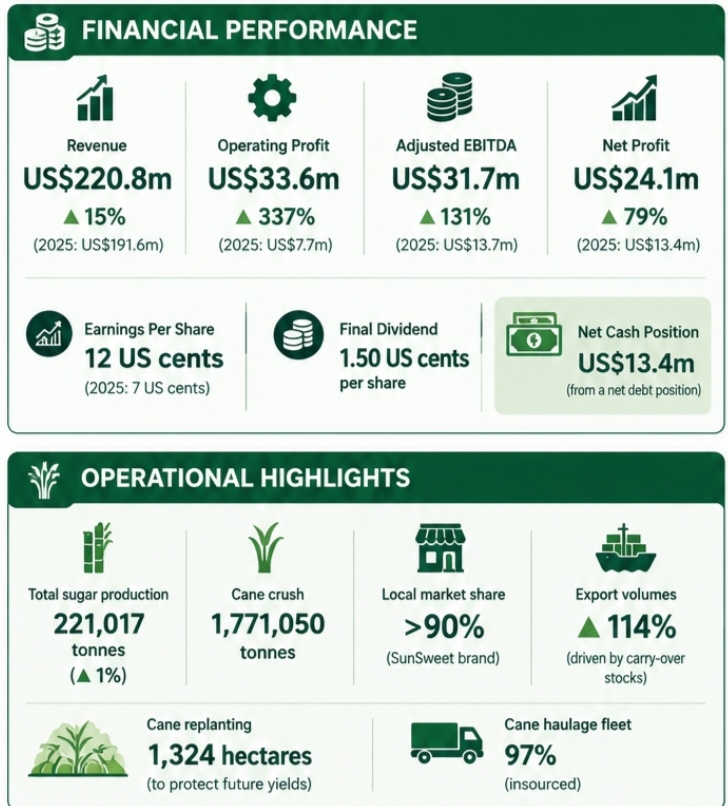
Hippo Valley Estates Limited’s net profit rose 79% to US$24.1 million in the year ended March 31, 2026, as stronger local demand and increased export volumes supported the sugar producer’s financial performance.
Revenue increased 15% to US$220.8 million, up from US$191.6 million in the previous financial year, while operating profit surged 337% to US$33.6 million from US$7.7 million.
The company’s adjusted earnings before interest, tax, depreciation and amortisation grew 131% to US$31.7 million, while net cash generated from operations rose to US$29.7 million from US$8.7 million.
The performance, outlined in the company’s 2026 integrated report, came as Hippo Valley celebrated its 70th anniversary under the theme “Tadzika Midzi”, meaning “Deeply Rooted”.
The board declared a final dividend of 1.50 US cents per share, following the improvement in earnings and the company’s transition to a net cash position.
Hippo Valley attributed its performance partly to strong local market demand and the sale of stocks carried over from the previous year.
Total sugar production increased by 1% to 221,017 tonnes, following the processing of 1.77 million tonnes of sugar cane.
The company maintained a local market share of more than 90% for its SunSweet brand, which it said was supported by regulatory measures against smuggled sugar imports.
Export volumes increased by 114%, largely due to the release of surplus stocks from the previous year.
However, the company continues to face pressure from high cane production costs, particularly the cost of sugar cane purchased from private farmers.
The report puts the cost of private farmer cane under the Cane Purchase Agreement at US$71 per tonne. A pending court case over the Division of Proceeds ratio also remains a concern, with the company recognising a contingent liability provision of US$2.7 million.
Hippo Valley is pursuing cost-containment measures under Project Zambuko, which focuses on reducing expenses and improving revenue.
In agriculture, the company replanted 1,324 hectares of sugar cane to support future production and reported a cane yield of 94.79 tonnes per hectare, down from 95.40 tonnes in the previous year.
The company also highlighted climate risks, including the possibility of an El Niño weather pattern, although it said current water levels in major supplying dams were sufficient to provide cover for at least three seasons.
Technology is also becoming part of its operational strategy, with the company adopting drone technology, artificial intelligence-driven data management and solar energy to improve irrigation and reduce costs.
On sustainability, Hippo Valley reported a 44% reduction in greenhouse gas emissions to 26,900 tonnes of carbon dioxide equivalent, largely driven by a 77% reduction in coal use.
The company generated 54,569 megawatt-hours of electricity from bagasse, a by-product of sugar cane processing, and exported 14,134 megawatt-hours of surplus electricity to the national grid.
It also distributed more than 191,000 kilogrammes of liquefied petroleum gas to employees to discourage firewood use and reduce pressure on local biodiversity.
Management said it remained focused on increasing SunSweet production to meet local demand while expanding into regional export markets.

About Audrey Galawu
Assistant Editor