
US$3.1bn Debt Penalties Tower Over Health Budget
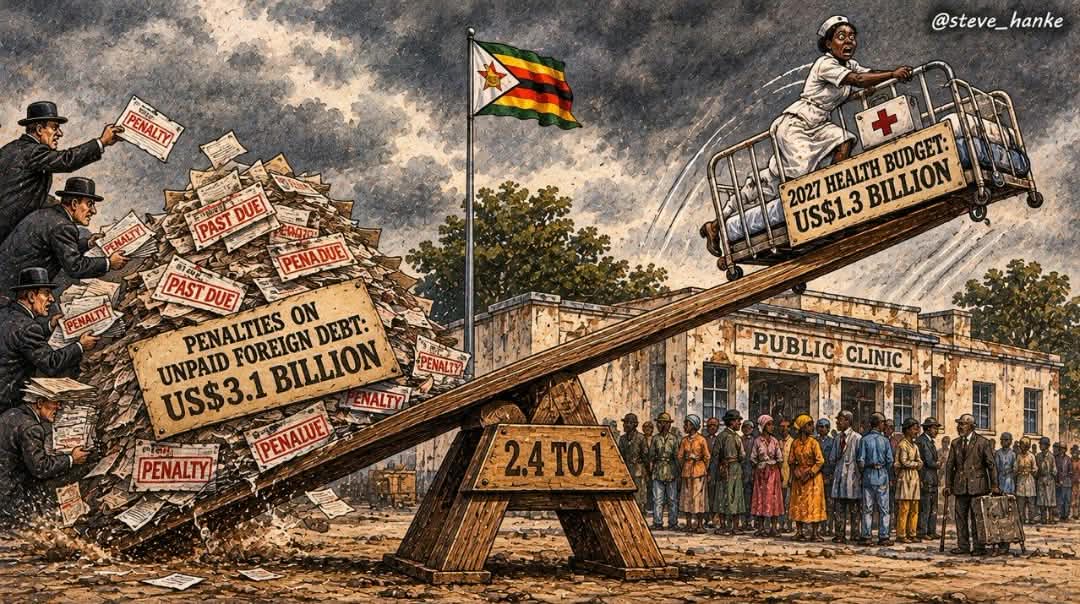
Zimbabwe's accumulated penalties on unpaid foreign debts have reached US$3.089 billion, more than twice the resources allocated to the health sector in the 2027 National Budget, highlighting the growing fiscal cost of the country's prolonged debt crisis.
The figures, contained in Treasury's 2027 Budget Statement, lend weight to American economist Steve Hanke's warning that Zimbabwe's failure to settle its foreign obligations is attracting substantial financial penalties, even as Government struggles to finance essential public services.
“ZimbabweWatch: Zimbabwe owes US$3.1 BILLION in PENALTIES alone on its unpaid foreign debts. That's 2.4x its entire 2027 health budget,” Hanke said.
Treasury's debt statistics show that, as at September 30, 2026, Zimbabwe's total public and publicly guaranteed debt stood at US$22.172 billion, comprising US$12.359 billion in external debt and US$9.813 billion in domestic obligations.
Of particular concern is the US$9.025 billion in external arrears and penalties, comprising US$3.888 billion in unpaid principal, US$2.048 billion in interest arrears and US$3.089 billion in penalties.
The Paris Club, a grouping of official bilateral creditors, accounts for US$2.721 billion of the penalties, while other bilateral creditors account for US$117 million. Multilateral creditors account for another US$251 million, largely attributable to the European Investment Bank.
The penalties alone are approximately 2.4 times the ZiG34.2 billion allocated to the health sector in the detailed 2027 Budget Statement, using Treasury's September exchange rate of ZiG26.7965 to the US dollar.
The comparison comes at a time when Government is seeking to expand healthcare infrastructure, improve access to medicines and strengthen hospital services, with the health allocation expected to cover employment costs, medical consumables, equipment and infrastructure development.
The debt burden also competes with other spending priorities through direct debt-servicing obligations. Treasury says Government will make debt-service payments amounting to ZiG31.2 billion in 2027, comprising ZiG22.3 billion in principal repayments and ZiG8.9 billion in interest.
During the first nine months of 2026, Government had already settled US$242.1 million in external debt-service payments, comprising US$226.2 million for its active debt portfolio, US$6.6 million for legacy debts and US$9.3 million in token payments to creditors.
The pressure is also reflected in how Government is using additional revenue collections.
Treasury projects revenue collections of US$11.6 billion in 2026, above the original budget target, with the additional resources expected to support debt servicing, arrears payments and the accumulation of financial buffers.
“The revenue windfall will go towards servicing some of the arrears to service providers, debt servicing and accumulation of buffers as contingency against the potential impact of the anticipated El-Nino induced drought during the 2026/27 agriculture season,” the Budget Statement says.
The Government's debt position has also complicated efforts to restore access to international development financing, with Zimbabwe effectively locked out of new lending from major multilateral institutions while outstanding obligations remain unsettled.
In a separate development highlighting the urgency of the process, Finance Minister Mthuli Ncube has approached multilateral lenders seeking financial assistance to clear arrears owed to the World Bank, African Development Bank and European Investment Bank.
In a November 10 letter to World Bank Managing Director of Operations Anna Bjerde, Ncube said Government remained committed to ending Zimbabwe's 26-year exclusion from international development financing.
“The people of Zimbabwe have been shut out of development financing for 26 years, and the Government is resolute in its goal of clearing its arrears to IFIs by end-March 2027, even in the event that full concessional financing is not available,” he said.
Government is pursuing grants and concessional financing as its preferred options, while retaining commercial borrowing as an alternative should sufficient affordable resources not be secured.
The Ministry of Finance has also indicated that grants and long-term concessional financing offer the most sustainable route, backed by continued reforms, transparency and responsible borrowing.
The stakes are significant because clearing the arrears would help restore access to development financing facilities that could support infrastructure, energy and other strategic projects, reducing reliance on domestic resources to finance major investments.
However, the scale of the obligations illustrates how much of the country's financial capacity remains tied to resolving past borrowing commitments.
While Treasury maintains that fiscal discipline and improved revenue mobilisation have helped stabilise public finances, the accumulation of US$3.089 billion in penalties and US$11.124 billion in total external arrears and penalties highlights the extent of the debt challenge beyond the headline debt-to-GDP ratio.

About Oscar Jeke - Reporter
Staff Writer