
Zimbabwe’s Growth Story Under Scrutiny as IMF Flags Mounting Fiscal Pressures
Zimbabwe's economic growth story is facing renewed scrutiny as mounting government obligations, under-executed social spending and costly gold-sector incentives expose the fiscal pressures beneath an otherwise resilient economic performance.
Lethukuthula Kozah has questioned the cost of the country's economic growth, drawing attention to the growing disparity between government spending commitments, payments to businesses and the resources being channelled into economic incentives.
“Zimbabwe’s economy is growing, but at what cost?” Kozah asked.
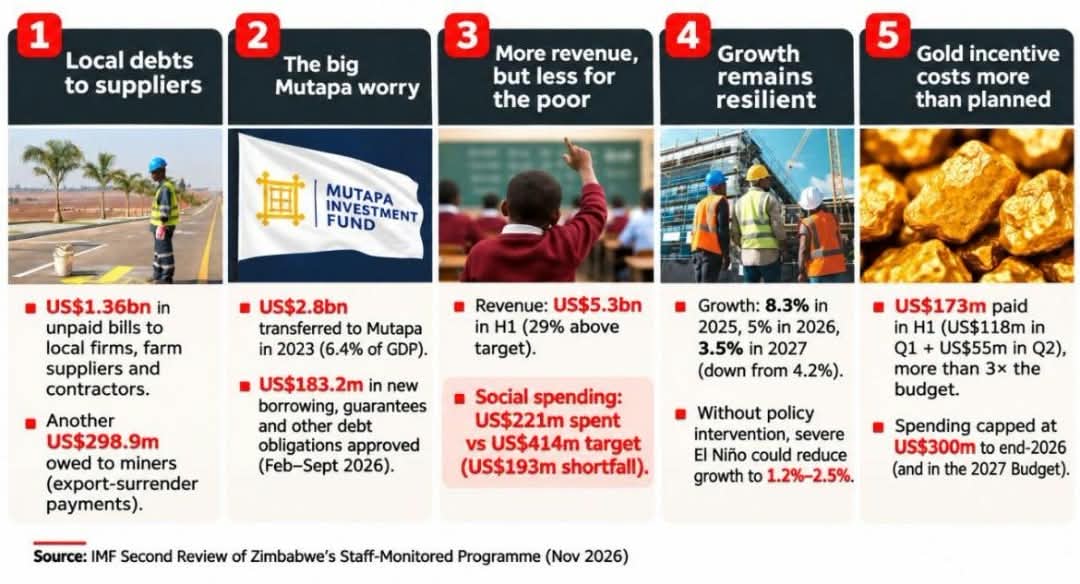
He pointed to US$1.36 billion owed to local suppliers, US$298.9 million owed to miners, a substantial shortfall in social spending and gold incentives costing more than three times their budgeted allocation.
His concerns find support in figures contained in the International Monetary Fund's latest review of Zimbabwe's Staff-Monitored Programme, which presents a complicated picture of stronger revenue collection alongside significant weaknesses in expenditure management.
The IMF acknowledged that Zimbabwe's economy remained resilient during the first half of 2026, with revenue collections exceeding expectations and the country's primary fiscal balance performing better than programmed. However, the Fund also raised concerns about the accumulation of domestic arrears, implementation bottlenecks affecting social programmes and the need for stronger oversight of public finances.
Government collected US$5.3 billion in revenue during the first half of 2026, 29 percent above target, but the stronger performance has not prevented the accumulation of substantial unpaid obligations.
According to the figures highlighted in the IMF review, US$1.36 billion was owed to local firms, agricultural suppliers and contractors, while another US$298.9 million was owed to miners through outstanding export-surrender payments.
The arrears raise questions about the effectiveness of public expenditure management, particularly the extent to which government commitments are being translated into actual payments to businesses supplying goods and services.
For local contractors and suppliers, delayed payments can create working-capital constraints, disrupt operations and limit their capacity to undertake new projects, potentially transferring government's liquidity pressures into the wider private sector.
The IMF has warned that stronger revenue collection must be accompanied by better expenditure controls and cash planning, recommending measures to improve budget credibility and prevent the accumulation of new arrears.
It called for authorities to strengthen public financial management and transparent liability-management operations to “translate favorable revenue performance into durable fiscal gains”.
The concern is particularly significant because the government is collecting more than anticipated but continues to face difficulties meeting some of its existing financial commitments.
Social expenditure presents another contradiction in the country's fiscal performance. The IMF figures show that US$221 million was spent on protected social and priority programmes against a target of US$414 million, leaving a US$193 million shortfall.
The spending covers programmes intended to support vulnerable households and essential services, including education, healthcare, food assistance and social protection.
In its October 7 announcement approving completion of Zimbabwe's second review under the Staff-Monitored Programme, the IMF said “persistent implementation bottlenecks affected key programs” and resulted in the country missing its protected social and priority spending target. The Fund further stressed that “timely execution of protected social and priority spending is essential”, highlighting the importance of ensuring that macroeconomic stabilisation translates into tangible benefits for vulnerable groups.
The under-expenditure is particularly significant against the background of government commitments to protect social spending. In the programme commitments presented to the IMF, authorities stated that “Social and priority spending will be protected”, with a planned US$592 million allocation for social programmes anchored on the Zimbabwe Social Registry.
The gap between that commitment and actual expenditure raises questions about budget execution and whether allocations are reaching intended beneficiaries within the financial year.
Meanwhile, the country's gold incentive programme has emerged as another point of scrutiny.
According to the IMF figures, government paid US$173 million in gold incentives during the first half of 2026, comprising US$118 million in the first quarter and US$55 million in the second quarter.
The amount was more than three times the budgeted allocation, with expenditure subsequently capped at US$300 million through to the end of 2026, a ceiling also reflected in the 2027 Budget.
Gold incentives are intended to support production and formal deliveries, but their fiscal cost raises questions about their effectiveness, sustainability and value for money.
The challenge for policymakers is to demonstrate whether the incentives are generating sufficient additional production, foreign currency receipts and broader economic benefits to justify the public resources committed to them.
The IMF had already urged authorities to assess the continued relevance of gold delivery incentives in the 2027 National Budget and contain payments to limit fiscal risks.
The management of the Mutapa Investment Fund also features among the concerns highlighted in the IMF review material.
The figures show that US$2.8 billion in assets was transferred to Mutapa in 2023, equivalent to 6.4 percent of GDP, while US$183.2 million in new borrowing, guarantees and other debt obligations was approved between February and September 2026.
Although asset transfers and borrowing obligations are different categories, the figures underline the importance of transparency and accountability in managing state-owned assets and associated financial risks.
The IMF called for continued adherence to borrowing controls for Mutapa and its subsidiaries, alongside the publication of audited financial statements for state-owned enterprises.
It also emphasised the need to “systematically monitor and disclose SOE financial health” to limit the accumulation of direct and contingent liabilities.
Economic growth, meanwhile, remains positive but is expected to moderate. Zimbabwe recorded growth of 8.3 percent in 2025, with the IMF projecting expansion of 5 percent in 2026 before slowing to 3.5 percent in 2027, down from an earlier projection of 4.2 percent. The Fund warned that a severe El Niño-related drought could further reduce growth to between 1.2 and 2.5 percent without appropriate policy intervention.
It cautioned that risks to the outlook remained tilted to the downside, particularly from a more severe drought and renewed commodity and energy price pressures.
The IMF recommended that stronger-than-expected revenue be used to build fiscal buffers against potential food-security and energy-related pressures, while urging authorities to anchor the 2027 Budget in prudent revenue and financing assumptions.

About Oscar Jeke - Reporter
Staff Writer