









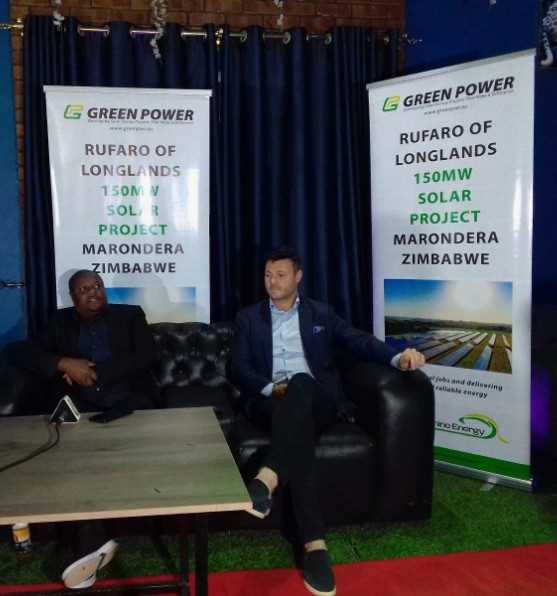
The proposed 150 megawatt Marondera Solar Project has received a major financial impetus following the signing of a strategic partnership between local energy firm De-Green Rhino Energy and United Kingdom-based renewable developer Green Power.
Under the agreement, Green Power will inject US$160 million into the development, which is expected to feed clean electricity into the national grid with the Zimbabwe Electricity Transmission and Distribution Company as the off-taker.
Located at Rufaro Farm in Marondera on land allocated by the Ministry of Lands, Agriculture, Fisheries, Water and Rural Development, the solar plant is expected to be a cornerstone of Zimbabwe’s escalating renewable energy rollout. Civil works are slated to begin in the first quarter of next year, with commissioning targeted for 2027.
“We are excited to be part of this transformative project, which will benefit more than 250 000 households in Marondera and surrounding areas. This investment will deliver clean, affordable energy to schools, hospitals, and local industries, reinforcing Zimbabwe’s growing appeal to international investors,” said Green Power CEO Jordan Assassa.
De-Green Rhino Energy Director Francis Gogwe highlighted the broader economic impact, noting that the project will inject momentum into the Mashonaland East provincial economy and create hundreds of jobs, particularly during construction.
The initiative aligns with the Zimbabwean government’s National Development Strategy 2, which prioritises universal access to reliable, affordable and sustainable energy by 2030 and actively promotes renewable energy, public-private partnerships, and Independent Power Producer participation.
Related Stories
Under this policy framework, ZETDC will act as an off-taker of last resort for excess power, supported by cost-reflective tariffs designed to enhance investor confidence and financial viability.
Zimbabwe’s electricity sector has historically struggled to keep pace with rising demand. While recent domestic generation has increased significantly, a structural deficit remains:
The country’s average daily generation in 2025 reached approximately 1 537 MW, up from about 866 MW in 2024, reflecting a substantial year-on-year increase driven by improved performance at major stations and expanded IPP contributions.
Despite this growth, peak national demand is estimated to be around 2 200 MW, leaving a persistent shortfall of roughly 600-800 MW that continues to exacerbate power outages and load shedding.
Independent analyses and parliamentary reports have suggested that installed capacity (the theoretical maximum) is even higher, but actual generation rarely approaches its full potential, due to infrastructure constraints, ageing equipment, and water shortages at hydropower facilities.
This gap between supply and demand has profound implications for households and businesses alike. Frequent power disruptions have forced many firms to rely on expensive diesel generators or captive power plants, raising operational costs and undermining competitiveness, especially in energy-intensive sectors such as mining and manufacturing.
Government statistics and independent observers also note that electricity access remains uneven, with rural electrification significantly lagging behind urban rates.








Leave Comments