







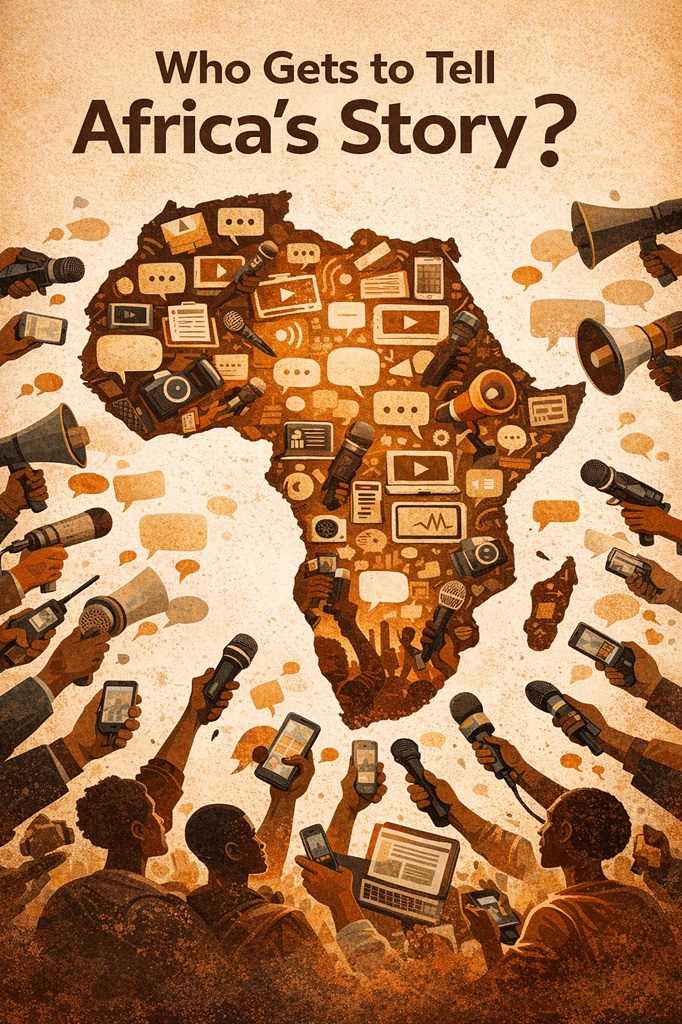
Late in December 2025, a China-Africa media dialogue explore the question: Who gets to tell Africa’s story and, on whose terms, confronting the story of Africa largely appearing in global headlines through moments of crisis like war, poverty, disease, coups
The frank discussion forum moderated by Song Wei and hosted by the Global Times brought together scholars and media practitioners to examine how narratives about Africa are formed, circulated, and legitimized globally.
Participants who included Monica Cheru Mpambawashe, founder of Zim Now, Allawi Ssemanda, founder of the Sino-Uganda Research Centre and Goitom Tatek Bisrat, a member of the Office of the President, special assistant on Diplomatic and International Relations of Ethiopia, challenged the long-standing dominance of Western media frameworks that often reduce Africa to a single storyline. Speakers argued that while Africa is constantly reported on, it is too often spoken about rather than heard.
This imbalance, the forum noted, does not merely distort perception. It influences policy choices, investor confidence, and how African societies are understood beyond their borders.
Moderating the session, Professor Song guided discussion toward practical cooperation, asking how African and Chinese media, academics, and creators can move from one-way storytelling to co-produced, plural narratives that reflect lived realities across the continent.
A key takeaway from the summit was that storytelling is a strategic domain, alongside trade, infrastructure, and technology.
With 2026 designated the Year of China-Africa People-to-People Exchanges, participants highlighted media, culture, and youth-driven digital platforms as central to reshaping how Africa is understood globally.
Related Stories
Short-form video, podcasts, independent digital outlets, and social media were identified as spaces where Africans are already reclaiming narrative agency, often faster and more authentically than traditional international media structures.
The forum emphasized a shift away from the idea of a single “Africa story” toward many African stories, told by Africans themselves, journalists, artists, entrepreneurs, scholars, and everyday citizens with agency, not within externally set scripts.
Rather than replacing one dominant narrative with another, speakers called for plurality, contradiction, and honesty, including space for failure, debate, and complexity.
That continental conversation resonates sharply in countries like Zimbabwe, where local media organizations struggle to survive even as Zimbabwe’s story circulates widely across global platforms.
Read forum transcripts here: https://www.globaltimes.cn/page/202512/1351908.shtml
The China-Africa dialogue offered solutions that surfaced a reality increasingly difficult to ignore: Africa’s struggle for narrative agency is inseparable from the survival, adaptation, and renewal of African media itself.
As global power dynamics shift, the ability of African societies to tell their own stories in all their complexity is as crucial as any economic or political alliance.






Leave Comments