






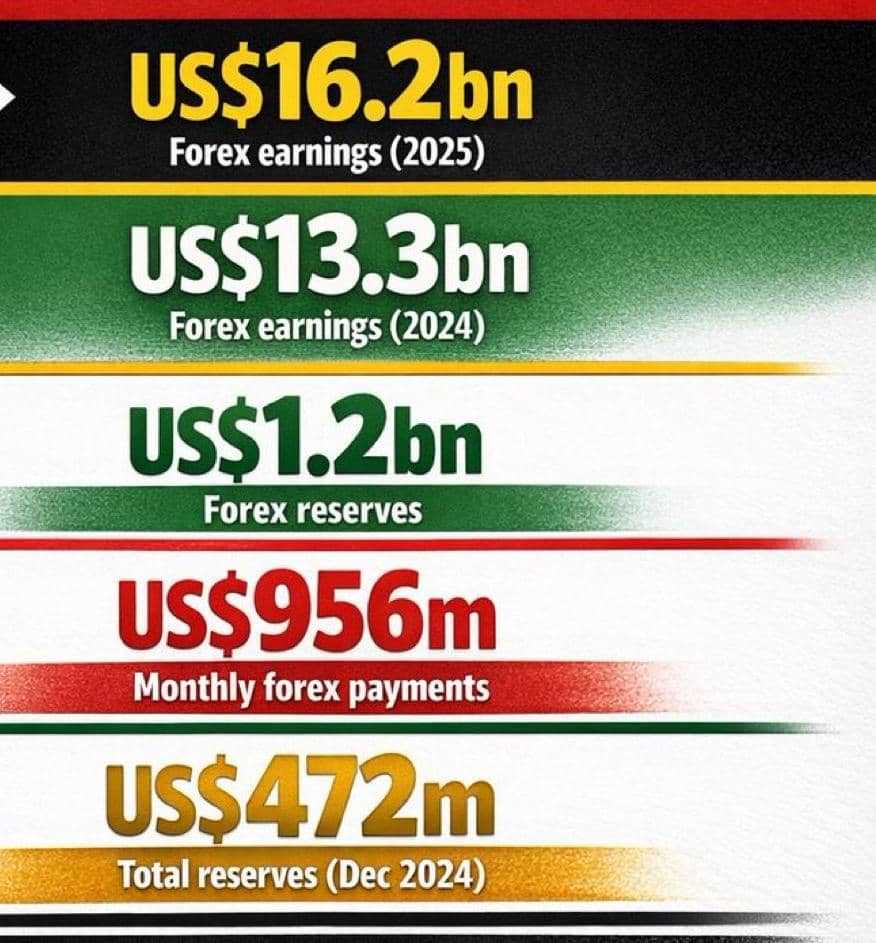
Zimbabwe’s foreign currency reserves climbed to US$1.2 billion by end-December 2025, marking a significant credibility gain for monetary authorities. However, the buffer still provides just 1.5 months of import cover, underscoring the fragility of the country’s macroeconomic stability.
In its Quarterly Snapshot on Monetary and Financial Conditions, the Reserve Bank of Zimbabwe said tight monetary controls implemented in 2025 helped rein in inflation, stabilise the exchange rate and restore confidence in the financial sector. The central bank argues that these outcomes reflect a decisive break from past policy indiscipline that fuelled currency collapse and hyperinflationary pressures.
“Monetary policy during 2025 demonstrated clear effectiveness, restored discipline and measurable macroeconomic gains, particularly in inflation control and exchange rate stability,” RBZ Governor John Mushayavanhu said in the report.
Inflation data point to one of the strongest disinflation episodes Zimbabwe has recorded in years. ZiG annual inflation slowed to 15% by end-2025, half the central bank’s 30% target, while month-on-month inflation averaged just 0.4% between February and December, suggesting relative price stability after prolonged volatility.
Currency stability also improved. The interbank exchange rate hovered around ZiG26 to the US dollar, while the parallel market premium was kept below 20% for most of the year, a notable compression in a market historically associated with sharp distortions and speculative behaviour.
However, the gains rest heavily on policy restraint rather than deep structural reform. While ZiG currency in circulation rose to ZiG5.31 billion, and domestic usage increased to an estimated 30–40% of national payment transactions, the economy remains partially dollarised, reflecting lingering confidence gaps.
Related Stories
On the monetary front, the RBZ maintained a 35% policy rate, with minimum deposit rates of 7.5% for time deposits and 5% for savings, reinforcing tight liquidity conditions.
Crucially, the Bank reported zero lending to Government, a long-standing trigger of monetary instability.
“Zero central bank financing of Government expenditure,” the RBZ said, was a cornerstone of renewed fiscal and monetary discipline.
Externally, Zimbabwe recorded US$16.2 billion in foreign currency receipts in 2025 and a projected current account surplus exceeding US$1 billion, supported by improved trade performance and sustained inflows.
The RBZ said foreign reserves now back ZiG reserve money by nearly six times, strengthening confidence in the local currency.
Still, the reserve position remains below internationally accepted comfort thresholds, where three to six months of import cover is generally considered adequate for external resilience. This gap tempers optimism around the RBZ’s assertion that conditions are gradually aligning for a future mono-currency regime.
While the central bank maintains that progress has been made through “macroeconomic stability, reserve accumulation, exchange rate stability, increased ZiG usage, payment system efficiency and strong fiscal-monetary policy coordination,” it concedes that sustainability in 2026 hinges on continued discipline.




Leave Comments