









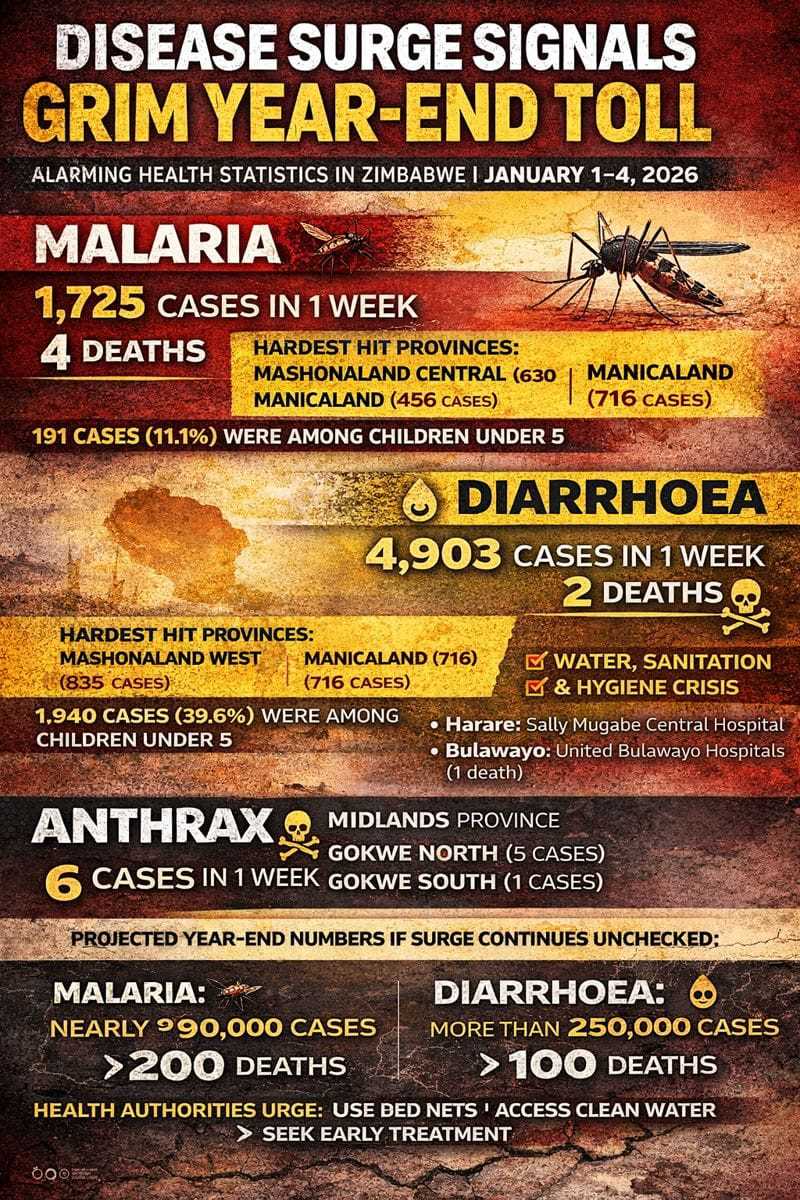
Zimbabwe’s disease surveillance figures from the first week of January are already painting a troubling picture of what 2026 could bring if current trends persist, with malaria and diarrhoeal diseases emerging as the country’s most immediate public health threats.
According to the Ministry of Health and Child Care, 1,725 malaria cases and four deaths were recorded during the week ending January 4, 2026. During the same period, 4,903 cases of common diarrhoea were reported, resulting in two deaths.
The scale of infections so early in the year has alarmed health officials, particularly as the rainy season enters its peak, a period historically associated with spikes in waterborne and mosquito-borne diseases.
Mashonaland Central and Manicaland provinces recorded the highest malaria burden, with 630 and 456 cases respectively. Children under the age of five accounted for 191 cases, representing 11.1 percent of infections, reinforcing concerns about the continued vulnerability of young children.
Malaria-related deaths were reported in Mount Darwin, Makonde, Parirenyatwa Group of Hospitals and Chitungwiza Central Hospital, highlighting the reach of the disease across both rural and urban settings.
Diarrhoeal diseases remain even more widespread. Of the 4,903 reported cases, 1,940 involved children under five, accounting for 39.6 percent of infections. Mashonaland West recorded the highest number of cases at 835, followed by Manicaland with 716.
Fatalities linked to diarrhoeal illness were recorded at Sally Mugabe Central Hospital in Harare and United Bulawayo Hospitals, underscoring the continued strain on major referral institutions.
Health and Child Care Minister Dr Douglas Mombeshora said the early figures were a clear warning sign requiring urgent, coordinated action.
“These numbers, coming at the very start of the year, are a clear warning,” Dr Mombeshora said. “If preventive measures are not strengthened now, we risk seeing avoidable illness and deaths escalate as the rainy season progresses.”
Related Stories
Permanent Secretary Mr Aspect Maunganidze said disease surveillance data often offers an early indication of how the year is likely to unfold.
“Historically, when we record high malaria and diarrhoea cases in January, the cumulative burden by year-end can be severe unless there is sustained intervention,” Maunganidze said.
Health officials estimate that if current trends continue without significant improvements in prevention and treatment, Zimbabwe could record up to 90,000 malaria cases and more than 200 related deaths by the end of 2026. Common diarrhoea cases could exceed 250,000 nationally, with over 100 deaths, the majority involving children under five.
Although these projections assume no improvement in control measures, experts say they illustrate the scale of the risk.
The public health situation is further complicated by the detection of six anthrax cases in Midlands Province—five in Gokwe North and one in Gokwe South—although no deaths have been recorded so far.
Chief Director for Epidemiology and Disease Control Dr Portia Manangazira said the cases highlight the continued threat of zoonotic diseases.
“Anthrax cases, even in small numbers, remind us that animal and human health are closely linked, particularly during the rainy season,” she said.
Public health specialists argue that the early surge reflects persistent challenges related to access to clean water, sanitation and timely healthcare, especially in densely populated urban settlements and rural communities.
Without intensified malaria control, improved water and sanitation interventions, and early treatment-seeking behaviour, hospitals could face mounting pressure by mid-year.









Leave Comments