









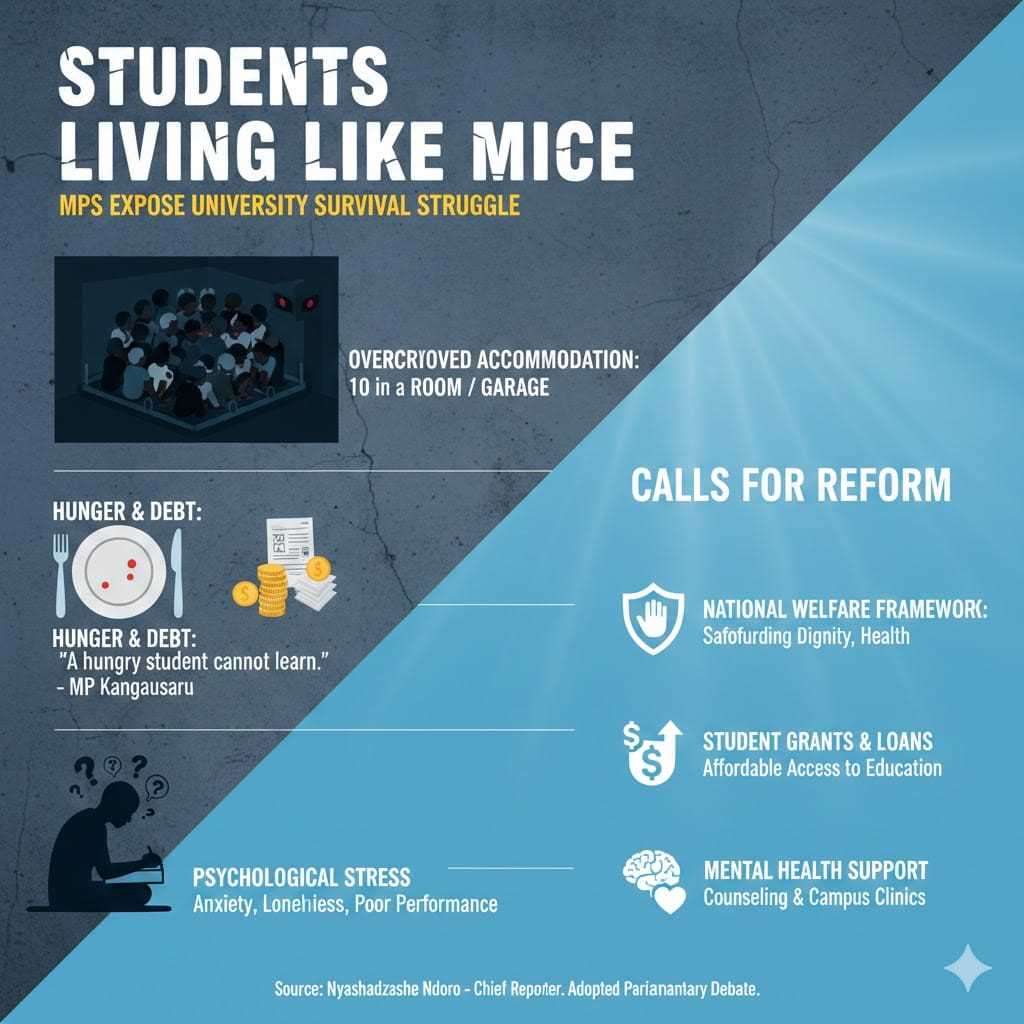
Members of Parliament have painted a grim picture of life in Zimbabwe’s tertiary institutions, revealing that some students are “living like mice” in overcrowded accommodation while battling hunger, debt and mounting pressure to survive, a development that threatens the country’s long-term development goals.
During a parliamentary debate on student welfare, Members of Parliament described a higher education system under strain, where many students struggle to afford tuition, meals and accommodation while facing health risks, exploitation and psychological stress.
The motion, which was ultimately adopted, calls on government ministries to strengthen student support services, expand HIV and STI programmes and establish a national framework to safeguard the welfare and dignity of students in tertiary institutions.
MPs said growing financial hardship is pushing students into desperate coping mechanisms, including unsafe relationships and excessive work commitments that interfere with studies.
Mt Darwin North MP Laban Munemo said students from rural backgrounds often arrive at university without support networks and face cultural shock and loneliness that can lead to psychological problems.
He warned that some female students become involved with wealthy older partners in exchange for financial assistance, exposing them to sexually transmitted infections and unwanted pregnancies.
“Most children do not complete their studies because they will be impregnated and infected,” he said.
Other students are forced to juggle studies with employment to survive, often leading to stress and poor academic performance.
MPs said many students lack reliable access to food and live in overcrowded and unsafe conditions both on and off campus.
Chiredzi Central legislator Ropafadzo Makumire said some students share cramped garages or small rooms in groups of up to ten because universities cannot provide sufficient accommodation.
“Students are living packed like mice,” he said.
Legislators warned that poor living conditions violate constitutional rights to health, education and a safe environment.
Hurungwe East Chenjerai Kangausaru said student welfare should be treated as a national development priority rather than a secondary issue.
“A hungry student cannot meaningfully enjoy the right to education,” he said.
MPs also noted that some parents struggle to raise fees consistently, leaving students stranded on campus while others return home during holidays.
Related Stories
Several legislators called for the restoration or expansion of student grants and loans, saying the absence of financial support has blocked access to higher education for many capable students.
Makumire said academically strong pupils are abandoning education and taking manual jobs because they cannot afford university fees.
He proposed the creation of a national student loan board offering affordable repayment terms.
The debate also exposed concerns about unethical practices within tertiary institutions.
Another legislator, Isaac Maposa said some students believe academic results can be influenced by bribery.
“There are increasing complaints from students who feel persuaded to offer money in order to pass exams,” he said.
Female students were also reported to be vulnerable to sexual exploitation by individuals in positions of authority.
Maposa said some young women face pressure suggesting their academic progress could depend on accepting inappropriate advances.
MPs also raised concerns about students being secretly filmed and exposed on social media, leading to online harassment and mental health problems.
Attachment Students Working Without Pay
Lawmakers criticised government departments and local authorities for failing to pay students on industrial attachment.
Makumire said many interns work full time without receiving allowances, unlike those in the private sector.
“The interns work for no stipend or payment,” he said.
MPs warned that financial pressure, academic stress and social isolation are contributing to mental health problems among students.
They called for expanded counselling services and campus clinics to support student wellbeing.









Leave Comments