







Global lithium markets reacted sharply after Zimbabwe announced an immediate suspension of exports of all raw minerals and lithium concentrates, a move aimed at accelerating in-country value addition and tightening oversight of mineral shipments.
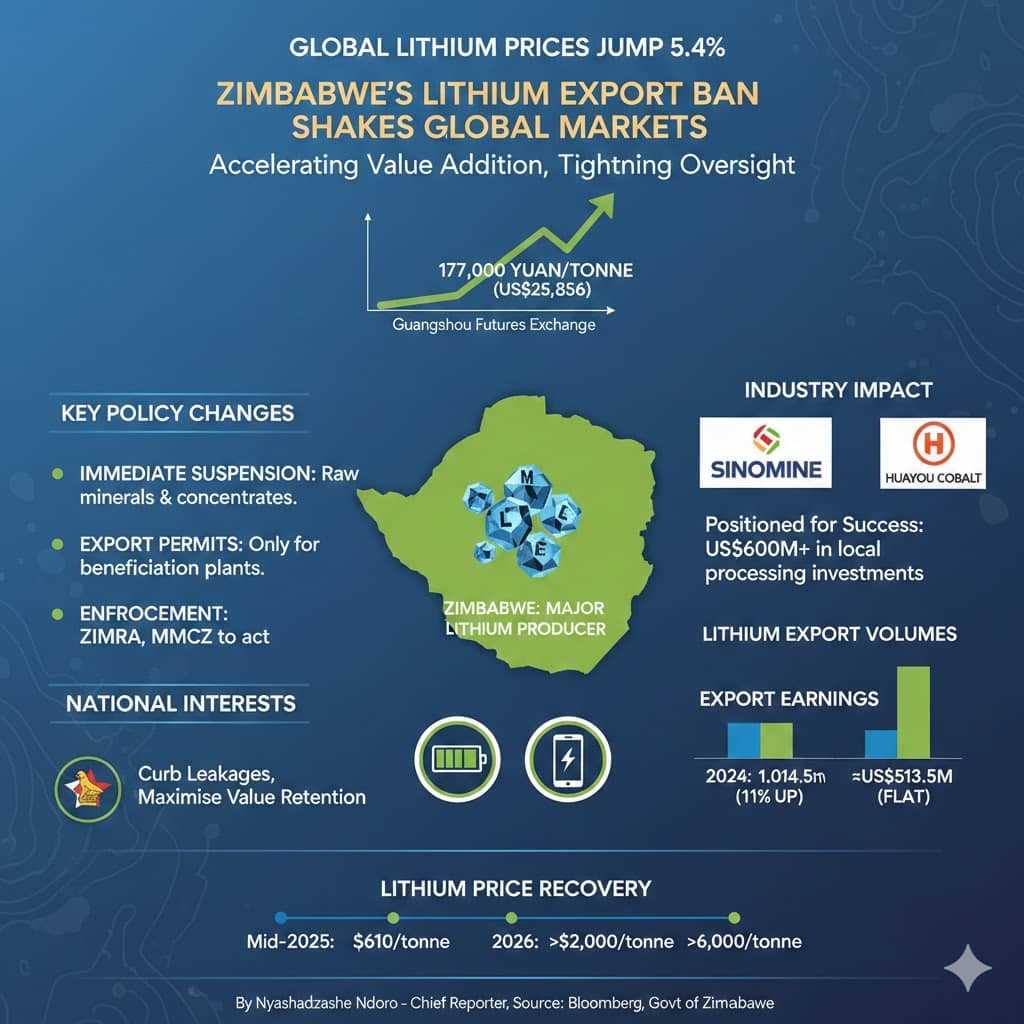
According to Bloomberg, lithium carbonate futures on the Guangzhou Futures Exchange rose 5.4 percent to 177,000 yuan (US$25,856) per tonne following the announcement, while shares of lithium producers across China, Australia and the Americas advanced on expectations that the policy could constrain global supply.
Mines and Mining Development Minister Polite Kambamura said the suspension takes effect immediately and applies to all consignments, including those already in transit. The Zimbabwe Revenue Authority, the Minerals Marketing Corporation of Zimbabwe and other regulators have been instructed to enforce the directive without exception.
Under the new framework, only mining companies holding valid mining titles and operating approved beneficiation plants will be authorised to export processed minerals. Agents and third-party traders are barred from exporting on behalf of title holders.
Applicants for export permits must submit a recommendation letter from the relevant Provincial Mining Office confirming beneficiation capacity and regulatory compliance, alongside a declaration of mineral composition for each shipment.
Authorities have also reserved the right to conduct independent verification tests. Exports without valid permits will be denied clearance, while continued use of expired permits could result in the withdrawal of both export licences and underlying mining titles.
Government officials say the measures are intended to curb leakages, eliminate irregular export practices and maximise value retention from the country’s mineral wealth.
The suspension builds on earlier beneficiation policies. In 2022, Zimbabwe banned exports of unprocessed lithium ore, pushing producers toward spodumene concentrate production.
Authorities have also signalled plans to phase out concentrate exports by 2027 and introduced a 10 percent levy on lithium concentrates to encourage investment in higher-value processing, including lithium sulphate production.
Related Stories
Zimbabwe is regarded as one of the world’s significant lithium producers, supplying material critical for electric vehicle batteries and energy storage systems. Authorities argue that exporting higher-value intermediates such as lithium sulphate, lithium hydroxide or lithium carbonate would generate greater economic returns than shipping concentrates.
Two Chinese-backed operators, Sinomine Resource Group and Zhejiang Huayou Cobalt, appear strategically positioned under the new regime after investing heavily in local processing capacity.
Sinomine, which operates Bikita Minerals, commissioned a US$200 million expansion and processing project in 2022 to upgrade lithium output beyond raw extraction. Separately, Huayou’s Prospect Lithium is developing a US$400 million lithium sulphate plant expected to be commissioned this year.
Combined, the projects represent nearly US$600 million in capital expenditure aimed at moving up the value chain. With approved beneficiation facilities in place or nearing completion, the companies are likely to meet the new export criteria, potentially preserving market access while competitors without processing infrastructure face disruption.
The export halt comes at a sensitive time for the sector. Zimbabwe’s lithium shipment volumes rose 11 percent in 2025 to 1.128 million tonnes from 1.014 million tonnes in 2024. However, weaker international prices kept export earnings broadly flat at about US$513.8 million, marginally below the US$514.5 million recorded the previous year.
After plunging to around US$610 per tonne in mid-2025, lithium prices have recovered to above US$2,000 per tonne in 2026, although they remain well below the peaks of over US$6,000 per tonne seen in 2022. The recent rebound, combined with Zimbabwe’s export ban, has reinforced expectations of tighter global supply.
Analysts say that while the suspension may cause short-term logistical and revenue disruptions—particularly for producers reliant on concentrate exports—it could accelerate a structural shift toward domestic processing.
For companies that have already invested in beneficiation, the policy may strengthen competitive positioning.
Government maintains that the measures serve the national interest by improving mineral accountability and ensuring Zimbabwe captures greater value from its resources.
However, the immediate application of the suspension, including to shipments already in transit, may raise concerns among some investors about policy predictability.





Leave Comments