









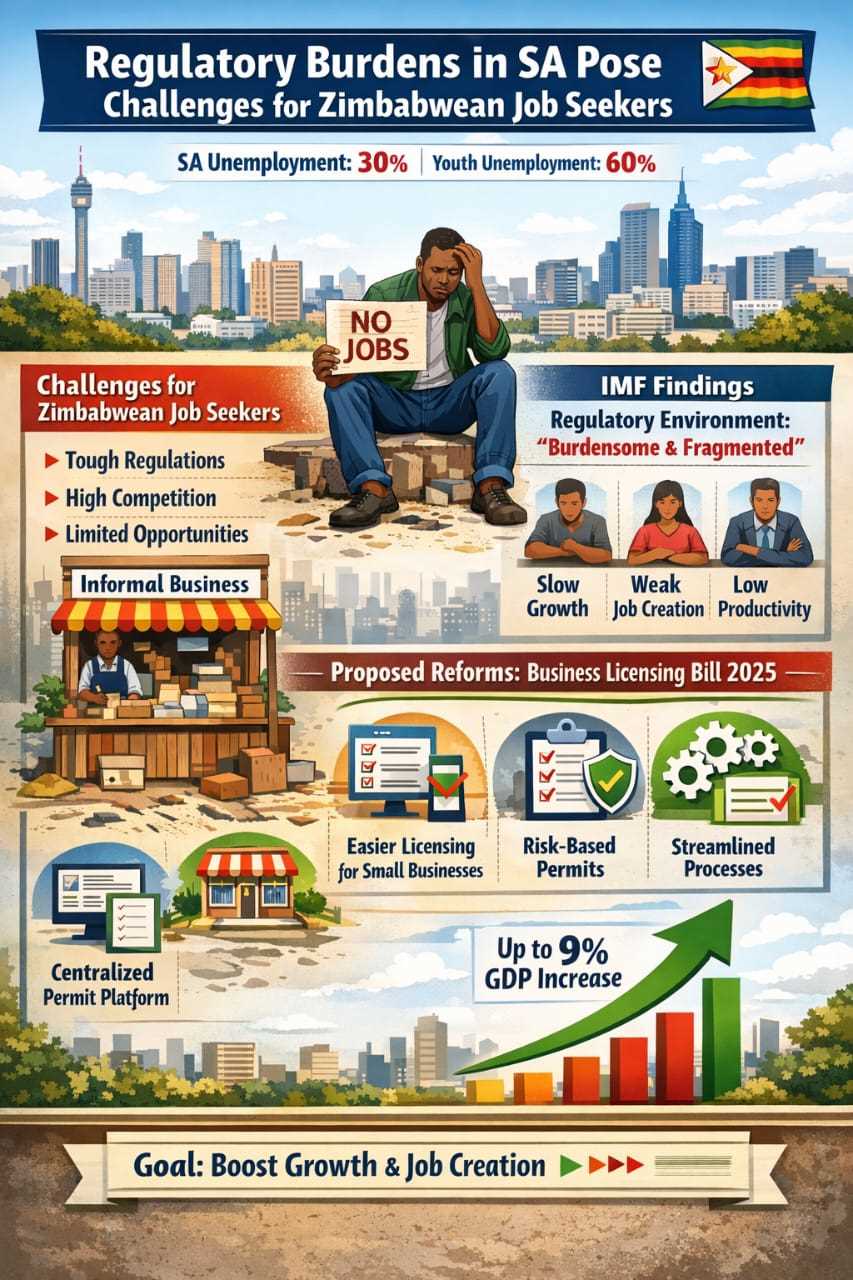
Millions of Zimbabweans living in South Africa face significant challenges in securing employment as the country struggles with persistently high unemployment and complex business regulations.
According to the International Monetary Fund, South Africa’s overall unemployment rate exceeds 30 percent, while youth unemployment stands at around 60 percent, making the labour market highly competitive.
For many Zimbabwean migrants who relocate in search of better economic opportunities, these figures highlight the difficulty of finding stable work, particularly in the informal and small-business sectors where many immigrants are employed.
IMF experts Tidiane Kinda and Nasha Mavee noted that the country’s regulatory environment, covering business licensing, permits, and compliance requirements, is “significantly more burdensome, fragmented, and costly” than in peer economies.
Their analysis shows that South African firms that spend more time navigating regulations tend to experience slower sales growth, weaker employment growth, and lower productivity. For small firms with fewer than 20 employees, the impact on productivity is nearly twice the average, directly affecting job creation.
“These regulatory frictions especially undermine the ability of small and micro businesses to scale up, innovate, and create jobs,” the IMF report said.
Related Stories
This has implications for Zimbabweans and other immigrants, who often operate businesses or seek employment in smaller enterprises that are most affected by regulatory burdens.
The IMF report highlights potential solutions, including the proposed Business Licensing Bill of 2025, which aims to modernise South Africa’s licensing system.
Key measures include establishing a centralised digital platform for permits, streamlining procedures for micro and informal firms, introducing risk-based licensing, and improving predictability through a public inventory of required permits.
If these reforms succeed, they could lower barriers for small businesses and informal traders, including many Zimbabweans, creating opportunities for entrepreneurship and employment.
The IMF projects that closing half the gap with emerging-market best practices could lift South Africa’s real output by up to 9 percent over the medium term, raising annual growth from 2 percent to around 3 percent.
“Our earlier analysis shows that reforms that close half the gap with emerging-market best practices on the business environment, governance, and labour market could lift South Africa’s real output by up to 9 percent over the medium term, raising annual growth from 2 to around 3 percent,” the experts noted.
“Simply put, durable growth that decisively reduces unemployment requires a shift toward business-friendly structural reforms,” they added.






Leave Comments