









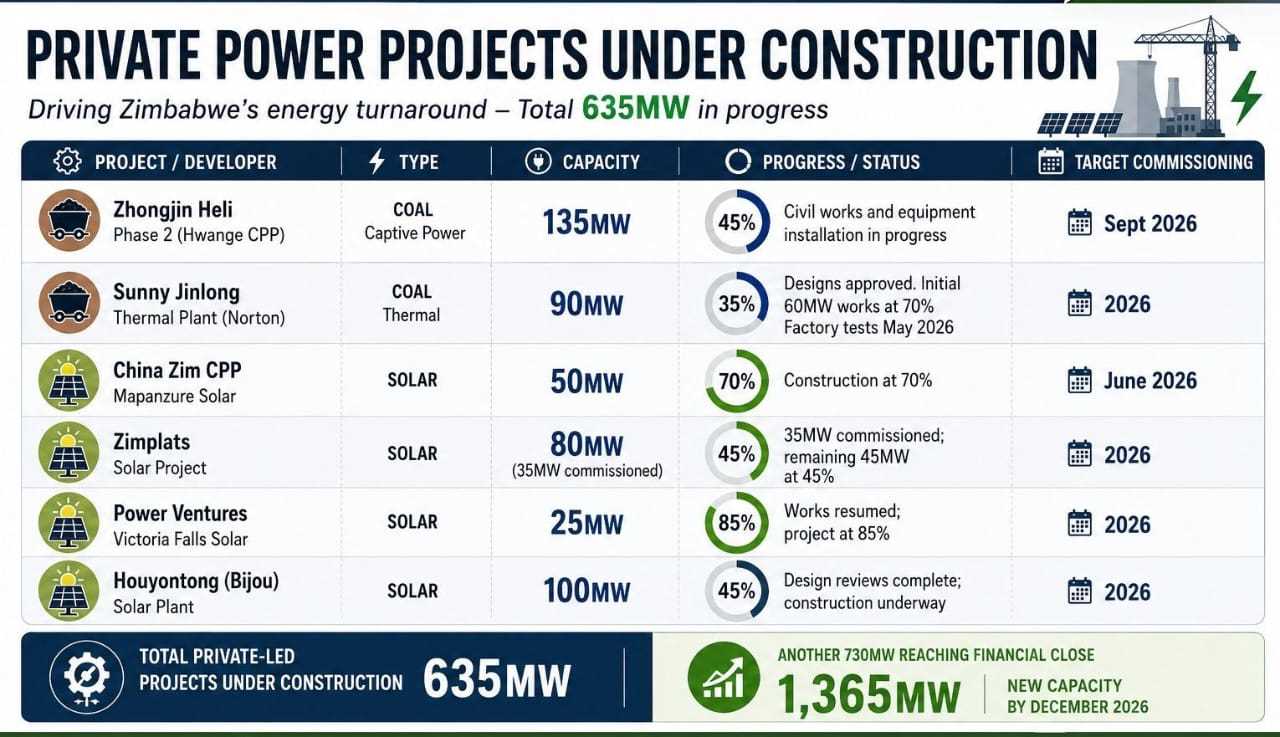
Zimbabwe has 635 megawatts of private-led power projects currently under construction as mining companies and independent investors accelerate electricity generation investments aimed at easing chronic power shortages and supporting industrial growth.
The projects form part of Government’s broader strategy to add 1,365MW of new generation capacity by December 2026 and ultimately eliminate electricity imports by 2027.
However, current projects under construction still leave a 730MW gap to reach the 2026 target.
According to the latest Zimbabwe Economic Review update, several large-scale coal and solar projects are already at advanced stages of implementation across the country.
Among the biggest developments is the 135MW Zhongjin Heli Phase 2 captive coal power project in Hwange, which is now 45 percent complete, with civil works and equipment installation underway. The project is targeting commissioning in September 2026.
The 90MW Sunny Jinlong thermal power plant in Norton is 35 percent complete, with initial works on the first 60MW phase reportedly progressing strongly following approval of project designs.
In the renewable energy segment, the 50MW Mapanzure Solar project under China-Zim CPP has reached 70 percent completion and is expected to be commissioned in June 2026.
Mining giant Zimplats has already commissioned 35MW from its planned 80MW solar project, with the remaining capacity currently under development.
Related Stories
The 25MW Victoria Falls Solar project by Power Ventures is now 85 percent complete after construction resumed, while the 100MW Houyontong Bijou Solar Plant has reached 45 percent completion following design reviews and construction works.
The expansion of private electricity generation comes as Zimbabwe continues to battle persistent electricity deficits caused by aging infrastructure, low generation capacity and rising industrial demand.
Mining companies have increasingly invested in captive power systems to secure stable electricity supplies for operations amid recurring load shedding.
At the same time, solar investments are emerging as a major pillar of Zimbabwe’s energy diversification strategy as authorities seek to reduce dependence on coal and imported electricity.
Separately, renewable energy company New Sahara Ventures has completed a new 6MW solar plant serving Mahuhwe and Muzarabani, adding to its existing 5.5MW solar facility in Guruve.
The company said the combined 11.5MW generation capacity would help strengthen rural electrification and agricultural productivity.
“With 11.5MWp of total combined capacity now online across these sites, we are proud to strengthen Zimbabwe’s green grid, boost agricultural productivity, and drive sustainable economic growth for rural businesses,” the company said.
The rapid growth of private-sector power projects reflects increasing investor confidence in Zimbabwe’s energy market reforms, although concerns remain over transmission infrastructure, project financing and regulatory consistency.










Leave Comments