








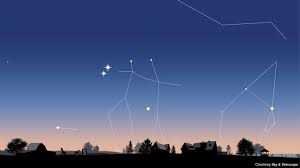
Your Southern Hemisphere viewing guide: On June 9, 2026, the western sky hosts a dazzling planetary show as Venus and Jupiter appear side by side, a stunning conjunction visible to the naked eye
Langton Mhembere- Guest Contributor
For those who enjoy observing the night sky, June 9, 2026, promises an interesting celestial event. On this evening, Venus and Jupiter will appear very close together in the western sky shortly after sunset in an event known as a planetary conjunction. Although the two planets will appear close from our perspective on Earth, they will in fact remain hundreds of millions of kilometres apart in space.
At the time of the conjunction, Venus will be approximately 80 million kilometres from Earth, while Jupiter will be nearly 800 million kilometres away. Despite being much larger than Venus, Jupiter may appear smaller and less brilliant because of its much greater distance from us. To put this into perspective, the orbits of Earth and Mars, together with the asteroid belt, lie between Venus and Jupiter.
Before the Moon rises, Venus and Jupiter will be among the brightest objects visible in the evening sky. The brightest stars visible from the Southern Hemisphere include Sirius, the brightest star in the constellation Canis Major, and Canopus, a luminous supergiant star in the constellation Carina.
This conjunction will occur against the backdrop of Gemini, one of the twelve Zodiac constellations, alongside others such as Taurus, Virgo, Pisces, and Leo. Astronomers recognise 88 constellations in the sky, of which the Zodiac constellations lie along the ecliptic, the Sun’s apparent path across the heavens. Gemini is famous for its two prominent stars, Castor and Pollux, often referred to as the “Twins.” Although they appear close together in the sky, they are separated by many light-years in space and can easily be seen with the naked eye.
Also visible in the constellation is Mercury, the innermost planet in our Solar System, completing a trio of planets in this planetary alignment. Although it is often difficult to observe because it remains close to the Sun, Mercury can be seen with the naked eye under favourable conditions, particularly when it is sufficiently elevated above the horizon and the sky is clear.
Those who have the Star Walk 2 application installed on their mobile phones can enjoy an enhanced view of this conjunction and many other fascinating celestial events. The application enables users to identify planets, stars, constellations, satellites, and other celestial objects in real time by simply pointing their device toward the sky. It also provides detailed information about these objects, making it an excellent tool for both amateur stargazers and astronomy enthusiasts.
Jupiter, the largest planet in our Solar System, has a diameter about eleven times that of Earth and is vastly larger than Venus. Classified as a gas giant, Jupiter is composed primarily of hydrogen and helium. Unlike Earth, it has no solid surface; instead, its atmosphere gradually transitions into deeper layers of liquid and metallic hydrogen under immense pressure.
It is fascinating to note that virtually every prominent star visible in the night sky has a name and belongs to a recognised grouping known as a constellation. Astronomers estimate that our Milky Way Galaxy contains between 100 and 400 billion stars, and it is just one of countless galaxies in the observable universe such as Andromeda, Triangulum, Sagittarius, etc.
Interestingly, we do not observe exactly the same stars throughout the year. The constellations visible in June differ from those seen in November because Earth is continuously orbiting the Sun, our nearest star. As our position changes during the year, the night side of Earth faces different regions of space, bringing different constellations into view.
For example, some constellations that dominate the winter sky may be absent from the summer sky, only to reappear several months later. This seasonal change in the night sky has been observed and used for navigation, agriculture, and timekeeping by civilisations for thousands of years.
In general, planets orbit stars, while stars appear relatively fixed because they are located at immense distances from Earth, light years. Although stars are also moving through space, their motions occur over such vast timescales that they seem stationary to the human eye. The Sun is one such star, and the planets of our Solar System, including Earth, orbit around it under the influence of gravity.
Langton Mhembere is a Zimbabwean novelist who has published two works, Kudenda Kure Kure and Pasi Rine Nharo. He is currently working on another literary project alongside other engagements. In addition to his literary pursuits, he has a strong interest in astronomy and celestial phenomena, and often spends time with his two sons observing and studying night sky objects, including stars and planets.
He holds a Diploma in Accountancy from the Southern African Association of Accountants (SAAA), a Bachelor of Accounting Science (BCompt) from the University of South Africa (UNISA), and a Master of Business Administration in Finance (MBA-Finance) from the University of Zimbabwe (UZ). He is also an International Organisation for Standardisation (ISO) Internal Auditor and a practising Quality Assurance Manager. lmhembere01@gmail.com










Leave Comments