









ZimNow News Desk
Chinese-linked manufacturers in Zimbabwe should be treated not only as foreign investors, but as anchor factories around which local suppliers, distributors and service companies can build stronger value chains, the Zimbabwe Chinese Business Association has said.
ZCBA executive vice chairperson Carrie Li told the CZI Manufacturing Sector Review in Harare that Chinese manufacturing investment is already contributing to local jobs, import substitution, factory capacity and regional exports.
She said the next step is to deliberately connect Chinese-linked manufacturers with Zimbabwean firms that can supply inputs, services, packaging, distribution, logistics, maintenance and other value-chain needs.
In her presentation delivered under the theme: “Building Manufacturing Partnerships: How Chinese and Local Enterprises Can Strengthen Zimbabwe’s Value Chains”, Li argued that Chinese manufacturing in Zimbabwe is now broader than mining and steel, touching areas such as footwear, tiles, cement, bricks, clothing, chemicals and washing products.
“The lens is not foreign factories only,” Li said. “Factories become anchors for Zimbabwean suppliers, distributors, services and SMEs.”
She cited Costham Footwear as one example of operational Chinese-linked manufacturing capacity in Zimbabwe. The company has operated in Harare and Chitungwiza since 2003, with 60 machines, production capacity of more than 2.5 million pairs of shoes a year, 600 employees and more than US$20 million invested over two decades.
Other examples cited include Sunny Yi Feng in Norton, which produces porcelain tiles, floor and wall tiles and ceramic tableware; Sino-Zim Cement, a Zimbabwe-China joint venture with 250,000 tonnes per year cement capacity; and Sino Brick in Gweru, with capacity of 40 million bricks a year.
She said local entry points are already visible. It cited Ganzim Water, which uses Zimbabwean distributorships as a route to market, and lithium logistics operations where Zimbabwean transport and logistics firms are contracted at commercial scale.
Related Stories
According to ZCBA, the opportunity is to formalise and scale such arrangements.
“The lesson is that value chains grow faster when local firms are intentionally matched with the factories already operating,” Li said.
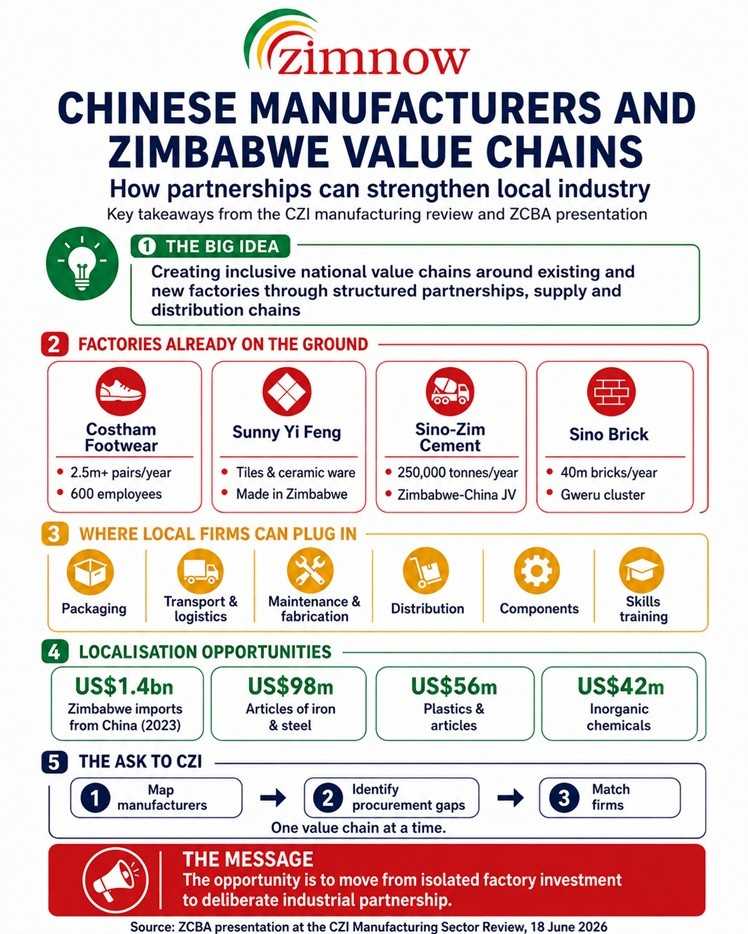
Li said Zimbabwe’s imports from China also show possible areas for future localisation. It cited US$1.4 billion in imports from China in 2023, including US$98 million in articles of iron and steel, US$56 million in plastics and US$42 million in inorganic chemicals.
Li said this does not mean every import line can be immediately replaced, but each line raises a practical manufacturing question: can some of it be produced locally, with Zimbabwean companies supplying inputs, packaging, distribution and services?
Around every factory, Li said, there are opportunities for Zimbabwean enterprises in packaging, transport and logistics, maintenance and fabrication, safety equipment, agricultural inputs, retail and wholesale, component making, after-sales service and skills training.
Li pointed to strategic infrastructure opportunities, including the announced joint venture between ZESA Enterprises and Shanghai Jingdao Electric to manufacture switchgear, smart meters and electric vehicle chargers in Zimbabwe.
She said local firms can participate from the commissioning stage through civil works, fittings, logistics, electrical components and safety systems, and later through maintenance, calibration, spares, technical training, after-sales support, distribution, installation and export links.
Li asked CZI to work with it on three concrete steps: mapping manufacturers sector by sector, identifying procurement gaps and matching Chinese manufacturers with Zimbabwean suppliers, SMEs and established firms.
The proposal fits into one of the major findings of the CZI survey: Zimbabwe’s manufacturing sector has limited value-chain integration, with only 7% of firms reporting strong vertical integration with suppliers or customers.
CZI CEO Sekai Kuvarika said that the organisation welcomed the synergy initiative from ZBCA and the tow organisations would work together to ensure implementation.







Leave Comments