







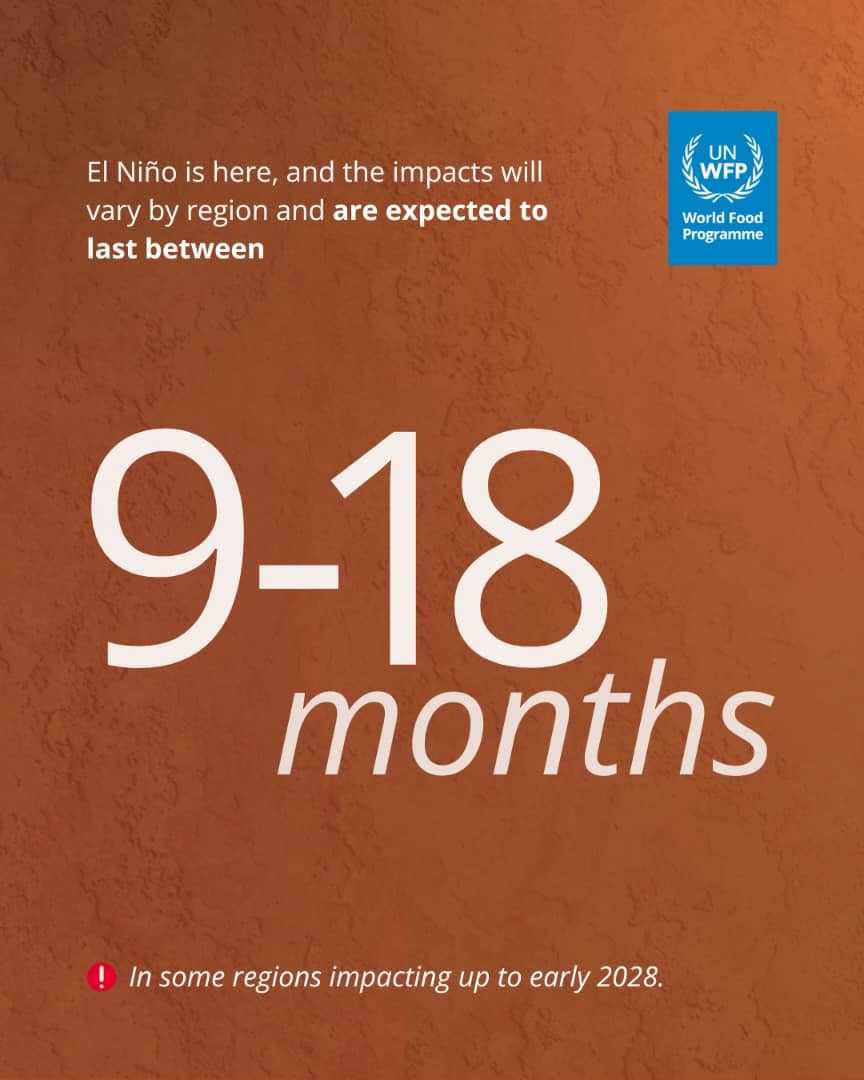
Zimbabwe could face an extended period of climate uncertainty after the World Food Programme warned that the newly declared El Niño weather phenomenon may persist for up to 18 months, with impacts in some regions expected to last into early 2028, raising concerns that southern Africa's drought cycle could become more prolonged than previously anticipated.
The warning comes as Zimbabwe continues rebuilding from the devastating 2023/24 El Niño-induced drought, one of the worst in decades, which crippled agricultural production, depleted water sources and left millions requiring humanitarian assistance.
In its latest climate update, the World Food Programme said the current El Niño is strengthening and could rank among the most powerful in modern history.
"El Niño has been officially declared, with forecasts warning it could rank among the strongest in modern history. Impacts will vary by region and are expected to last between 9 and 18 months – in some regions into early 2028."
While the agency noted that impacts will differ across regions, southern Africa has historically experienced below-average rainfall, prolonged dry spells and above-normal temperatures during strong El Niño episodes, conditions that significantly increase the likelihood of drought.
The forecast is significant because it extends the timeline of climate risks beyond a single farming season. Rather than preparing for one difficult rainy season, governments, farmers and humanitarian agencies may have to plan for a prolonged period of weather instability that could affect food production, water supplies, livestock and rural livelihoods well into 2028.
Zimbabwe has become increasingly vulnerable to recurring climate shocks. Successive droughts and floods have repeatedly disrupted agricultural production, placing pressure on food security and slowing economic recovery.
Related Stories
Permanent Secretary in the Ministry of Agriculture, Mechanisation and Water Resources Development Professor Obert Jiri acknowledged that unpredictable weather patterns are no longer exceptional but are becoming a defining feature of Zimbabwe's climate.
"Erratic rainfall is becoming the new normal. We are prioritising the expansion of irrigation schemes and water harvesting technologies to safeguard farmer productivity and strengthen national food security."
His remarks reflect a broader policy shift from responding to drought emergencies towards investing in long-term climate resilience.
The warning also raises questions about whether existing adaptation measures can keep pace with increasingly frequent climate extremes. Although Government has expanded irrigation infrastructure and promoted climate-smart agriculture, the majority of Zimbabwe's farmers still depend on rainfall, leaving agricultural production highly exposed to prolonged dry conditions.
Beyond agriculture, an extended drought could have cascading effects across the economy. Lower water levels may reduce hydroelectric power generation at Kariba Dam, increasing pressure on electricity supplies. Urban councils could face worsening water shortages, while reduced agricultural output may affect food prices, export earnings and rural incomes.
Development agencies have repeatedly warned that climate change is making extreme weather events more frequent and severe across southern Africa, requiring governments to move beyond emergency food assistance towards sustained investments in water infrastructure, irrigation, drought-resistant crops and early warning systems.
The World Food Programme's latest outlook suggests that climate planning can no longer be based solely on annual rainfall forecasts. If El Niño persists into early 2028 as projected, Zimbabwe may have to prepare for a prolonged cycle of climate-related disruptions rather than an isolated drought event.
The immediate challenge for policymakers will be determining whether existing drought preparedness measures—including irrigation expansion, water harvesting, strategic grain reserves and climate adaptation programmes—are sufficient to withstand what could become one of the longest periods of El Niño-related climate pressure in recent years.





Leave Comments