





Zimbabwe approved US$1.59 billion worth of new investment projects in the second quarter of 2026, with mining and manufacturing accounting for almost 80% of the projected investment value, even as the overall value of new approvals fell sharply from the same period last year.
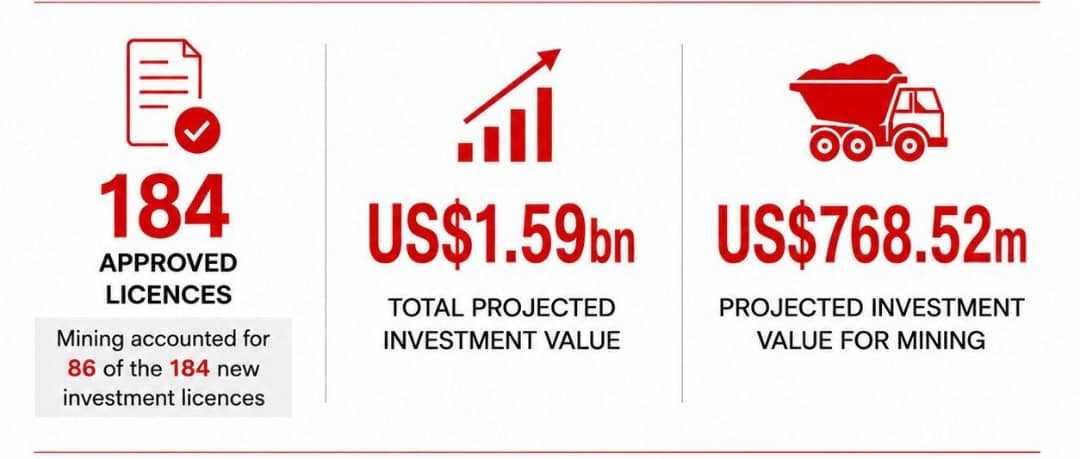
The latest figures from the Zimbabwe Investment and Development Agency (ZIDA) show that 184 new investment licences were issued during the quarter, carrying a combined projected investment value of approximately US$1.59 billion.
Mining accounted for the largest share, with 86 licences worth US$768.52 million, while manufacturing followed with 43 licences valued at US$496.72 million.
Together, the two sectors accounted for approximately US$1.27 billion, or 79.6% of the quarter's projected investment pipeline.
ZIDA chief executive officer Tafadzwa Chinamo said the figures reflected continued investor confidence, but also a shift in the agency's focus from simply attracting investors towards ensuring that approved projects are implemented.
“Quarter Two reflects continued investor confidence in Zimbabwe and demonstrates the Agency's deliberate shift from investment promotion towards investment conversion,” Chinamo said.
The Q2 performance is significantly different from the same period in 2025.
In Q2 2025, ZIDA issued 190 new investment licences worth US$2.47 billion, meaning the number of approvals fell by only about 3.2% this year, while the projected value dropped by roughly 35.6%.
The sharp difference in investment value is largely explained by the composition of last year's approvals.
In Q2 2025, the energy sector alone accounted for US$1.803 billion, or about 74% of the US$2.47 billion total. ZIDA said the figure was driven largely by a major natural gas and coal project in Gwayi, Lupane District, which included plans for liquefied natural gas production and fertiliser manufacturing.
Mining and manufacturing were considerably smaller components of the Q2 2025 pipeline.
Mining received 91 licences worth US$369.23 million, while manufacturing received 55 licences valued at US$125.83 million.
The year-on-year comparison therefore reveals a substantial change in the sectors driving Zimbabwe's investment pipeline.
Mining's projected investment more than doubled, rising from US$369.23 million in Q2 2025 to US$768.52 million in Q2 2026, an increase of about 108%.
Manufacturing recorded an even larger increase, with projected investment rising from US$125.83 million to US$496.72 million, or approximately 295%.
The number of mining licences, however, fell from 91 to 86, while manufacturing licences declined from 55 to 43.
This means the increase in projected investment is being driven not by a greater number of projects, but by larger projected investments attached to the projects being licensed.
Related Stories
The shift is particularly evident in manufacturing, where 43 licences in Q2 2026 carried almost four times the projected investment associated with the 55 manufacturing licences issued a year earlier.
Chinamo said ZIDA was increasingly assessing the quality and potential economic impact of investor engagement rather than simply measuring the number of enquiries or promotional activities.
“These figures reflect our continued emphasis on quality investor engagement capable of producing implementable projects rather than simply increasing promotional activity,” he said.
During the quarter, ZIDA directly engaged 241 targeted investors, generated 38 qualified investor leads and facilitated 15 tripartite investment meetings, according to the agency.
It also secured eight investor commitments and non-disclosure agreements representing approximately US$413.8 million in investment commitments.
The agency is consequently placing greater emphasis on what happens after an investment licence has been issued.
“Investment promotion is ultimately measured not only by projects approved, but by projects implemented, businesses established, employment created and long-term economic value generated,” Chinamo said.
That distinction is important given the difference between the projected investment pipeline and actual capital deployed.
The Q2 2026 figures represent investments attached to approved licences and should not be interpreted as US$1.59 billion already invested in the economy.
The latest figures instead show the scale and composition of projects that have entered the approved investment pipeline.
The increase in mining investment comes as Zimbabwe continues to position the sector as a major source of investment, foreign currency and industrial activity, while manufacturing is being prioritised as part of efforts to rebuild domestic productive capacity.
The combined US$1.265 billion projected for mining and manufacturing also means that almost four-fifths of the Q2 2026 pipeline is concentrated in two sectors.
This is a marked contrast to Q2 2025, when energy dominated the investment landscape because of the US$1.8 billion project.
The shift does not necessarily indicate weaker investor interest in Zimbabwe.
Instead, the year-on-year figures show that the headline investment value is highly sensitive to the size and sector of individual projects entering the licensing pipeline.
In Q2 2025, one major energy-related project accounted for most of the quarter's investment value. In Q2 2026, the pipeline is more heavily distributed between mining and manufacturing.
Chinamo said the agency was moving towards investment conversion as a central part of its mandate, with the ultimate measure being whether approved projects translate into businesses, jobs and economic activity.






Leave Comments