





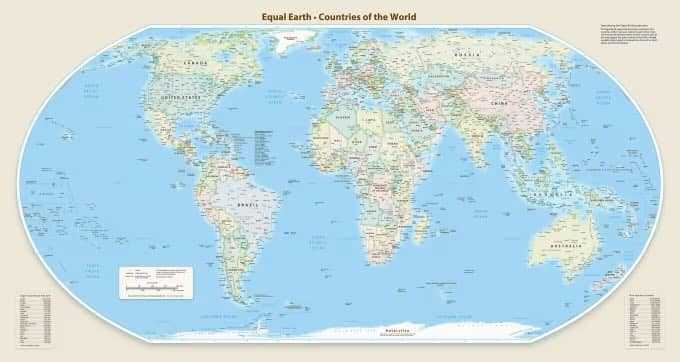
The United Nations General Assembly has overwhelmingly backed an African-led campaign to change how the world is represented on maps, with 164 countries voting in favour, one against and six abstaining in a resolution aimed at correcting long-standing distortions of Africa’s size.
The resolution, A/80/L.104, titled “Correct the Map: Rebalancing global cartographic representation and promoting equitable representation of the world’s regions, particularly Africa,” was adopted on Friday after being championed by African Union member states and led by Togo.
The United States was the only country to vote against, while Georgia, Estonia, Lithuania, Moldova, Serbia and Ukraine abstained, according to the voting record displayed on the UN General Assembly screen.
The vote seeks to promote wider use of map projections that represent continents according to their actual relative areas, challenging the dominance of the Mercator projection, which has been criticised for making territories closer to the poles appear substantially larger than they actually are.
Under the Mercator projection, Greenland can appear roughly comparable in size to Africa, despite Africa being about 14 times larger.
Togo, which spearheaded the African campaign, framed the issue as more than a technical dispute among cartographers.
“A fair world begins with a fair map,” Togo’s Foreign Minister Robert Dussey said ahead of the vote.
African advocates argue that repeated visual distortions have influenced how the continent is perceived in classrooms, the media, digital platforms and international institutions, effectively making Africa appear smaller and less significant than its actual geographical scale.
Related Stories
The African Union has backed the Equal Earth projection, an equal-area projection that provides a more proportionate representation of the continents. The resolution is intended to encourage its adoption alongside other projections that more accurately portray the relative sizes of the world’s regions.
The significance of Friday’s vote, however, is largely normative rather than legally coercive. The resolution does not ban the Mercator projection or prevent its continued use for purposes such as maritime and aviation navigation, where it remains technically useful.
Washington’s opposition therefore created a striking diplomatic split. The United States argued that the initiative was driven by an ideological agenda and distracted the UN from what it regarded as more pressing international problems.
For Africa, the vote represents an attempt to challenge not only a cartographic convention but also the historical narratives embedded in systems of knowledge and representation.
The campaign’s supporters maintain that maps are not neutral images. What is enlarged, reduced or placed at the centre can influence perceptions of relative importance, power and geography.
The campaign is now expected to move beyond the UN chamber, with advocates pushing for more accurate projections to be used in schools, textbooks, newsrooms, businesses, digital mapping platforms and international institutions.
The overwhelming vote also gives the African Union and its partners a powerful diplomatic mandate, but the harder battle may be implementation. The Mercator projection has been embedded in educational materials, online mapping systems and public consciousness for generations, meaning a UN resolution alone cannot immediately change how billions of people visualise the world.
France, meanwhile, announced on Friday that it was abandoning the Mercator projection in favour of the Eckert IV projection, which more accurately represents the relative surface areas of regions closer to the equator, aligning with the broader campaign for fairer cartographic representation.
The result is unlikely to redraw the world’s maps overnight. Instead, it marks an African-led challenge to the conventions through which the world has been visually represented and places the question of who gets to define the world’s image firmly on the international agenda.





Leave Comments