








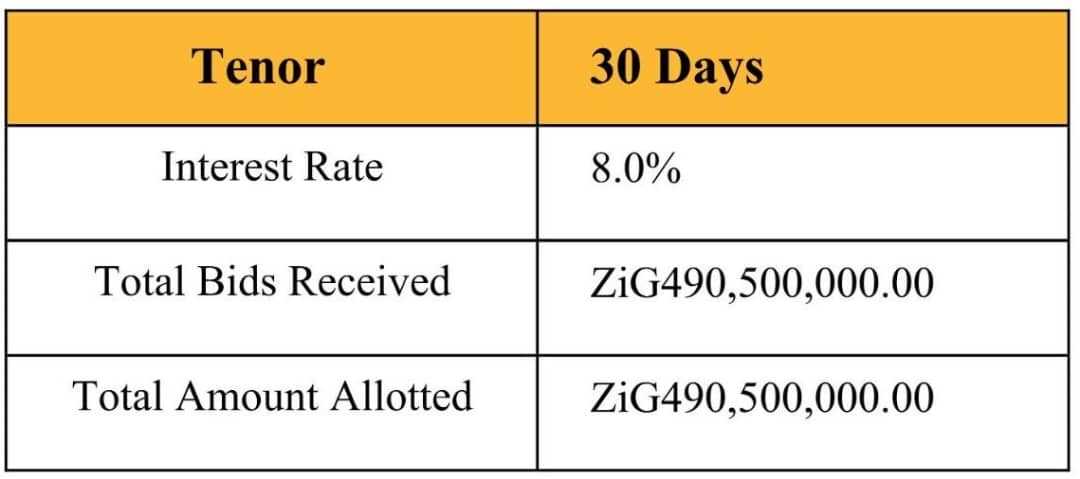
The Reserve Bank of Zimbabwe has absorbed ZiG490.5 million through its latest 30-day Term Deposit Facility, with every bid received allotted at an 8% annual interest rate, highlighting growing participation in the central bank’s new market-based approach to managing local-currency liquidity.
The September 9 results show that the RBZ received bids totalling ZiG490.5 million and allotted the entire amount, giving the latest auction a 100% allocation rate.
The instrument carries an 8% annual yield, equivalent to approximately 0.66% over 30 days.
The RBZ describes the ZiG-Denominated Term Deposit Facility Bills as “a modern open market operation instrument offering positive real returns to investors”, introduced under the 2026 Monetary Policy Statement to “uphold the stability of Zimbabwe Gold and promote a savings culture”.
The facility is also explicitly designated for Open Market Operations, meaning the central bank can use it to influence the amount of ZiG liquidity circulating in the financial system.
The latest allocation is substantially larger than the ZiG110 million initially taken up by the 30-day facility when the instrument was launched earlier this year.
At the time, the RBZ’s Monetary Policy Committee said it was encouraged by the initial uptake of ZiG367.2 million on the 90-day instrument and ZiG110 million on the 30-day instrument, yielding 11% and 8%, respectively.
The MPC said:
“In the near to medium-term, the Committee expects the ZiGDTDF interest rates to guide the minimum savings interest rates that ensure positive real returns, support a domestic savings and investment culture, and provide impetus to ongoing efforts to develop the capital and money markets.”
This suggests that the RBZ is attempting to establish an observable market price for holding ZiG over different periods, giving banks and other financial institutions a reference point when pricing savings and other domestic-currency instruments.
The facility is open to banks, POSB, deposit-taking microfinance institutions, insurance and pension funds, corporates and individuals. The latest prospectus set minimum subscriptions at ZiG10 million for financial institutions, ZiG500,000 for corporates and ZiG100,000 for individuals.
Governor John Mushayavanhu previously explained the purpose of the instrument in more direct terms, saying:
Related Stories
“The ZiGDTDF will enable the RBZ to effectively mop up excess liquidity while preserving the value of ZiG deposits for banks.”
He said participating banks would be able to place excess liquidity with the central bank in return for a yield, with the resulting certificates being tradable in the interbank market and usable as collateral for central bank financing.
That design represents a shift away from relying predominantly on direct administrative controls towards a more market-based monetary policy approach.
The latest RBZ prospectus reinforces this, saying the instrument is part of its “Open Market Operations toolkit” and is intended to support “exchange rate stability, market-based liquidity management, and strengthening confidence in ZiG-denominated financial assets”.
Why the return matters
The 8% headline rate can look high in isolation, but the actual 30-day return is only about 0.66%.
The return nevertheless remains positive against Zimbabwe’s current low monthly inflation environment. RBZ data shows ZiG monthly inflation at 0.10% in August, while annual ZiG inflation stood at 2.89%.
That gives the central bank room to market the instrument as a positive-real-return asset, provided inflation and the exchange rate remain contained.
However, investors face a double test: whether the 8% yield exceeds inflation and whether the ZiG retains its purchasing power against the US dollar over time.
A nominally positive return can still be undermined if exchange-rate depreciation outpaces the interest earned.
The RBZ’s latest operation represents two things at once: a liquidity-management exercise and an attempt to make ZiG-denominated savings more attractive.
The central bank has also made the instrument eligible for prescribed-asset and liquid-asset status, while allowing it to be used as collateral and traded. It is redeemed by the RBZ at maturity.
Those features make the facility more useful to institutional investors than an ordinary fixed deposit.
The MPC itself has linked the facility to the development of Zimbabwe’s capital and money markets, while the RBZ’s 2026 Monetary Policy framework calls for money-supply growth to remain aligned with real economic activity and liquidity conditions consistent with the inflation objective.









Leave Comments