
Construction in Garabagh: New developments rise amid the region’s mountainous landscape. Photo: Sello Lentsoane
Military victory can reclaim territory. But how do we know when a homeland has been rebuilt? Is it by counting the homes constructed or by asking whether the people returning can build secure lives there?
Beyond the ruins
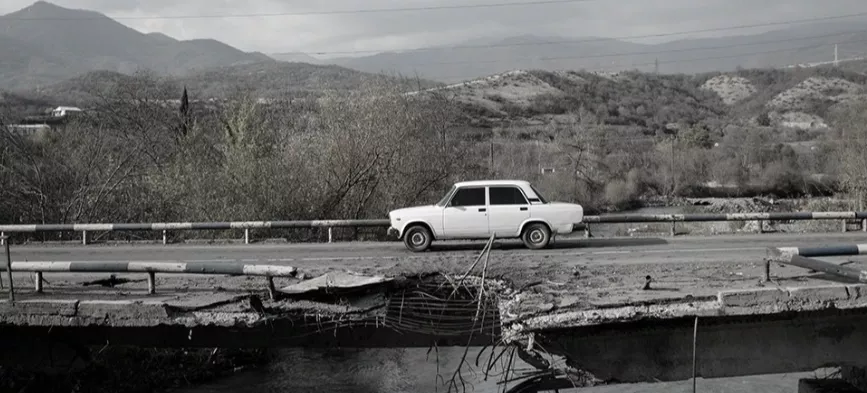
As our charter plane descends towards Garabagh, the scars of conflict come into view. At Fuzuli International Airport, international media delegates arrive at a modern terminal. Further inland, Victory Road cuts through the mountains. Cranes rise above new apartment blocks, while roofless stone houses stand across the road.
Reconstruction is transforming the region, but new infrastructure alone cannot tell us whether a homeland has truly been rebuilt.
At the Fourth Shusha Global Media Forum, Azerbaijani President Ilham Aliyev described the transformation: “The first time, probably when they came here, they saw only ruins… Now they see cities”.
By 19 October 2026, Azerbaijan’s National Agency for Mine Action (ANAMA) reported that 308,945 hectares of land had been cleared of mines and unexploded ordnance. In September, ANAMA Deputy Chairman Samir Poladov said that 11,667 square kilometres remained contaminated, with more than one million mines believed to be present.
The region, internationally recognised as part of Azerbaijan, has endured decades of conflict with Armenia. The First Karabakh War (1988–94) killed about 30,000 people and displaced more than one million. Azerbaijan regained control of surrounding districts and parts of Nagorno-Karabakh in 2020 before taking full control of the region in September 2023. More than 100,000 ethnic Armenians fled to Armenia following the 2023 offensive.
For Azerbaijanis displaced during earlier phases of the conflict, reconstruction offers the prospect of returning home decades later.
When a house isn’t enough
“The flat is beautiful, and we have electricity, but our lives are in the courtyard,” one relocated resident explains. “If the children kick a ball past the outer gravel path, we freeze. The asphalt is safe, but the soil is still a battlefield”.
Her family has a new home, but the threat of landmines still shapes how they use the surrounding space. A house can be rebuilt before the landscape around it is safe.
Official statements in October 2026 outlined an extensive infrastructure programme covering roads, airports, schools, healthcare facilities and Garabagh University. On 14 October, officials reported that more than 40,000 people had returned to 47 residential settlements, while nearly 100,000 people were living, studying or working in the liberated territories.
These figures demonstrate the scale of development and return, but they do not establish whether people feel safe or can build sustainable lives in the region.
Sabina Mammadova, a coordinator for BIG Azerbaijan, identifies another challenge: “Another problem is that the home they remember may have changed or it may not be there anymore”.
Rebuilding houses does not necessarily restore familiar streets or social connections. Nor does returning automatically guarantee access to employment, education or the support people need to settle.
Rebuilding a community means creating the conditions that enable people to establish meaningful and sustainable lives there.
Who gets to define progress?
Victory monuments in Baku and Khankendi commemorate Azerbaijan’s military success and the sacrifices associated with it. For many Azerbaijanis, they represent national unity. However, the story of reconstruction extends beyond the official symbols of victory.
My visit took place during an organised media tour. Azerbaijanis still awaiting the opportunity to return home were not represented in my reporting, nor were the ethnic Armenians who fled in 2023. A visit focused on reconstruction in Azerbaijani-controlled territory cannot capture the experiences of everyone affected by the conflict.
That absence matters. A landscape can be observed, but the experiences of everyone affected cannot simply be inferred from what is visible.
Accountability beyond the skyline
Along the road, cranes and ruins occupy the same frame. One represents what is being built; the other, what was destroyed. Neither reveals whether recovery is complete.
To assess recovery, we need to do more than count new buildings and the number of people who have returned. Authorities should provide transparent reports on construction progress, mine-contaminated areas and access to essential services, employment and education.
Independent scrutiny and residents’ participation are essential to establishing whether official measures reflect conditions on the ground.
These are not arguments against reconstruction. Rather, they are standards against which it should be judged.
Military victory may restore territorial control, while infrastructure may reconnect communities. But a homeland is not rebuilt simply because buildings have been replaced or former residents have returned.
Its recovery must also be measured by whether people can live safely, access opportunities and participate in shaping the future of their communities. Source: nnatvplus

About Zim Now Writer
Staff Writer