
Stanbic Broadens Sustainability Drive Through Local Investment and Green Projects
Stanbic Bank Zim reduced its fuel consumption by more than half in 2025, expanded solar energy initiatives and directed 93 percent of its procurement spending to local suppliers
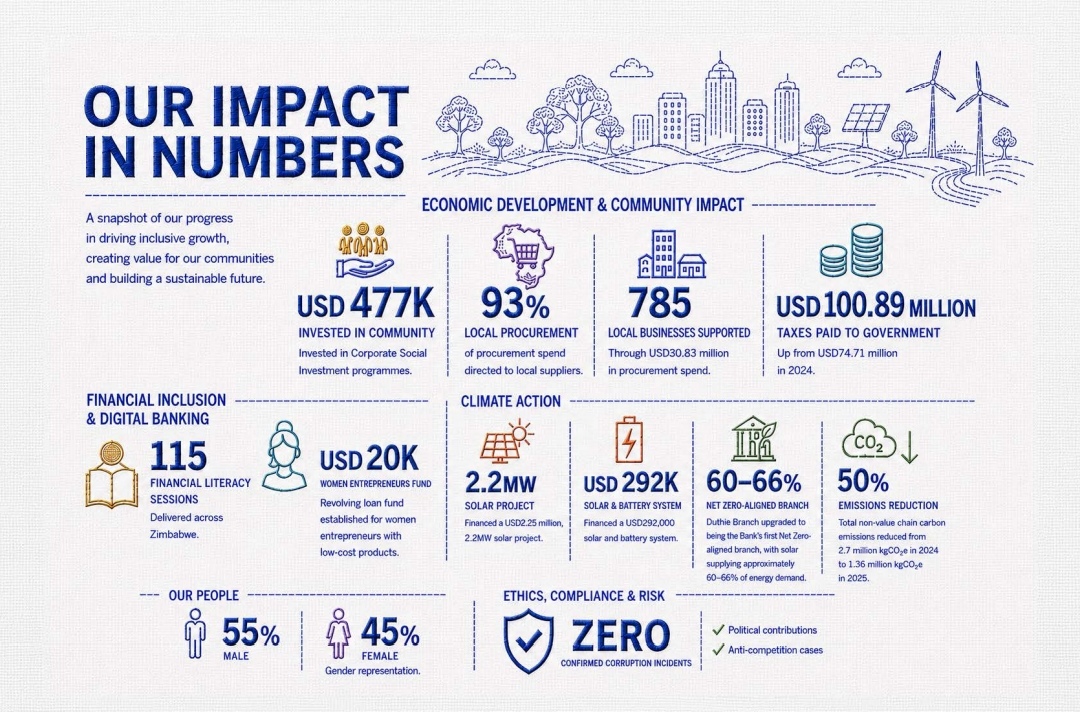
Stanbic Bank Zimbabwe reduced its operational greenhouse gas emissions by 50 percent in 2025, directed US$30.8 million in procurement spending to local suppliers and invested US$477,520 in community initiatives as it expanded its sustainability programme.
The figures, contained in the bank's 2025 Sustainability Report, reflect efforts to integrate environmental, social and governance considerations into its business operations, lending decisions and engagement with communities.
The bank's reported operational emissions fell from 2.7 million kilogrammes of carbon dioxide equivalent in 2024 to 1.36 million kilogrammes in 2025. Fuel consumption also declined from 873,788 litres to 301,888 litres over the same period.
Stanbic attributed the reduction in fuel use to improved national electricity supply, expanded solar generation, better energy management and reduced reliance on generators.
Renewable energy investments included financing a 2.2-megawatt solar project worth US$2.25 million and a US$292,000 solar and battery system at Ruzawi School.
At Duthie Branch, an upgraded solar installation supplies between 60 and 66 percent of the branch's energy requirements, supporting the bank's efforts to improve energy efficiency in its own infrastructure.
Beyond its environmental initiatives, the bank reported that 93 percent of its procurement expenditure, amounting to US$30.8 million, went to local suppliers in 2025, benefiting 785 businesses. This was an increase from 87 percent in the previous reporting period.
In his statement, the Board Chairman said sustainability was becoming more firmly embedded in the bank's governance, strategy and operations.
He highlighted stronger Board oversight of environmental, social and governance issues, including the appointment of a Board-level Sustainability Champion to support accountability and guide the institution's sustainability agenda.
Chief Executive Solomon Nyanhongo described 2025 as a year of translating sustainability commitments into business outcomes.
He said the bank was focusing on areas where its financial services could contribute to economic development, including renewable energy, infrastructure, financial inclusion and support for entrepreneurship.
Speaking at the Blue on Green Sustainability Conference in Harare, Nyanhongo said sustainability required cooperation across institutions and sectors.
“Your presence reflects a shared understanding that sustainability cannot be delivered by one institution, one sector or one set of experts. It requires the deliberate interweaving of people, ideas, partnerships, innovation and responsible action,” he said.
The bank's Sustainability Champion, Neeta Joshi, is responsible for helping ensure that sustainability considerations are incorporated into its decision-making processes, including credit evaluation, risk management and performance monitoring.
The report identifies climate change and extreme weather events among the bank's top 10 risks for 2025. Stanbic said it was strengthening its approach through climate risk assessments, emissions monitoring, scenario analysis and stress testing.
The institution is also developing a climate risk dashboard to improve its ability to monitor and respond to climate-related risks.
Community investment and financial inclusion
Stanbic reported spending US$477,520 on community initiatives during 2025, covering health and sanitation, education, environmental sustainability and humanitarian disaster response.
Health and sanitation received US$348,000, while US$54,020 went towards education, US$25,500 towards environmental sustainability and US$50,000 towards humanitarian disaster response.
Among the health initiatives, the bank invested US$160,000 in 16 infant incubators for Parirenyatwa Group of Hospitals and Mater Dei Hospital. The equipment is expected to benefit approximately 2,200 babies annually.
It also provided US$40,000 in specialised medical equipment to Harare Children's Hospital, with more than 2,500 paediatric patients expected to benefit.
In education, the bank supported more than 800 girls through the National Reusable Pad Drive. Its other initiatives included scholarships and support for learners through education partnerships.
Financial inclusion was another major part of the bank's sustainability agenda.
Stanbic said it was expanding access to financial services through digital banking platforms, including StanPay, agency banking and USSD services. These channels are intended to make banking more accessible to underserved communities and small businesses.
The bank also continued initiatives targeting women entrepreneurs. Working with Plan International, it established a US$20,000 revolving loan facility and provided financial support and business development opportunities for women-owned enterprises.
These interventions form part of the bank's three High Impact Goals: infrastructure and economic development, financial inclusion, and entrepreneurship and job creation.
Stanbic has also been participating in the Reserve Bank of Zimbabwe's voluntary Sustainability Standards and Certification Initiative, which seeks to strengthen the integration of sustainability into financial institutions' governance, strategy and operations.
The bank began its journey towards the initiative in 2023, with progress in 2025 including approval of its purpose statement and three High Impact Goals by the central bank.

About Audrey Galawu - Assistant Editor
Staff Writer