








The Reserve Bank of Zimbabwe's Monetary Policy Committee resolved on December 1, 2025, to maintain the Bank Policy Rate at 35%, opting to "stay the course" of a tight monetary policy stance despite a significant drop in annual local currency inflation.
The decision underscores the central bank's commitment to durably anchoring price stability before normalizing interest rates to support private sector credit and investment.
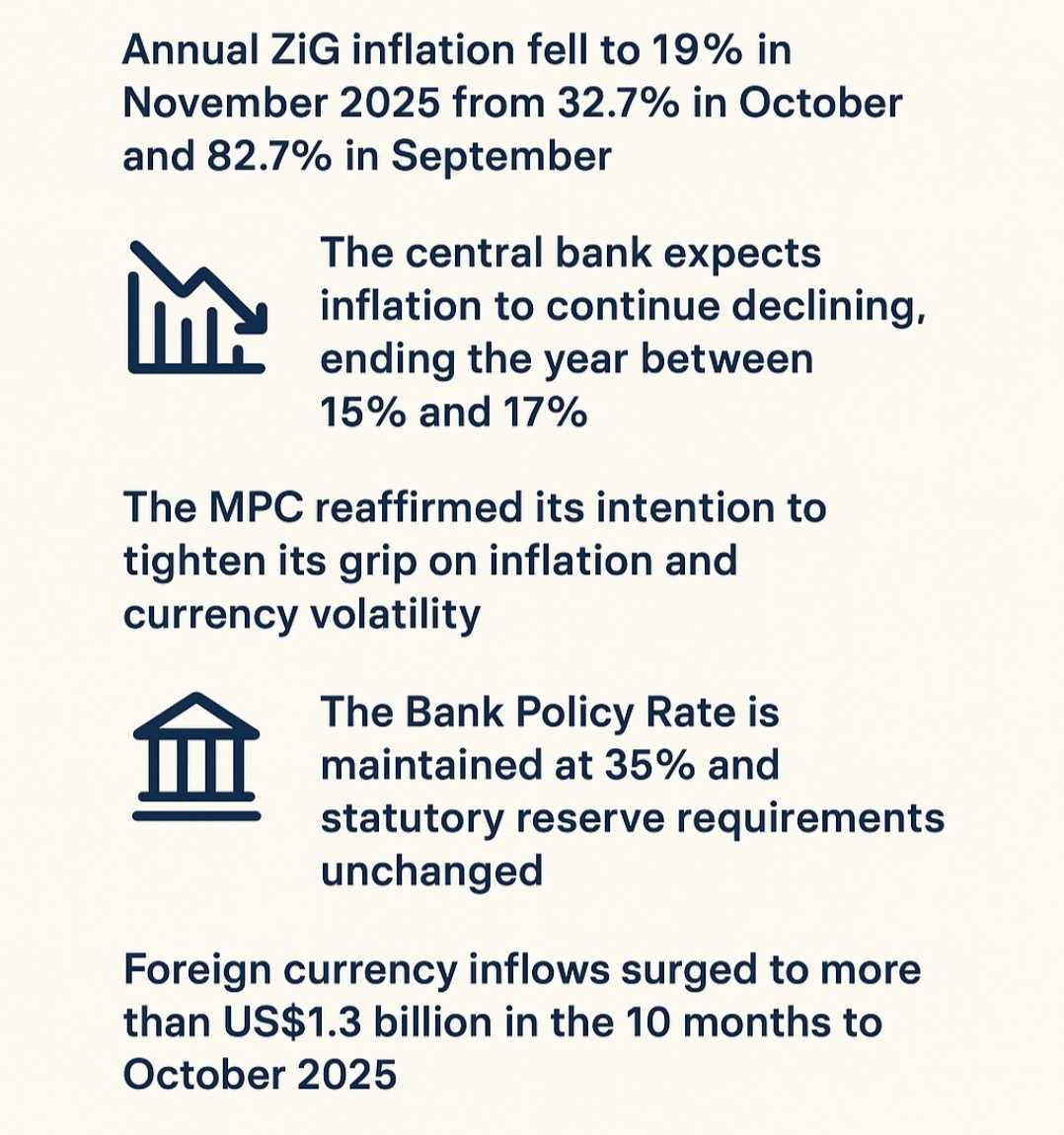
The MPC welcomed the deceleration of the ZiG annual inflation rate, which plummeted from 82.7% in September to 32.7% in October, and further to 19.0% in November 2025.
This positive trend, attributed to the maintenance of a prudent monetary policy since September 2024, has led the RBZ to revise its year-end inflation forecast down to 15-17%, from the earlier 20-30% range.
The central bank anticipates that for the first time in over 20 years, local currency annual inflation will reach single-digit levels in the first quarter of 2026.
The tight monetary policy stance is aimed at sustaining and entrenching the prevailing price, currency, and exchange rate stability, allowing the effects of the current policy to fully transmit to the real economy.
Related Stories
Statutory reserve requirements remain unchanged: 15% for savings and time deposits and 30% for demand and call deposits in both local and foreign currency.
Governor John Mushayavanhu reaffirmed the MPC's commitment to maintaining a positive real interest rates environment to boost demand for the ZiG, protect the value of savings, and discourage speculative borrowing.
The meeting highlighted the country's continued robust performance in the external sector.
In the first ten months to October 2025, total foreign currency inflows reached over US$13 billion, marking a 21% increase compared to the same period in 2024.
This surge, driven by stronger export earnings and remittances, has supported the foreign exchange market, operating smoothly under the Willing-Buyer Willing-Seller arrangement.
Foreign currency reserves backing the ZiG increased to approximately US$1 billion, providing import cover for more than 1.2 months.
The stability achieved through strong foreign currency performance and prudent monetary policy is noted as a key step towards meeting the Conditions Precedent (CPs) for transitioning to a monocurrency by 2030, as announced in the National Development Strategy 2 (NDS2).
The MPC also welcomed the 2026 National Budget measure to reduce the Intermediated Money Transfer Tax (IMTT) on ZiG-denominated transactions from 2% to 1.5%. This fiscal measure is expected to complement monetary policy efforts to promote the wider use of the domestic currency and advance financial inclusion.







Leave Comments