







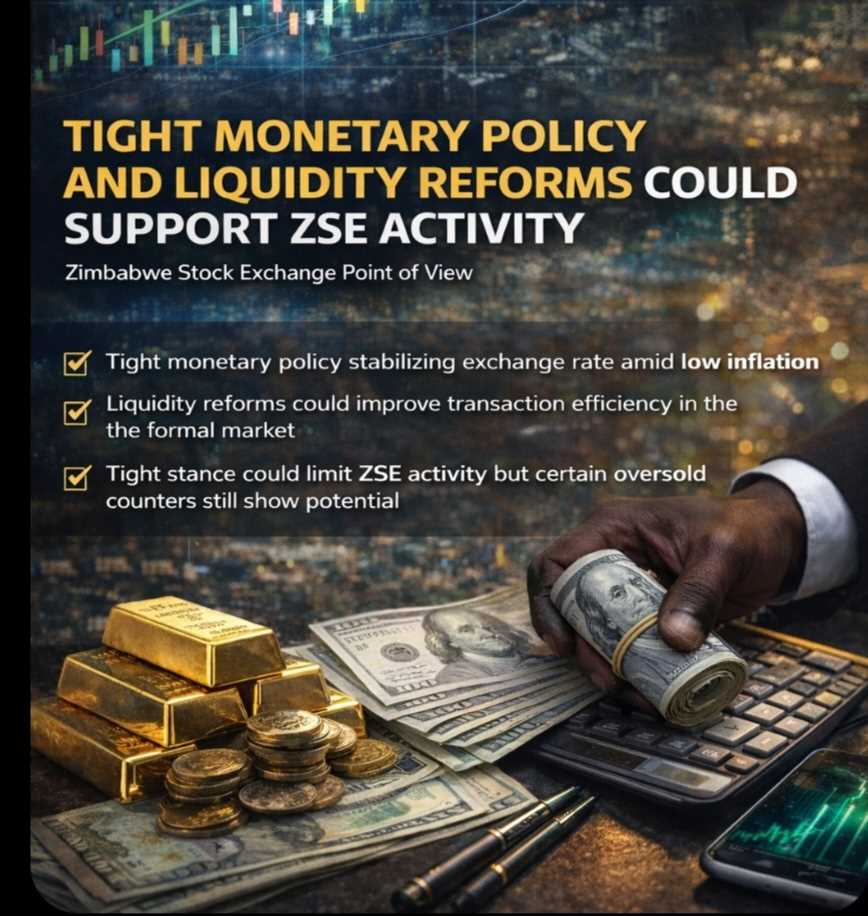
Zimbabwe’s tight monetary policy stance and reforms aimed at improving transaction efficiency could gradually support activity on the Zimbabwe Stock Exchange, although liquidity constraints are expected to persist in the short term.
According to a macroeconomic update by IH Securities, the measures introduced by the Reserve Bank of Zimbabwe are designed to stabilise the currency and deepen the use of the Zimbabwe Gold, developments that could influence capital market performance.
In its latest review, IH Securities said the central bank maintained a tight monetary stance during the 2026 Monetary Policy Statement presented by RBZ Governor John Mushayavanhu.
“The Reserve Bank of Zimbabwe Governor, Dr John Mushayavanhu, presented the Monetary Policy Statement for 2026 on 27 February 2026 amid a period of sustained tight monetary conditions designed to anchor exchange rate stability and inflation containment while deepening domestic currency usage,” the report said.
The policy rate was maintained at 35 percent, while statutory reserve requirements were set at 30 percent for demand and call deposits and 15 percent for savings and fixed deposits.
IH Securities said beyond the policy stance, the central bank introduced several operational reforms aimed at improving liquidity circulation within the formal financial system.
“Beyond the stance, the RBZ shifts toward practical measures to deepen ZiG usage, reduce transaction frictions and strengthen monetary transmission,” the report said.
For the ZSE, improved payment infrastructure and transaction efficiency could help support trading activity, particularly as the financial system becomes more integrated.
Related Stories
“Our thoughts: In our view, the 2026 measures will materially toward improving transaction liquidity in the formal system,” IH Securities noted.
The report, however, cautioned that the tight monetary environment could continue to weigh on stock market performance in the near term.
“However, with the tight stance still in place, ZSE performance is likely to remain largely decoupled from fundamentals and continue to mirror liquidity cycles rather than earnings,” the report added.
Zimbabwe’s macroeconomic environment has shown signs of stabilisation, with inflation easing significantly. Month-on-month ZiG inflation fell to 0.0 percent in January 2026, while annual inflation dropped to 4.1 percent from 95.8 percent recorded earlier in 2025.
“According to the RBZ, the combination of low monthly inflation and exchange rate predictability has anchored expectations and reduced inflation volatility risk,” the report said.
The external sector also strengthened during the period, with foreign currency receipts increasing to US$16.2 billion in 2025 from US$13.3 billion in 2024, supported by higher export earnings from gold, tobacco and platinum group metals.
While improved macroeconomic indicators could eventually strengthen investor confidence, IH Securities said liquidity conditions will remain a key driver of activity on the ZSE.
The brokerage firm noted that some counters could still attract investor interest despite subdued market liquidity.
“Given that several counters are currently oversold, we expect a number of companies with strong catalysts for upside momentum such as gold-linked counters like Padenga and Caledonia as gold prices are expected to continue to rally,” the report said.










Leave Comments