






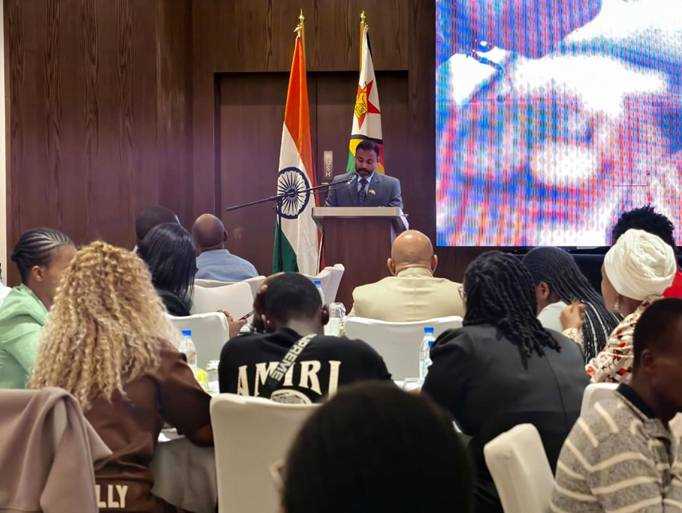
A hybrid trade seminar held in Harare this past week was a forum where the Indian Ambassador, His Excellency Brahma Kumar, redefined what 21st-century diplomacy looks like: less about protocol, more about proof; less about sentiment, more about trade.
What made the engagement remarkable was not just turnout, but structure. Instead of building another government-heavy platform, the Embassy placed business at the centre, nearly 300 exporters from India connected virtually, while around 60 Zimbabwean firms filled the room.
Government officials were present, but not as the main act. They functioned instead like engineers on-site, providing clarity, removing blockages, and answering questions the private sector has been asking for years. It was diplomacy recalibrated for outcomes.
The Ambassador’s approach speaks to a new style of engagement, one that recognises that relationships are strengthened by shared prosperity, not just shared statements. The presence of the Federation of Indian Export Organisations (FIEO) was a deliberate choice, signalling a shift towards B2B-led cooperation rather than traditional government-only talks.
Their delegation did more than present; they challenged, questioned and acknowledged the realities of African market entry. Penetration remains difficult, financing is often insufficient, logistics require patience, and regulatory frameworks can be inconsistent. Yet the appetite is unmistakably strong, especially in sectors like pharmaceuticals, machinery, agro-processing, plastics, textiles and natural oils.
Zimbabwean SMEs matched that honesty with honesty of their own. One firm disclosed that it has been waiting a full year for machinery already paid for, a story that captures the trust deficit that slows trade even when opportunity is abundant. Deals must be safe for both sides, Indian exporters need credit support, Zimbabwean buyers need delivery assurance. This seminar did not hide those tensions. It surfaced them, and in doing so, moved the relationship forward.
Related Stories
To be fair, Zimbabwe has laid groundwork worth noting. ZIDA’s continued digitisation, Finance Minister Mthuli Ncube’s decision to scrap several licensing fees and streamline compliance, and ongoing macro-stabilisation efforts together signal a country consciously lowering the cost of doing business. None of these reforms are magic bullets, but taken together, they build predictability and predictability is the real currency investors price.
The Ambassador himself emphasised a truth few articulate: Zimbabwe is not just a market; it is a gateway. Through SADC, COMESA and the AfCFTA, goods assembled or value-added here gain access to more than a billion consumers under reduced or preferential tariffs. The opportunity is not merely in selling to Zimbabwe, but in building in Zimbabwe for the continent. That is where Indian interest will grow fastest, if Zimbabwe continues to make entry smoother, transparent and trustworthy.
None of this means the challenges have vanished. Corruption remains a heavy stone tied to progress, from informal facilitation demands to slow approvals and opaque systems. Investors read risk before reward, and perception can undo policy if governance does not match reform. But the tone set at this engagement was one of honest ambition: we know where we are, we know what we want, and with discipline, we can bridge the two.
What the Ambassador of India achieved was subtle but powerful. He took bilateral relations off the podium and into the marketplace. He made diplomacy a trade instrument. He showed that friendship is strongest when it is useful, creates jobs, factories, contracts and exports. And he positioned India not just as a partner who speaks well of Zimbabwe, but as one ready to do business with it.
This moment could be the beginning of a new chapter, but only if we follow through. The blueprint exists. The will was visible. The business cards have been exchanged. Now, Zimbabwe must prove that opportunity here can convert into outcomes, not one year late, not with hidden costs, but with integrity, delivery and confidence.
The Ambassador brought the table. The question is whether Zimbabwe will serve the meal.






Leave Comments