






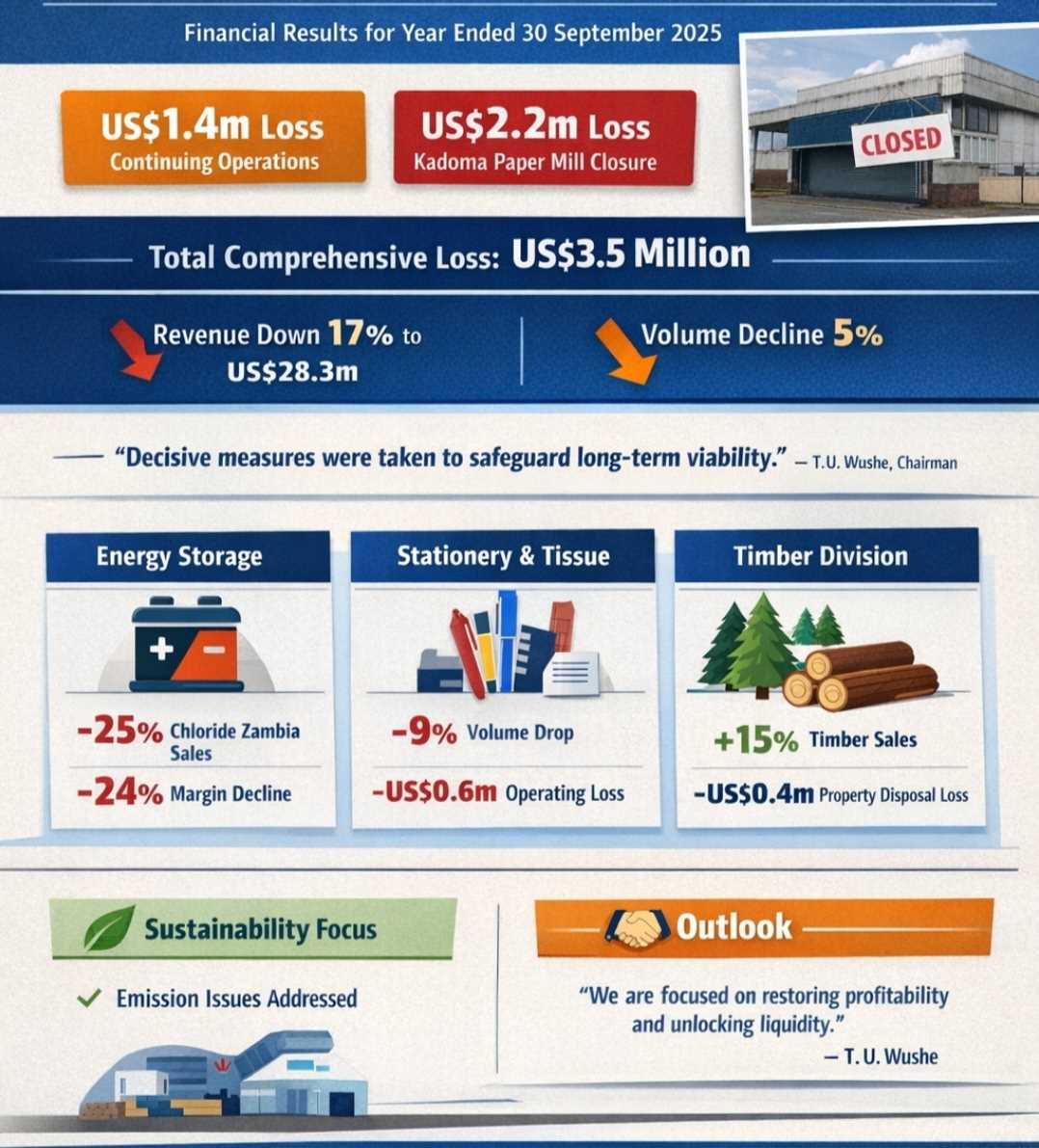
ART Holdings Limited recorded a total comprehensive loss of US$3.5 million for the year ended 30 September 2025 after a difficult trading period marked by pricing pressures, liquidity constraints and heightened competition from imported products.
The loss comprises a US$1.4 million loss from continuing operations and a further US$2.2 million loss from discontinued operations following the shutdown of the Kadoma Paper Mill.
Group turnover declined 17 percent to US$28.3 million, while overall volumes fell 5 percent as the Group implemented price reductions in the first half of the year to defend market share.
Chairman Dr Thomas Utete Wushe said the year was “both challenging and defining” for the Group, noting that decisive restructuring steps were taken to protect long-term viability.
“Although the operating environment stabilised in the second half of the year, the Group was unable to recover from the pricing pressures, constrained liquidity and imported product competition experienced in the first half,” Wushe said.
Gross profit margins declined by 10 percent, resulting in an operating loss of US$0.8 million. High borrowing costs forced the Group to reduce customer credit, while persistent power supply challenges increased operating expenses due to reliance on alternative energy sources.
The Board approved the discontinuation of the Kadoma Paper Mill after prolonged underperformance driven by structural shifts in the paper sector, inconsistent power availability and sustained working capital demands.
“This shutdown eliminates a significant operational drag and enables capital to be redirected towards more sustainable and profitable divisions,” Wushe said.
The paper milling assets have been reclassified as held-for-sale, with the disposal process underway and expected to be completed by the end of 2026.
Despite revenue pressures, cost-containment initiatives delivered a 26 percent reduction in operating expenses. Capital expenditure was limited to essential upgrades as liquidity preservation remained a priority. Management said receivables and elevated inventory levels continue to require close attention as the Group seeks to balance product availability with cash generation.
In the Energy Storage division, local battery volumes declined marginally by 1 percent due to supply chain disruptions affecting maintenance-free battery orders. Chloride Zambia volumes fell 25 percent as competition intensified and customers struggled to meet payment terms, although export sales to Malawi and Mozambique rose 11 percent.
Related Stories
Margins in the batteries segment declined 24 percent due to higher metal input costs.
“Market channels were streamlined during the year, reducing reliance on franchised outlets and increasing operational control through company-owned shops,” Wushe said.
The Stationery and Tissue division recorded a 9 percent decline in volumes as weak consumer liquidity in the first half of the year led to product returns from cash-constrained customers. Gross margins dropped sharply to 21 percent from 39 percent in the prior year due to pricing distortions during the back-to-school period, resulting in an operating loss of US$0.6 million.
Softex remained in transition following the closure of the Kadoma Mill, with tissue converting operations successfully relocated. Production is expected to commence in January 2026.
“The streamlined unit will be more agile and is now better positioned for recovery,” Wushe said.
Timber operations at Mutare Estates performed strongly, with sales volumes rising 15 percent on the back of robust demand for structural timber and improved milling efficiencies. However, rental income declined 23 percent following the partial disposal of properties, which resulted in a US$0.4 million loss on disposal.
Illegal mining activities at Inodzi Estate were halted after a protracted legal process, and the Group has since secured mining rights to allow participation in the exploitation of the estate’s resources.
On sustainability, the Group said emission irregularities detected at its lead furnace were swiftly resolved.
“Each challenge encountered was treated as an opportunity to refocus and strengthen our processes,” Wushe said.
The company did not declare a dividend, citing its current financial position.
ART Holdings said the restructuring undertaken in 2025 has laid the foundation for recovery, with management focused on restoring profitability, unlocking liquidity through non-core asset disposals and maintaining strict cost discipline.
“We remain confident that Government reforms will continue to support a conducive operating environment, including stronger enforcement against illegal imports and counterfeits,” Wushe said.




Leave Comments