








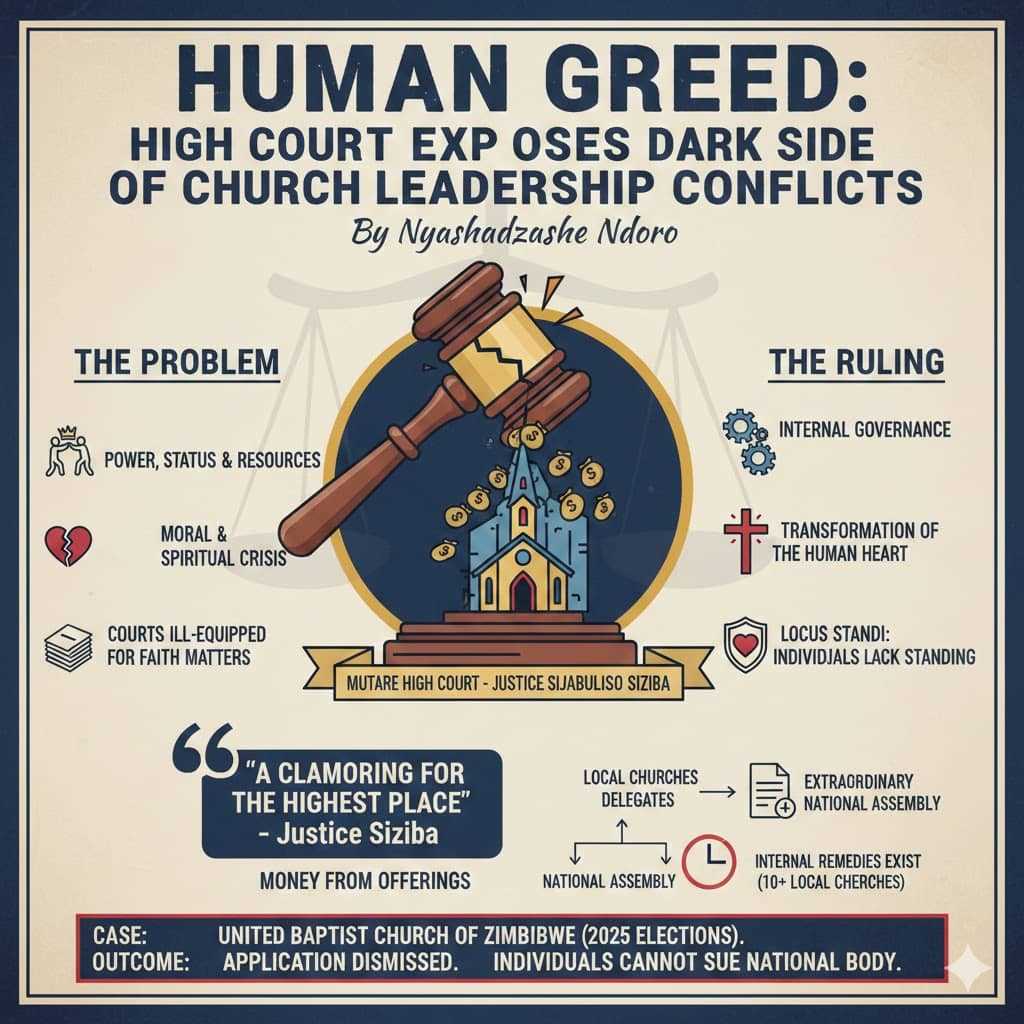
The High Court has warned against the growing tendency by church members to drag internal leadership disputes to secular courts, stressing that such conflicts reflect a deeper moral and spiritual crisis that cannot be cured through litigation but through a transformation of values and respect for internal governance systems.
In a recent judgement delivered in Mutare, Justice Sijabuliso Siziba observed that church disputes have become increasingly common amid the proliferation of churches, often driven by struggles for power, status and control of resources.
He cautioned that these conflicts contradict the core values of peace, unity and harmony that churches profess to uphold, and noted that courts are ill-equipped to resolve matters rooted in faith, conscience and ecclesiastical governance.
"There is a clamoring for the highest place," the judge noted.
"This goes along with the concomitant desire to earn more money from the offerings which the genuine and sometimes gullible believers would have putatively dedicated and sacri-ficed to the Almighty God who is the unblem-ished author of all peace, love, unity and har-mony.
"Surely something has gone wrong somewhere, and the best solutions for all this will not come from the courts of law but from a transformation of the human heart itself.
"There should be a proper philosophy about church business by both the shepherds and their flock. These church disputes are always a surprise to the society and also to the courts. The courts should therefore not be too quick to delve into church disputes if such disputes can be resolved through other inter-nal channels or structures of governance which are provided for in the church canons."
The remarks were made in a case involving more than 20 applicants who challenged the conduct of national executive elections held by the United Baptist Church of Zimbabwe on 29 March 2025. The applicants sought to have the elections nullified, arguing that the church’s National Committee unlawfully vetted and disqualified candidates, violated constitutional provisions, and presided over a flawed electoral process.
Related Stories
They asked the court to declare the elections null and void, reinstate the former leadership on an interim basis, and order fresh elections in line with the church constitution.
The respondents opposed the application, raising several preliminary objections, chief among them that the applicants lacked locus standi. They argued that under the church constitution, membership of the national church body vests in local churches, not individual congregants, and that only local churches, acting through proper structures, could challenge national processes.
In dismissing the application, Justice Siziba upheld the preliminary objection on locus standi, ruling that the applicants, as individuals, were not members of the church association at national level and therefore had no right to challenge decisions of the National Assembly.
The court held that the church follows a representative governance model in which local churches, through duly nominated delegates, exercise decision-making powers at national level. Any grievances, the judge said, must first be raised and resolved within local church structures before being escalated through constitutionally recognised channels
Justice Siziba noted that the church constitution provides internal remedies, including the convening of an Extraordinary National Assembly by at least ten local churches, which could address contested elections or other governance issues without court intervention.
While the court acknowledged the applicants’ concerns, it stressed that allowing individuals to litigate national church matters without mandate from their local churches would undermine order, unity and harmony within the organisation.
"The applicants who are not members of the church organisation and who have no right to vote in their individual capacity in its business affairs at national level without being delegated that right and function by their local churches have no locus standi to bring this case before this court," the court ruled.
Other preliminary objections, relating to whether nominees had complained, whether the matter had been overtaken by events, and whether there were material disputes of fact, were either dismissed or found not to be decisive.
The application was ultimately dismissed with costs.









Leave Comments