








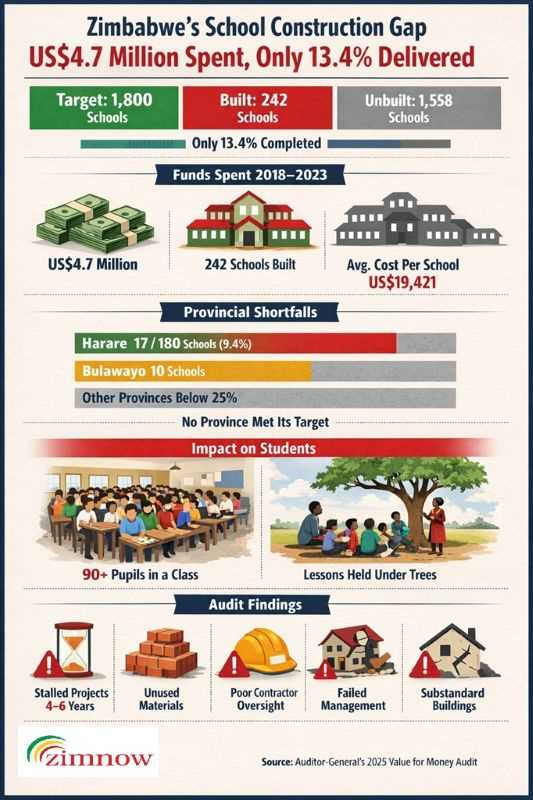
Zimbabwe spent approximately US$4.7 million on school construction between 2018 and 2023 but delivered only 242 schools out of a planned 1,800, translating to an average cost of US$19,421 per school, a 2025 Auditor-General’s Value for Money audit has revealed.
The audit, which assessed the Ministry of Primary and Secondary Education’s infrastructure program, found that 1,558 schools remain unbuilt despite near-full utilization of allocated public funds. Nationally, the program achieved only 13.4 percent of its construction target over the five-year period.
Acting Auditor-General Rheah Kujinga said the slow pace of delivery, stalled projects, and weak execution had directly worsened overcrowding in schools. In some areas, classrooms accommodate more than 90 pupils, forcing schools to introduce three-session days or hold lessons under trees.
Provincial performance was equally poor. Harare Province completed just 17 schools out of a target of 180, representing only 9.4 percent achievement, while Bulawayo Province constructed just 10 schools, contributing to severe congestion in urban schools. No province met even a quarter of its construction target during the period under review.
Related Stories
The audit revealed that several projects stalled for four to six years, with building materials in some cases procured years in advance but left unused. Kujinga warned that such delays exposed public funds to wastage and price escalations while learners continued to study in unsafe and overcrowded conditions.
Serious governance and management weaknesses were also flagged, including poor supervision of contractors, weak contract management, and the collapse of the national project management committee. In some cases, substandard buildings were completed and later condemned, further undermining value for money.
The Ministry of Primary and Secondary Education acknowledged the scale of the infrastructure backlog, blaming funding constraints, inflation, and coordination challenges with local authorities and communities. The ministry said more than 9,000 satellite schools are now operating nationwide as a stopgap measure.
However, the Auditor-General warned that the current approach raises serious concerns about value for money, execution capacity, and accountability, urging authorities to prioritize completion of existing projects before starting new ones.









Leave Comments