








Zimbabwe’s 2025 corporate earnings season paints a picture of recovery, but a closer look reveals a more complex reality shaped by restructuring costs, accounting adjustments, commodity tailwinds and once-off gains.
Across key sectors, companies including Padenga Holdings Limited, NMBZ Holdings Limited, BAT Zimbabwe Limited and Unifreight Africa Limited reported improved headline performances. However, the underlying drivers suggest that the rebound remains uneven and, in some cases, fragile.
Commodity windfall versus operational strain
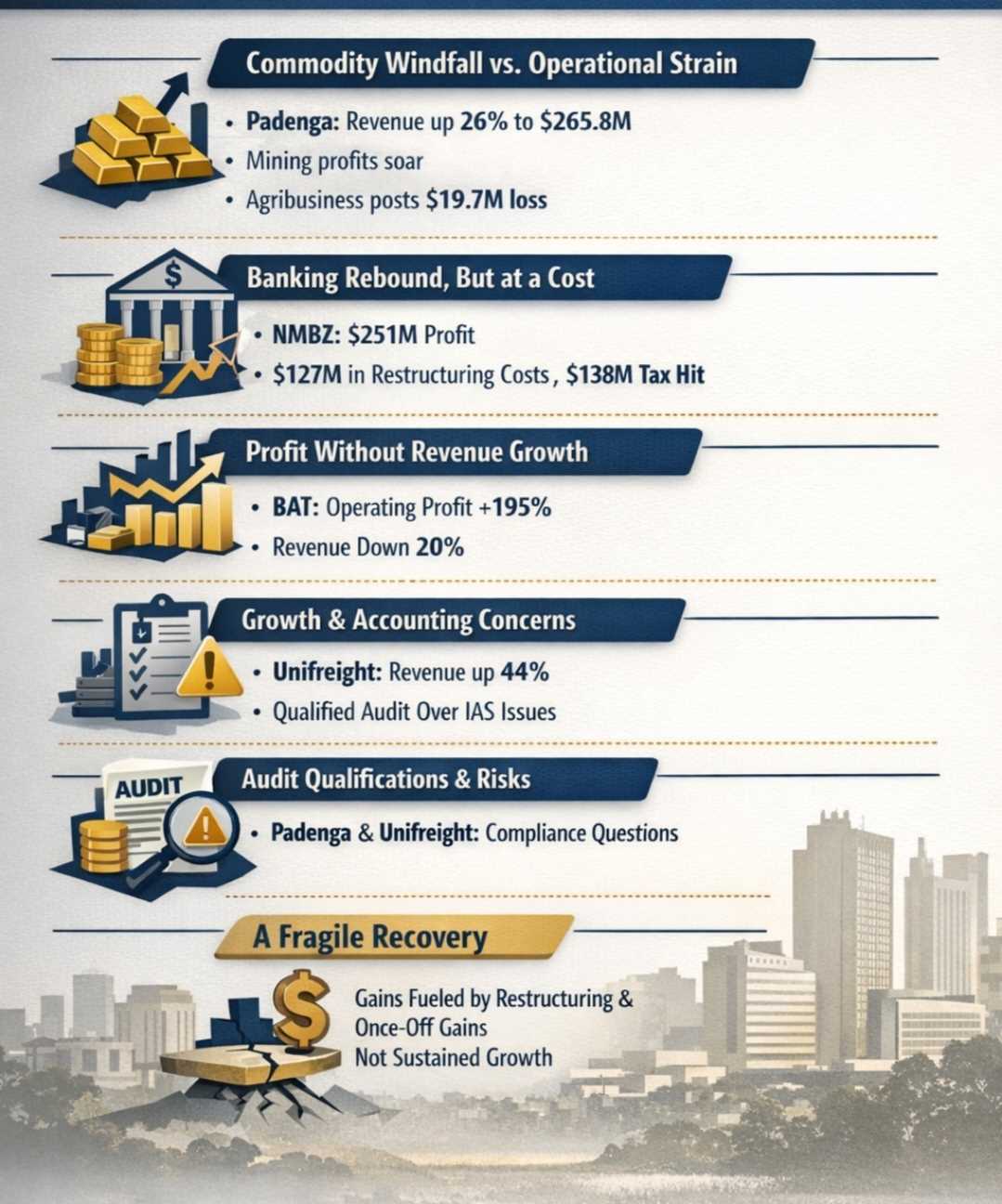
At the centre of the recovery is mining, where elevated global gold prices significantly boosted earnings. Padenga delivered a 26 percent increase in group revenue to US$265.82 million, with EBITDA from continuing operations rising 72 percent to US$113.03 million. Profit before tax more than doubled to US$93.88 million.
The performance was largely driven by its mining arm, which contributed 94 percent of total revenue, benefiting from strong gold prices that averaged US$3,448 per ounce during the year.
Yet performance within the group remained uneven. Padenga’s agribusiness division posted an after-tax loss of US$6.06 million from continuing operations, weighed down by a US$7.65 million fair value loss on biological assets linked to weak global demand. Discontinued operations associated with the closure of its Ume crocodile farm deepened losses further, resulting in a total segment loss of US$19.74 million.
The divergence highlights a broader trend: while commodity exposure is driving profitability, other business segments remain under pressure.
Banking sector rebounds, but at a cost
In financial services, NMBZ Holdings returned to profitability, reporting a ZWG 251 million after-tax profit compared to a loss of ZWG 205 million in 2024.
The turnaround was supported by an eight percent rise in operating income to ZWG 2.03 billion and strong balance sheet growth, with total assets increasing 27 percent to ZWG 9.0 billion. Customer deposits surged 44 percent while loans and advances grew by 48 percent, reflecting renewed lending activity in a stabilising economic environment.
However, the recovery came despite significant one-off financial pressures. The group incurred ZWG 127 million in restructuring costs and absorbed a ZWG 138 million impact from an adverse tax ruling that disallowed certain interest expenses.
These once-off charges underscore how profitability improvements were achieved alongside structural adjustments rather than purely organic growth.
Profitability without revenue growth
A similar pattern emerged at BAT Zimbabwe, where profitability improved sharply despite declining revenue.
Related Stories
The company reported a 195 percent increase in operating profit to US$16.1 million even as revenue fell 20 percent to US$29.1 million. Profit attributable to shareholders reached US$11.5 million, reversing a prior-year loss.
The turnaround was largely attributed to cost containment measures, improved manufacturing efficiencies and a shift to US dollar invoicing, which stabilised earnings.
Additionally, the resolution of US$16.4 million in blocked funds through Treasury Bills removed a long-standing balance sheet risk, further supporting the improved financial position. The gains therefore reflect internal restructuring and financial adjustments rather than top-line expansion.
Growth tempered by accounting concerns
In the logistics sector, Unifreight Africa reported strong operational growth, with revenue rising 44 percent to ZWG 1.36 billion and operating profit increasing 74 percent to ZWG 230.1 million.
Profit for the year climbed to ZWG 128.6 million, more than doubling from the prior year, supported by an eight percent increase in volumes alongside investments in fleet renewal and operational efficiencies.
However, the company’s results were accompanied by a qualified audit opinion from its external auditors, who flagged non-compliance with International Accounting Standard IAS 21 relating to changes in functional currency.
The qualification raises concerns about the reliability of certain financial statement elements and reflects ongoing reporting challenges within Zimbabwe’s volatile currency environment.
Audit qualifications and reporting risks
Audit qualifications were not limited to Unifreight. Padenga also received a qualified audit opinion due to prior-year issues linked to foreign currency translation under IAS 21 and accounting policy application under IAS 8.
The recurrence of audit qualifications across corporates suggests that, despite improved earnings performance, compliance and reporting consistency remain areas of concern for investors and regulators.
A recovery built on shifting foundations
The broader picture emerging from the 2025 results is one of recovery supported by a combination of external tailwinds and internal restructuring.
Mining companies are benefiting from favourable global commodity prices, while banks are leveraging economic stabilisation to rebuild balance sheets. At the same time, cost-cutting initiatives, restructuring programmes, asset revaluations and accounting adjustments are playing a significant role in shaping reported profits.
Zimbabwe’s corporate sector is showing signs of stabilisation, but the earnings rebound remains fragile — driven as much by once-off interventions and favourable external conditions as by sustained operational expansion.










Leave Comments