







Zimbabwe’s capital markets are poised for a notable development with the planned launch of the First Mutual Wealth Management Gold Exchange Traded Fund, a product positioned as a gateway for investors seeking offshore gold exposure through a domestically listed security.
The proposed ETF is expected to list on the Victoria Falls Stock Exchange, reinforcing the exchange’s ambition to position itself as Zimbabwe’s foreign-currency investment hub.
While the abridged prospectus presents an innovative investment vehicle, a closer analysis reveals both strategic promise and structural complexities that could shape its long-term performance.
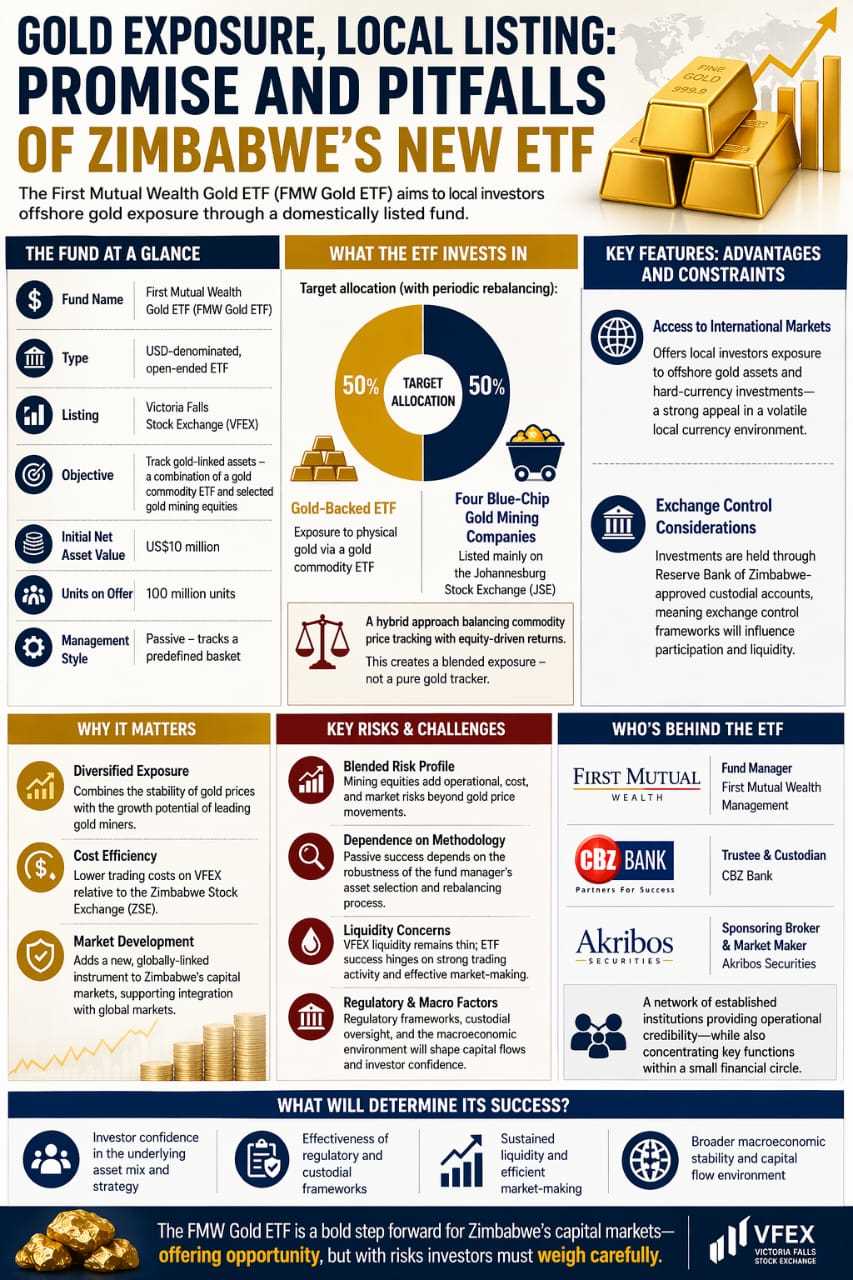
At its core, the FMW Gold ETF is structured as a United States dollar-denominated, open-ended fund designed to track gold-linked assets rather than physical bullion alone. The investment strategy combines exposure to a gold commodity ETF with selected gold mining equities listed primarily on the Johannesburg Stock Exchange.
The fund targets a 50/50 allocation between a gold-backed ETF and four blue-chip gold mining companies, with periodic portfolio rebalancing to maintain this weighting.
This hybrid approach reflects a deliberate attempt to balance commodity price tracking with equity-driven returns. While direct gold ETFs typically mirror bullion prices more closely, mining equities introduce an additional layer of performance variability influenced by operational efficiency, production costs and broader equity market sentiment.
In effect, the fund offers blended exposure — combining commodity price movements with corporate performance risk.
The ETF’s initial net asset value of US$10 million, alongside an offer of 100 million units, suggests a cautious market entry strategy aligned with investor appetite in Zimbabwe’s evolving financial markets.
Related Stories
Its passive management model, which tracks a predefined asset basket rather than relying on active stock selection, mirrors global ETF trends favouring transparency and cost efficiency. However, passive structures remain dependent on the robustness of underlying asset selection methodologies, which in this case are internally determined by the fund manager.
A defining feature of the ETF is its reliance on offshore-listed assets despite being domiciled locally. For Zimbabwean investors, this provides access to international markets and hard-currency exposure — an attractive proposition in a historically volatile domestic currency environment.
At the same time, participation will operate through Reserve Bank of Zimbabwe-approved custodial accounts, meaning exchange control regulations could influence liquidity, capital flows and investor accessibility.
Institutionally, the fund is anchored by several established financial institutions. CBZ Bank will act as trustee and custodian, while Akribos Securities assumes multiple roles including sponsoring broker and market maker.
This structure is intended to enhance operational credibility and investor confidence. However, analysts may also note the concentration of key functions within a relatively small segment of Zimbabwe’s financial sector, raising potential concerns around systemic interdependence should market stress emerge.
Cost positioning forms another pillar of the ETF’s appeal. The prospectus emphasises lower trading costs on VFEX compared to the Zimbabwe Stock Exchange (ZSE), reinforcing efforts to shift investor activity toward the offshore-oriented platform.
Yet liquidity remains one of VFEX’s persistent challenges. The success of the ETF will depend heavily on sustained trading volumes, active participation by institutional investors and effective market-making mechanisms to ensure price discovery and efficiency.
Ultimately, the FMW Gold ETF represents a significant step in Zimbabwe’s broader effort to diversify capital market instruments and deepen integration with global financial markets.
Its success will likely hinge on investor confidence in the blended asset structure, the stability of regulatory and custodial frameworks, and macroeconomic conditions shaping capital inflows into Zimbabwe’s financial system.










Leave Comments