





Farewell event captures ambassador’s people-first diplomacy as he says UK-Zimbabwe relations have moved from shouting to talking
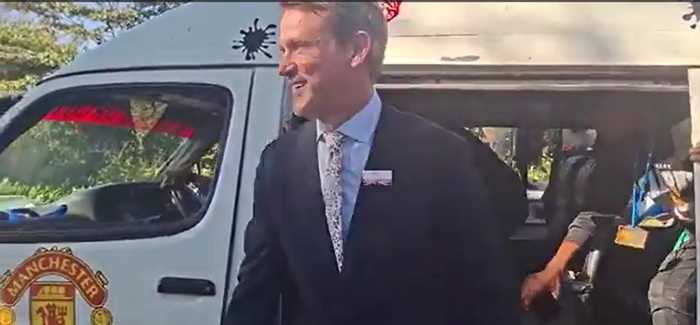
Outgoing British Ambassador to Zimbabwe Pete Vowles dumped the usual polish, and stiff protocol in favour of an unforgettable farewell script for his King’s Birthday Party and farewell engagement.
After personally receiving guests with a handshake and a few words as the Churchill Boys High pipe band played, At on June 11, Vowles then made his way to the stage in a kombi, seated with a director from the Ministry of Foreign Affairs and International Trade.
https://x.com/zimbabwewriter/status/2065058239754965064?s=20
In a scene that many Zimbabweans understand too well, Amb Vowles put out his hand to open the kombi door, and discovered that kombi doors do not work as the manufacturer promised. The hwindi had to step in and do his tricks to let out the dignitaries.
In that small comic scene sat much of the Vowles tour of duty: formal diplomacy stripped of stiffness, the United Kingdom trying to speak to Zimbabwe without the old colonial hauteur, and an ambassador who understood that you can’t relate to people whose lives are reduced to mere statistics and perceptions.
The open-air event was deliberately warm and accessible. Classic cars stood on show. A mock-up of 10 Downing Street gave guests a playful photo point.
Government was represented by a director from the Ministry of Foreign Affairs and International Trade, who delivered the formal remarks, including Zimbabwe’s pitch around its United Nations Security Council ambitions.
But the lasting image of the evening was Vowles, the departing envoy, being driven to the stage in a kombi and needing local assistance to disembark.
It was unscripted, funny and oddly perfect.
From shouting to talking
In a media huddle at the event, Vowles said UK-Zimbabwe relations had moved from a difficult period in which the two countries were “shouting at each other” into a space where they can now sit in the same room and talk.
He said the two countries had gone through “20 something years” of strain, with Britain often blamed for Zimbabwe’s problems, including sanctions and land. The result, he said, was that the relationship became difficult and unproductive.
“We weren’t able to then talk with governments and governments between in Africa and Europe need to be able to talk,” he said.
Vowles said part of his mission had been to move the relationship away from public megaphone diplomacy and towards the kind of engagement Britain would have with any other country, where disagreements can be handled without constant public shouting.
Vowles said relationships between countries are not static. They are dynamic and shaped by many layers of contact, including culture, arts, education, business and human interaction
He said the next stage must be about using the repaired relationship to create practical benefit for both Zimbabweans and British people, including through political dialogue, commercial engagement and businesses that can flourish.
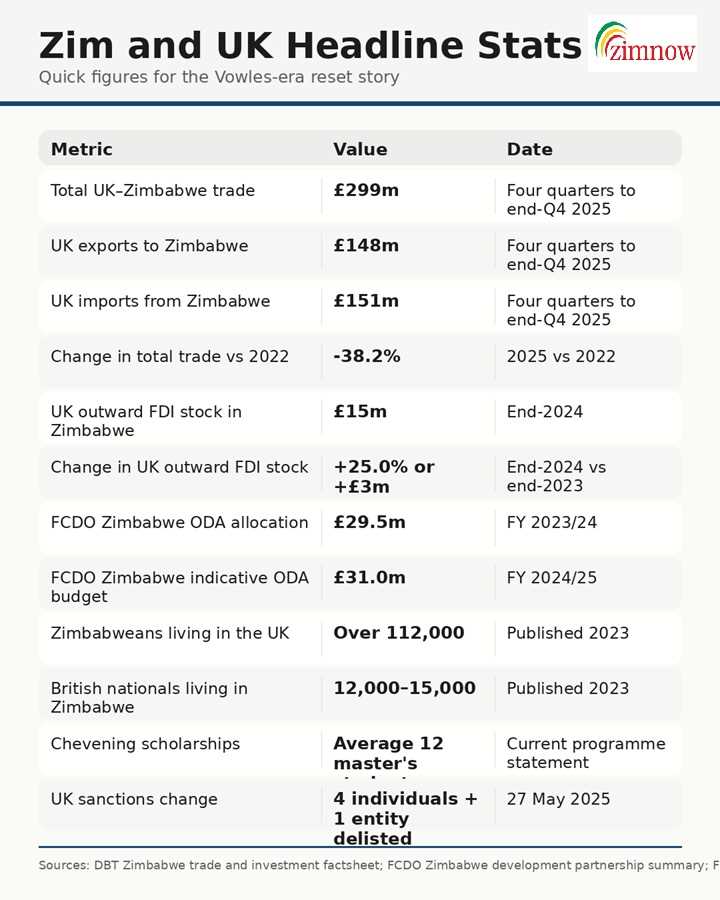
Understanding The UK’s Altered Posture
Asked whether the thaw reflected a change in Zimbabwe or a change in the UK approach, Vowles pointed to a broader shift in how Britain works with African countries.
He said while this does not erase hard questions, the UK had recognised that it does not have all the answers to the challenges facing Zimbabwe or the continent and has no authority to dictate what Zimbabwe should or should not do. And that conflicts are constructively through private dialogue rather than megaphone declarations.
Making relations mean something to ordinary people
Vowles also pushed back against what many Zimbabweans know as the “mega deal syndrome”, where large figures are announced but ordinary people struggle to see what changed in their lives.
He said both governments, including the British government, had been guilty of announcing big numbers that become meaningless unless translated into real impact.
Instead of only saying there is a £10 million or £100 million investment, he said, the conversation must become more specific.
“Let’s talk about jobs,” he said.
He gave the example of explaining an investment in terms of jobs in a place such as Gwanda, rather than simply announcing a large financial figure that people cannot easily connect to their daily lives.
Vowles said Zimbabwean companies interested in doing business with the UK should engage the British trade team. He said the UK wants to support two-way investment, including Zimbabwean businesses investing in the UK, and cited Air Zimbabwe’s interest in reopening a UK route as one area where the embassy has been offering support around approvals.
The Mudzi circle
Vowles’ Zimbabwe story began in 1992, when he worked as an assistant teacher under the Ministry of Education in Mudzi before later working for an NGO in Murehwa. He described arriving in rural Zimbabwe as a middle-class young man from Britain and finding himself in a school community with no electricity and no running water.
That experience, he said, transformed him.
What he will miss
Asked what he will miss most, Vowles zeroedin on Zimbabwean warmth, hospitality, generosity and humour.
He also joked in his official speech that he hoped to be considered an honorary Zimbabwean diasporan.
And the good part, Zimbabweans wholeheartedly endorse the application:
https://x.com/zimbabwewriter/status/2065058239754965064?s=20
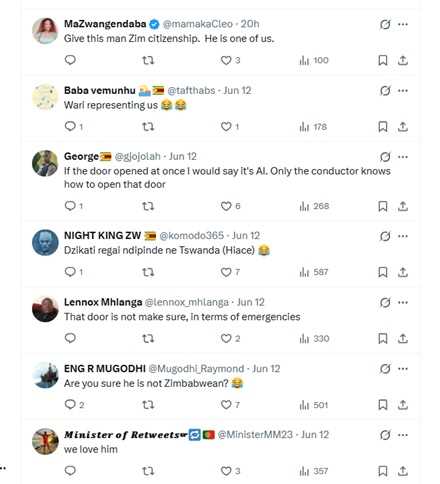
Why the kombi moment worked so well
For all the policy language around re-engagement, dialogue and partnership, the Kombi ride was probably the perfect encapsulation of Vowle’s tour of duty: things work better when VIPs are willing to get out of the official car and really experience the ride that is the normal for ordinary people.



Leave Comments