



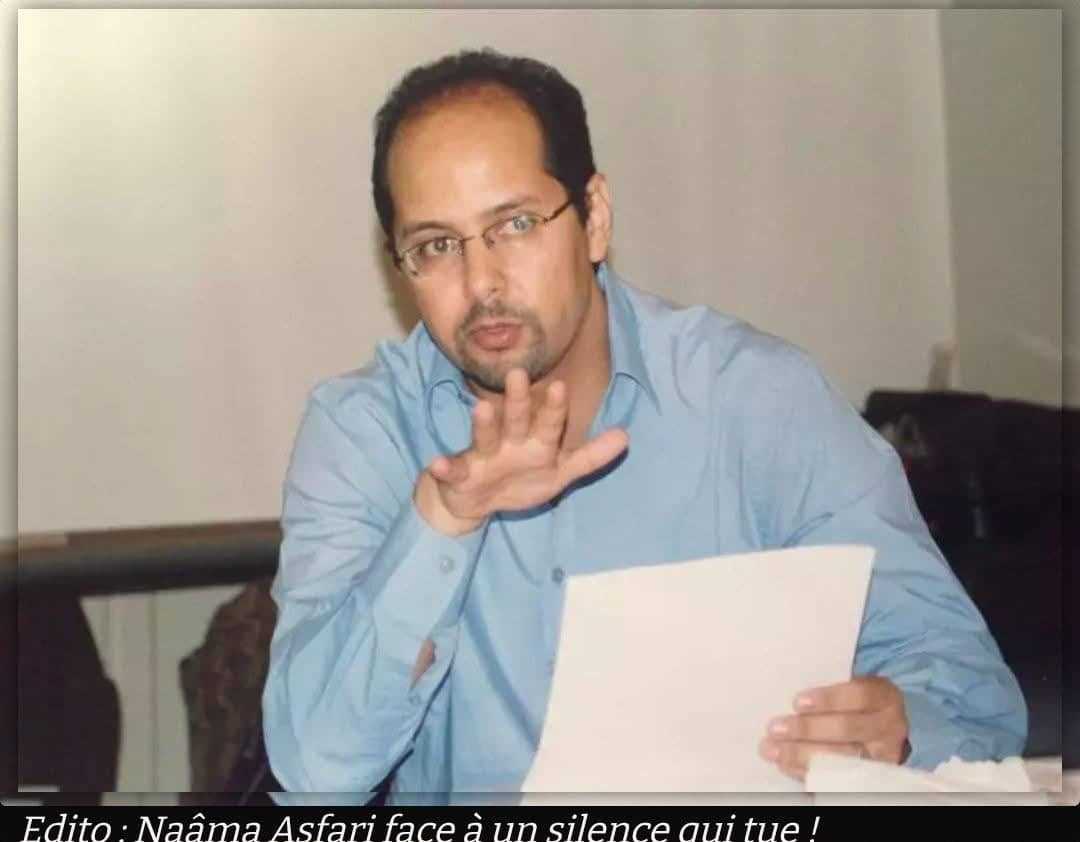
The Sahrawi Arab Democratic Republic (SADR) has appealed for urgent international intervention, claiming that Sahrawi political prisoner and human rights defender Naama Asfari is in critical condition after more than a month on an open-ended hunger strike.
In a statement issued by its Ministry of Foreign and African Affairs, SADR said Asfari, who reportedly began the hunger strike on 8 June 2026, has lost more than 10 kilograms and is suffering from severe weakness and worsening chronic health conditions allegedly linked to years of imprisonment and inadequate medical care.
According to the ministry, "his life is now in imminent danger" after decades of what it described as arbitrary imprisonment, torture, ill-treatment and repeated hunger strikes.
The statement alleged that Moroccan prison authorities had failed to respond despite his worsening condition.
"Despite the alarming deterioration of his health, the Moroccan prison authorities continue to ignore his legitimate demands and have failed to provide the urgent humanitarian and medical assistance required by international law," the ministry said, adding that "this ongoing neglect places his life at immediate risk."
The ministry further argued that Asfari has spent more than 15 years in prison following proceedings that United Nations human rights mechanisms have found to be arbitrary. It cited Opinion No. 23/2023 of the United Nations Working Group on Arbitrary Detention, which called for the release of Asfari and other members of the Gdeim Izik Group, saying Morocco had continued to disregard the decision.
Related Stories
SADR said it "holds the Kingdom of Morocco fully responsible for Naama Asfari's life, physical integrity, and well-being, as well as for any irreversible consequences resulting from the continued denial of his fundamental rights."
The ministry appealed to the United Nations Secretary-General, the UN Security Council, the UN High Commissioner for Human Rights, the African Union, the European Union, the International Committee of the Red Cross, governments and international human rights organisations to intervene.
It called for urgent humanitarian action to save Asfari's life, immediate access to independent and specialised medical care, unrestricted access for the ICRC and his family, independent international observers to visit Sahrawi political prisoners in Moroccan prisons, implementation of Opinion No. 23/2023 of the UN Working Group on Arbitrary Detention, and "the immediate and unconditional release of Naama Asfari and all Sahrawi political prisoners."
The ministry also appealed to parliamentarians, human rights organisations, trade unions, academic institutions, media outlets, artists and writers to mobilise.
Warning of broader implications, the statement said: "Silence in the face of this situation would not only endanger the life of one man; it would further undermine the credibility of the international human rights system by allowing a United Nations decision to remain unimplemented while a prisoner dies slowly in custody."
The case comes amid the long-running dispute over Western Sahara, a territory claimed by both Morocco and the Polisario Front, which proclaimed the Sahrawi Arab Democratic Republic in 1976. The United Nations continues to regard Western Sahara as a non-self-governing territory whose final status remains unresolved.







Leave Comments