








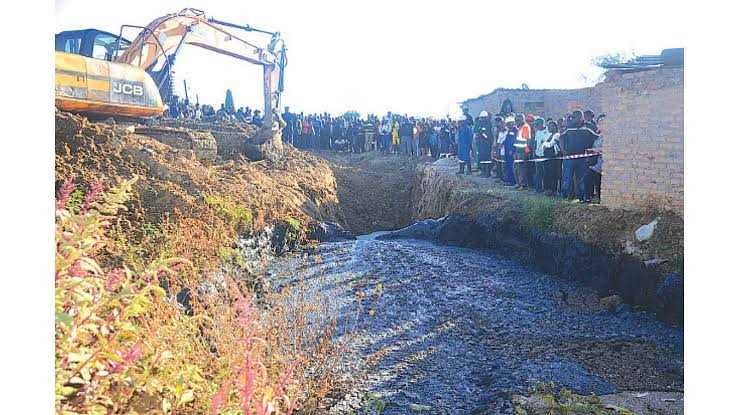
The retrieval of three bodies from an unsecured sewer excavation in Budiriro has left Zimbabwe shocked and grieving. Yet beyond the sorrow lies a deeper and more urgent question: what must change to ensure no other family suffers a similar loss?
For residents, legal experts and civic organisations, the Budiriro deaths were not an isolated incident. Instead, they have exposed longstanding concerns about deteriorating sewer infrastructure, delayed responses to hazards and weak enforcement of public safety measures.
Legal Practitioner, Moffat Makuvatsine said local authorities have a legal obligation to protect residents from dangers created during public works.
"The City Council has a legal duty to ensure the safety of people under its area. The duty includes not creating hazards like digging up pits and leaving them uncovered as they did. In failing to do so, it makes it liable to damages emanating from negligence," he said.
He said there can be no legal justification for leaving dangerous excavations exposed.
"There is no defence in leaving an open pit or trench without warning signs or fencing. Every person has the right to life and whatever endangers life through human conduct is not acceptable at law. Council breached that duty."
Makuvatsine said families affected by such incidents may seek compensation through the courts.
"Normally the remedy is in the form of cash and what is considered is whether or not the person was a breadwinner. The court also considers the emotional pain and loss suffered as a result of the death of a family member."
He added that residents have constitutional avenues to compel action from authorities.
"Residents can enforce their Constitutional rights either through compelling orders of court or by petitioning the Ministry."
A Pattern Of Negligence?
The Harare Residents Trust (HRT) argues that Budiriro should not be viewed as an isolated accident.
HRT director Precious Shumba said the incident reflects a broader pattern of infrastructure-related failures across the city.
"We do not accept the word tragedy as sufficient to describe what happened. A tragedy implies fate. What occurred in Budiriro is the direct consequence of institutional negligence, a culture of impunity and the City of Harare's sustained failure to protect the very residents it is mandated to serve," he said.
Shumba cited previous incidents involving dangerous excavations and sewer infrastructure, including the death of a child in Dawnview after falling into an open sewer line and the death of an elderly woman in Mbare after falling into a trench left open by council workers.
"The pattern is undeniable. The negligence is systemic. And the consequences are fatal."
HRT is calling for an independent investigation into the Budiriro deaths, a citywide audit of open trenches and pits, improved responsiveness to residents' complaints and stricter enforcement of minimum service delivery standards.
"Accountability must not stop at the level of the labourers; it must reach up the chain of command," said Shumba.
The organisation is also urging affected families to pursue legal action against the City of Harare.
Residents Say Warnings Were Ignored
For Budiriro residents, the danger was visible long before the tragedy occurred.
Mitchell Tsungai Kabanda said community members attempted to reduce the risks themselves.
"We placed warning signs and ropes near the ditch and told children to stay away," he said.
Kabanda said he personally contacted council officials.
"I called and emailed the Council, who promised to look into the issue, but they never did anything."
Without official intervention, residents resorted to their own safety measures.
"Neighbours took turns watching the ditch at night and put up reflective tape on nearby poles."
Looking ahead, he believes communities can play a role in reducing risks.
"Form a small safety group that regularly reports issues together and installs simple barriers using funds collected by the community."
Related Stories
The experience has also affected residents' confidence in local authorities.
"I avoid that path because I personally feel unsafe. My trust in local government has become very low because they ignored a clear danger in the community."
Communities And Council Must Work Together
Combined Harare Residents Association representative David Pasipanodya said sewer-related hazards remain widespread in several suburbs.
"Perennial burst sewers are a real menace in a number of suburbs notably Budiriro, Glen View and Glen Norah. We are in constant engagement with city council concerning the issue of a broken sewer infrastructure now posing a serious threat to human health and the city has proved incapacitated to address the problem."
Pasipanodya said collaboration between residents and council structures could improve responses.
"Organising joint hall meetings between residents associations and council where community issues are discussed improves coordination and provides a good platform for questions and answers."
He revealed that CHRA is finalising a Memorandum of Understanding with the City of Harare on service delivery issues.
Among the practical measures he recommends are community reporting systems, joint site inspections and temporary barricades around dangerous areas.
"Barricading and putting danger warning marks using bright tapes or old tyres to cordon off open manholes and sewage overflows may help avert these dangers."
Pasipanodya also encouraged residents to document hazards and maintain records of complaints.
"When Council drags its feet, a paper trail becomes a necessary escalation ladder. 'We told them' only works if you can prove it."
For Budiriro resident Munyaradzi Mudzingwa, the tragedy has changed daily life.
He recalls overhearing his wife warning their daughters not to walk near suspicious-looking wet ground while travelling to school, church or local shops.
"These cannot be trusted as they may fall into pits like the Budiriro victims," she told them.
Just days after the incident, Mudzingwa encountered another burst pipe while returning home from work at night.
"I had to beg the combi crew not to drop me off at my intended destination lest I become a victim of the unmarked and unattended pits. There was obviously no sign of council or any authority in sight," he said.
"Yet this was just three days after the tragedy where three bodies were retrieved only a kilometre away."
Harare Mayor Jacob Mafume said council is committed to preventing similar incidents.
"The council is committed to finding lasting solutions and safeguarding communities from similar incidents in the future."
He said investigations are underway.
"The police are investigating the issue and will tell us what we need to do and we will solve it."
Mafume added that council has appointed officials to examine the circumstances surrounding the incident and insisted that standard procedures exist for worksites.
City of Harare spokesperson Stanley Gama said residents also have a role to play in protecting sewer infrastructure.
"We can't rush into solutions without looking at the main cause of the problems," he said.
"Residents often throw different things such as used pampers, sanitary pads and rotten food which cause the sewer not to function well."
However, while improper waste disposal may contribute to infrastructure failures, residents' groups argue that it does not excuse leaving dangerous excavations exposed to the public.
The Budiriro deaths have reignited debate over infrastructure safety, accountability and service delivery in Harare.
The solutions proposed by residents, legal experts and civic groups are neither complex nor unattainable: secure work sites, faster responses to reported hazards, stronger oversight, improved equipment for workers, community participation and enforcement of existing safety standards.







Leave Comments