









ZimNow Features Desk
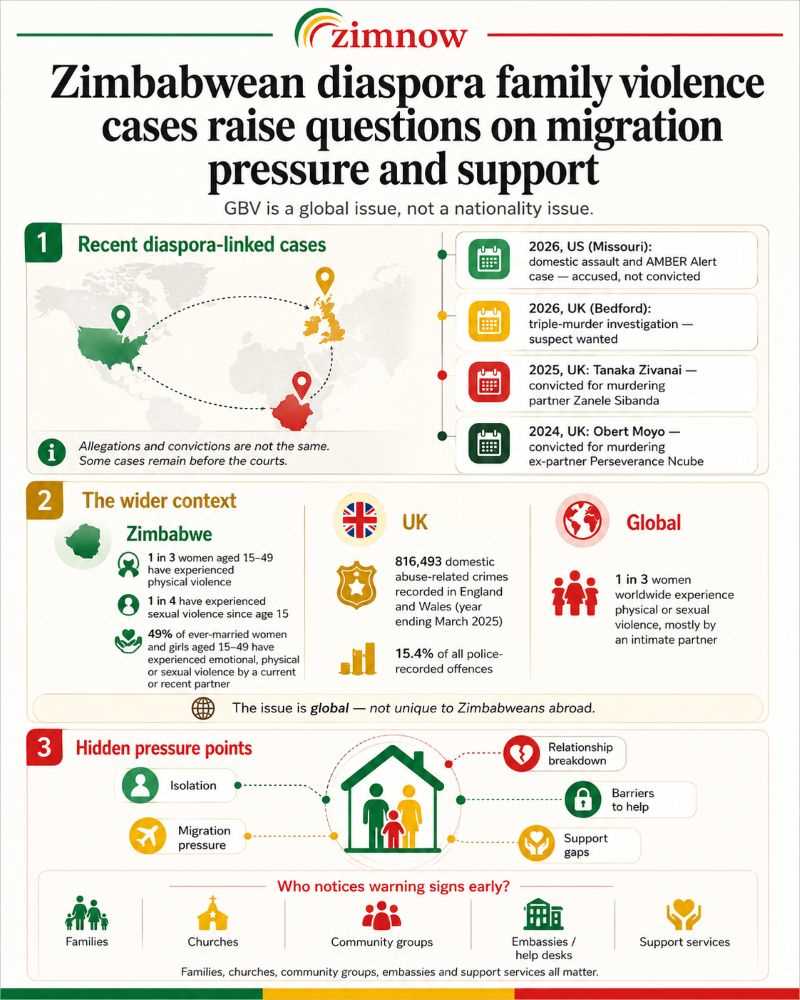
Two serious family-violence cases involving Zimbabwean diaspora links have emerged within days in the United States and the United Kingdom.
Bedfordshire Police said Ndodana Mkhanyisi Tshuma, also known as Mark, 45, is wanted in connection with the deaths of his wife, Nothabo Zandile Tshuma, 42, and their two daughters, Natalie, 15, and Nala, five, whose bodies were found at a property in Great Denham, Bedford.
Police said Tshuma, a British citizen of Zimbabwean heritage, is believed to have left the United Kingdom through Heathrow Airport on July 4 using a British passport. Bedfordshire Police said officers from the Bedfordshire, Cambridgeshire and Hertfordshire Major Crime Unit launched a murder investigation after the bodies were discovered on July 7.
Detective Inspector Lee Martin, the senior investigating officer, said police believed Tshuma was in Zimbabwe and were working with national and international agencies to locate him. In a direct appeal, he urged Tshuma to “come forward and hand yourself in to local authorities.”
In Missouri, United States, Munyaradzi Chiturumani, 36, has been charged with first-degree domestic assault, armed criminal action and two counts of endangering the welfare of a child creating substantial risk after authorities alleged he attacked his wife and left with their young daughter, triggering an AMBER Alert. Local media reported that the child was later found safe and Chiturumani was arrested. The charges remain allegations and have not been tested in court. He is presumed innocent unless proven guilty.
The two current cases have also prompted Zimbabweans in the UK to revisit older publicly reported killings involving Zimbabwean-linked families. These include the murders of Linda Vilika in Essex, Simbiso Moula in east London, Leigh-Anne Mahachi in Sheffield, Emily Munemo in Hillingdon and Madina Landsberg in Hertfordshire. Some of the cases are outside the past five years, but they show why diaspora organisations and family networks are now asking whether warning signs, including stalking, coercive control, separation conflict and earlier police contact, are being taken seriously enough.
In January 2025, Tanaka Zivanai, a Zimbabwean man living in Gloucester, United Kingdom, was sentenced to life imprisonment after admitting the murder of his partner, Zanele Sibanda. Gloucestershire Police said Zivanai, then 32, had admitted murdering the 28-year-old following an investigation by the Major Crime Investigation Team. He was ordered to serve a minimum term of more than 20 years.
Related Stories
In April 2024, Obert Moyo was sentenced to life imprisonment with a minimum term of 27 years for murdering his ex-partner, Perseverance Ncube, in Greater Manchester. Greater Manchester Police said Moyo had pleaded guilty on the first day of trial. Police described the killing as the culmination of stalking after the relationship had ended.
The cases do not show that Zimbabwean men are uniquely violent, and they do not prove that migration causes abuse. Rather, they reflect a global pattern in which intimate-partner violence can become lethal when control, separation, isolation and weak intervention systems collide.
Experts on gender-based violence caution against treating nationality, ethnicity or migration status as the cause of abuse. Domestic violence occurs across countries, classes and cultures. It is rooted in power, control, entitlement, fear, coercion and, in many cases, the failure of families, communities and institutions to recognise danger early enough.
UNFPA Zimbabwe says about one in three women aged 15 to 49 in Zimbabwe have experienced physical violence, while about one in four have experienced sexual violence since the age of 15. Afrobarometer has also cited Zimbabwe data showing that 40% of women aged 15 to 49 have experienced physical and/or sexual violence by an intimate partner, including 19% who experienced such violence in the previous 12 months.
In 2024, the Government of Zimbabwe and partners launched a gender-based violence project, with UNFPA noting that at least 49% of ever-married adolescent girls and women aged 15 to 49 had experienced some form of emotional, physical or sexual violence by a current or most recent husband or partner.
Globally, the World Health Organisation and UN agencies have repeatedly described violence against women as a major public-health and human-rights crisis. UN Women estimates that one in three women worldwide experience physical or sexual violence in their lifetime, mostly by an intimate partner.
The UK, where most of the recent diaspora-linked fatal cases were reported, also has a serious domestic-abuse burden. The Office for National Statistics says police in England and Wales recorded 816,493 domestic abuse-related crimes in the year ending March 2025, representing 15.4% of all police-recorded offences. Domestic abuse-related offences also accounted for nearly a third of violence-against-the-person offences.
The question, therefore, is not whether violence is a Zimbabwean problem or a diaspora problem. It is both local and global. What changes in the diaspora setting is the environment around the family.
Research on migration and intimate partner violence shows that migrant women and families may face additional barriers when abuse occurs. These can include social isolation, economic dependence, immigration uncertainty, fear of authorities, unfamiliarity with support services, language barriers, stigma and pressure to protect the family’s image within a small community.









Leave Comments