







In November 2025, the Zimbabwe Republic Police shared four separate murder cases that unfolded across the country. Three were intimate partner killings. One involved a son accused of murdering his mother. All within days of each other.
In Rutenga a young woman was found dead hours after an argument with her boyfriend about a missing birth certificate. The boyfriend vanished before dawn and remains on the run.
In Norton a woman was allegedly strangled by her husband. Her body was discovered by a railway line, a jacket tied around her neck.
In Buhera a wife was reportedly struck with an axe by her husband, who later died by suicide.
And in Inyathi, a mother lost her life after being beaten by her son during a family dispute.
These are only the cases we know because police shared the reports. There may be more. Many more. For all our years of campaigning, Zimbabwe still does not publish a national, disaggregated annual record of intimate partner homicides. Murder statistics exist as broad categories that lump cases together without revealing how many are driven by domestic violence.
. To understand how incomplete our picture is, consider the numbers we do have. In 2024 Zimbabwe recorded hundreds of murder cases nationwide. The 2025 figure will follow a similar trend.
Yet we cannot tell how many of those deaths were tied to GBV. We also do not have consolidated national data on reported beatings or attempted murder related to domestic violence, sexual assault, or harassment.
We do not know how many victims receive justice or how many cases collapse before judgment. We do not know how many survivors even manage to report.
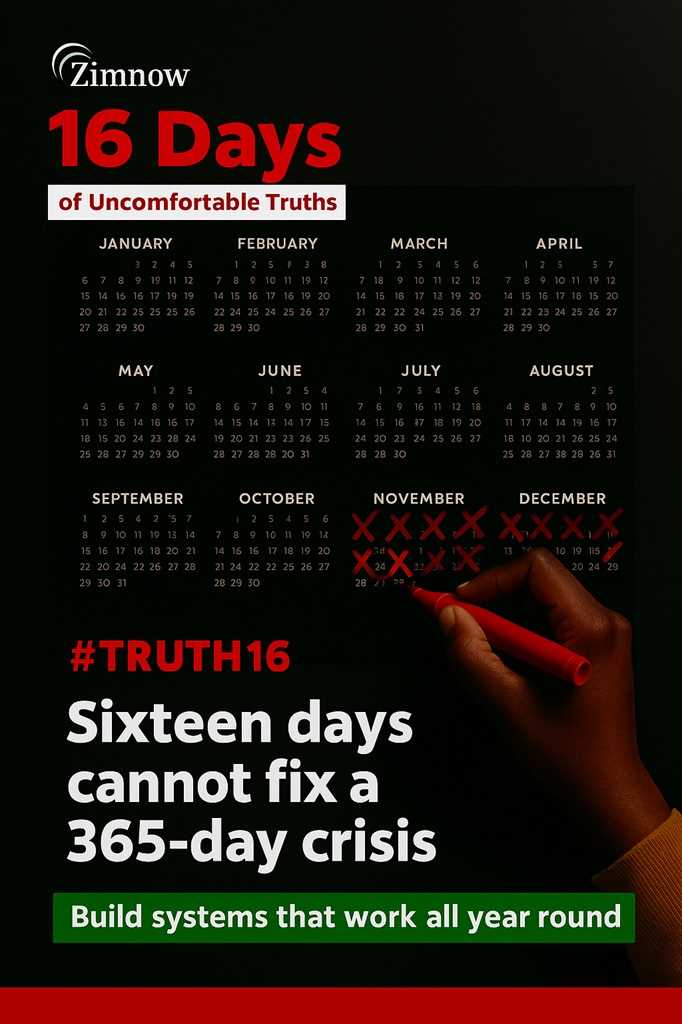
Without structure the annual call for action is reduced to posters, marches, and panel discussions that echo loudly for sixteen days and then fade as the country resets. Awareness has brought us far. It has shifted attitudes. It has broken silence. It has reshaped laws. But it cannot replace systems.
Related Stories
This is why the 16 Days campaign must evolve. 33 years later we can’t be patting ourselves on the back for awareness. This period must be about launching concrete national targets for the coming year.
In 2026 we could start by ensuring that Zimbabwe creates a real-time national digital database of GBV cases that captures reports, progress, outcomes, and convictions. A platform accessible to police, courts, social services, media, researchers, civil society, students, and policymakers. A platform that tells us the truth in numbers, not impressions.
Such a system would require collaboration between Parliament, police, justice administrators, civil society, shelters, tech experts, institutional innovation hubs, and the private sector. It requires investment. But so did every major reform this country has achieved.
Donor withdrawal has created a crisis that can become an opportunity. It is time for local innovation and local development models that allow us to design solutions that fit Zimbabwe instead of waiting for a global theme or an international grant to dictate our priorities.
This shift does not erase the victories of the past three decades. They matter. The establishment of the Zimbabwe Gender Commission gave survivors a national watchdog. The government’s commitment to build shelters created lifesaving infrastructure where none existed.
Police have improved handling of GBV, and more cases reach prosecution. The justice system has become more responsive. Communities now speak where once they silenced victims. These are real Zimbabwean successes, and they deserve recognition.
But they also prove that we have the capacity to go further. We have built the foundation. What is left is structure. We cannot rely on awareness forever. It is time to move from mobilization to measurable impact. From sympathy to systems. From imported themes to local targets. From seasonal activism to year-round accountability.
Zimbabwe has reached the stage where the next gains will not come from changing themes and repeating the same words. They will come from building architecture that protects survivors every day of the year.
The future will judge us not by how loudly we spoke from 25 November to 10 December, but by what change we engineered by 24 November of the following year.










Leave Comments